Pakistan’s Bank Alfalah in final stages to acquire Saudi shares in Samba Bank — Bloomberg

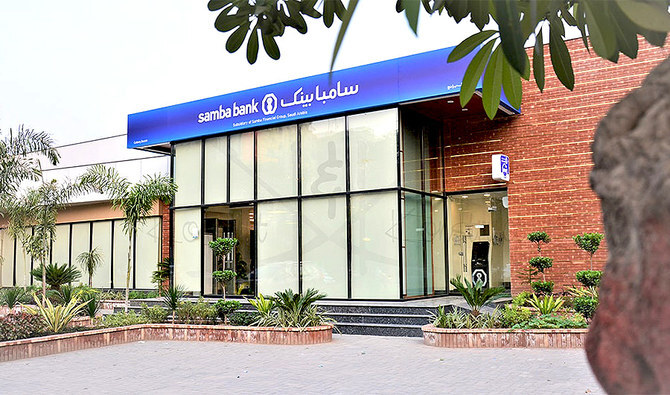
This undated photo shows regional branch of Samba Bank in Lahore, Pakistan. (Photo courtesy: Social media)
Short Url
Updated 20 August 2024
Follow

Pakistan’s Bank Alfalah in final stages to acquire Saudi shares in Samba Bank — Bloomberg

  • Bank Alfalah is Pakistan’s fourth largest lender by assets and is owned by UAE-headquartered Abu Dhabi Group
  • It has seen second fastest deposit growth in past five years among Pakistani banks, according to data from Bloomberg

ISLAMABAD: Pakistan’s Bank Alfalah Ltd. is open to further acquisitions to boost growth as the South Asian nation tries to emerge from a chronic economic crisis, Bloomberg reported this week, with the lender entering the final stages of reaching an agreement to acquire Saudi National Bank’s majority stake in Samba Bank Ltd.
Closing that deal should make Bank Alfalah a contender for future assets that go up for sale, Chief Executive Officer Atif Aslam Bajwa said in an interview to Bloomberg. 
“One-off opportunities will come by, and we want to be in play for that,” Bajwa said. “We’re looking for organic and inorganic growth.”
Bank Alfalah is Pakistan’s fourth largest lender by assets and is owned by United Arab Emirates-headquartered Abu Dhabi Group. It has seen the second fastest deposit growth in the past five years among Pakistani banks, according to data compiled by Bloomberg. 
That growth has come as its home country has been lurching from one loan to another from the International Monetary Fund to keep up with its debt payments that stand at about $26 billion for the year starting July. The nation expects the IMF’s executive board to approve a new $7 billion loan program later this month.
Pakistan has also asked China to “reprofile” some of its debts by extending the payment period to create more breathing room.
“The IMF program is paramount for the country to achieve because that will help in giving confidence to the rest of the world,” Bajwa said.
Pakistan’s central bank cut the policy rate by a cumulative 250 basis points in June and July from a record 22 percent. Inflation slumped from a record 38 percent in May 2023 to 11 percent in July.
The central bank’s efforts have been supportive to Pakistan’s equity markets, Bajwa said, noting that he expects interest rates to fall to single digits by 2025.
“The equity markets have been responding quite nicely,” he said. 
The benchmark KSE-100 Index has rallied 71 percent in dollar terms in the past year, making it the best performing stock market globally:
“Some foreign funds have started coming back into the market to give it some support.”


Pakistan, global crypto exchange discuss modernizing digital payments, creating job prospects 

Updated 05 December 2025
Follow

Pakistan, global crypto exchange discuss modernizing digital payments, creating job prospects 

  • Pakistani officials, Binance team discuss coordination between Islamabad, local banks and global exchanges
  • Pakistan has attempted to tap into growing crypto market to curb illicit transactions, improve oversight

ISLAMABAD: Pakistan’s finance officials and the team of a global cryptocurrency exchange on Friday held discussions aimed at modernizing the country’s digital payments system and building local talent pipelines to meet rising demand for blockchain and Web3 skills, the finance ministry said.

The development took place during a high-level meeting between Finance Minister Muhammad Aurangzeb, Pakistan Virtual Assets Regulatory Authority (PVARA) Chairman Bilal bin Saqib, domestic bank presidents and a Binance team led by Global CEO Richard Teng. The meeting was held to advance work on Pakistan’s National Digital Asset Framework, a regulatory setup to govern Pakistan’s digital assets.

Pakistan has been moving to regulate its fast-growing crypto and digital assets market by bringing virtual asset service providers (VASPs) under a formal licensing regime. Officials say the push is aimed at curbing illicit transactions, improving oversight, and encouraging innovation in blockchain-based financial services.

“Participants reviewed opportunities to modernize Pakistan’s digital payments landscape, noting that blockchain-based systems could significantly reduce costs from the country’s $38 billion annual remittance flows,” the finance ministry said in a statement. 

“Discussions also emphasized building local talent pipelines to meet rising global demand for blockchain and Web3 skills, creating high-value employment prospects for Pakistani youth.”

Blockchain is a type of digital database that is shared, transparent and tamper-resistant. Instead of being stored on one computer, the data is kept on a distributed network of computers, making it very hard to alter or hack.

Web3 refers to the next generation of the Internet built using blockchain, focusing on giving users more control over their data, identity and digital assets rather than big tech companies controlling it.

Participants of the meeting also discussed sovereign debt tokenization, which is the process of converting a country’s debt such as government bonds, into digital tokens on a blockchain, the ministry said. 

Aurangzeb called for close coordination between the government, domestic banks and global exchanges to modernize Pakistan’s payment landscape.

Participants of the meeting also discussed considering a “time-bound amnesty” to encourage users to move assets onto regulated platforms, stressing the need for stronger verifications and a risk-mitigation system.

Pakistan has attempted in recent months to tap into the country’s growing crypto market, crack down on money laundering and terror financing, and promote responsible innovation — a move analysts say could bring an estimated $25 billion in virtual assets into the tax net.

In September, Islamabad invited international crypto exchanges and other VASPs to apply for licenses to operate in the country, a step aimed at formalizing and regulating its fast-growing digital market.