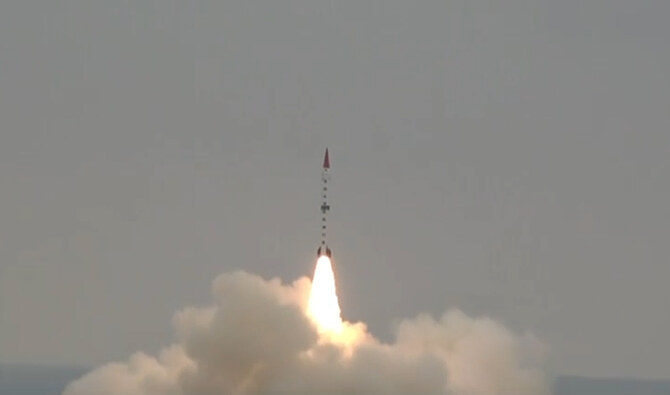
Pakistan conducts successful training launch of surface-to-surface Shaheen-II ballistic missile

This screengrab, taken from a handout video released by Pakistan’s Inter-Service Public Relations (ISPR) on August 20, 2024, shows Pakistani military conducting a test launch of surface-to-surface Shaheen-II ballistic missile, according to the military’s media wing. (Photo courtesy: ISPR)
Short Url
Updated 20 August 2024
Follow

Pakistan conducts successful training launch of surface-to-surface Shaheen-II ballistic missile

  • Training launch aimed at training troops, validating various technical parameters, says military’s media wing
  • Pakistan sees its missile development as a deterrent against its nuclear-armed South Asian neighbor India

ISLAMABAD: Pakistan’s army on Tuesday conducted a successful training launch of its surface-to-surface ballistic missile Shaheen-II, the military’s media wing said, explaining that the exercise was aimed at training troops and evaluating the performance of sub-systems incorporated to ensure improved accuracy of its missiles.
Pakistan sees its missile development as a deterrent against nuclear-armed neighbor India, with which it has fought three wars since independence from Britain in 1947. Both nations have been developing missiles of varying ranges since they conducted nuclear tests in May 1998. In December 2023, the Pakistan Army successfully conducted the flight test of the Fatah-II missile, which has a range of 400 kilometers. 
As Pakistan and India continue to test missiles and build their weapons armor, analysts warn Asia may be sliding into an accelerating arms race. 
“Pakistan today conducted successful training launch of surface-to-surface ballistic missile Shaheen-II,” the Inter-Services Public Relations (ISPR) said. “The training launch was aimed at training of troops, validating various technical parameters and performance evaluation of different sub-systems incorporated for improved accuracy and enhanced survivability.”
The military’s media wing said the launch was witnessed by senior officers from the Strategic Plans Division, Army Strategic Forces Command, scientists and engineers of strategic organizations.
It said that the director general of the Strategic Plans Division appreciated the technical prowess, dedication and commitment of scientists who contributed toward the “landmark achievement.”
“The President, Prime Minister of Pakistan, Chairman Joint Chiefs of Staff Committee and Services Chiefs congratulated the scientists and engineers on this achievement,” the ISPR concluded.


Pakistan reviews austerity measures amid Middle East crisis, urges strict nationwide implementation

Updated 11 March 2026
Follow

Pakistan reviews austerity measures amid Middle East crisis, urges strict nationwide implementation

  • Deputy Prime Minister Ishaq Dar chairs review meeting of austerity steps
  • Officials briefed on salary cuts, school closures, four‑day week, petrol conservation

ISLAMABAD: Pakistan’s government on Wednesday assessed progress on a sweeping set of austerity measures introduced to mitigate the country’s economic strain from sharply rising global oil prices and supply disruptions linked to the ongoing war in the Middle East.

Prime Minister Shehbaz Sharif this week announced a series of austerity steps, including a four‑day work week for government offices, requiring 50  percent of staff to work from home, cutting fuel allowances for official vehicles by half, grounding up to 60  percent of the government fleet and closing all schools for two weeks to conserve fuel amid the global oil crisis.

The measures were unveiled in response to global oil market volatility triggered by the conflict involving the United States, Israel and Iran, which has disrupted supply routes such as the Strait of Hormuz and pushed crude prices sharply higher, straining Pakistan’s heavily import‑dependent energy sector.

“The meeting stressed the importance of strict and transparent adherence to the austerity measures, promoting fiscal responsibility and prudent use of public resources,” Deputy Prime Minister and Foreign Minister Senator Mohammad Ishaq Dar said in a statement.

He was chairing a meeting of the Committee for Monitoring and Implementation of Conservation and Additional Austerity Measures, constituted under the directions of the PM, bringing together federal and provincial officials to review execution of the broad cost‑cutting plan. 

Dar emphasized the government’s commitment to enforcing the PM’s austerity steps nationwide. The committee’s review also covered reductions in departmental expenditure, deductions from salaries of senior officials earning over Rs. 300,000 ($1,120), and coordination with provincial administrations to ensure uniform implementation of the plan.

Participants at the meeting reiterated that all ministries and divisions must continue strict monitoring and reporting, with transparent oversight mechanisms, as Pakistan navigates the economic pressures from the prolonged Middle East crisis and its fallout on global energy and trade markets.