UN says Houthis have returned its rights office in Yemen

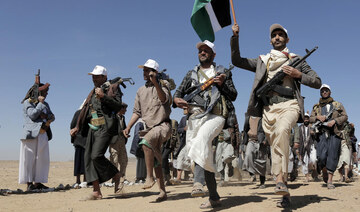
The UN on Monday called again for the release of 13 of its staff and dozens of NGO and embassy employees who have been held by the Houthis for more than two months. (AFP file photo)
Short Url
Updated 20 August 2024
Follow

UN says Houthis have returned its rights office in Yemen

  • UN rights chief Volker Turk, who announced the seizing of the office last week, called it “a serious attack on the ability of the UN to perform its mandate”

UNITED NATIONS, United States: Yemen’s Houthi rebels have returned the United Nations Human Rights Office in Sanaa, which they had seized earlier this month, a UN spokesman said Monday.
On August 3, the Iran-backed group sent a delegation to the UN Human Rights Office’s premises and forced staff to hand over the keys.
“The office was handed back today to our resident coordinator in Yemen,” said Stephane Dujarric, UN spokesman for the secretary-general.
According to the coordinator “the office appears to be in its original state, but an inventory is currently underway,” Dujarric said.
UN rights chief Volker Turk, who announced the seizing of the office last week, called it “a serious attack on the ability of the UN to perform its mandate.”
The UN on Monday called again for the release of 13 of its staff and dozens of NGO and embassy employees who have been held by the Houthis for more than two months.
Secretary-General Antonio Guterres is “deeply concerned about the well-being” of the detainees, Dujarric said, adding that he called for their “immediate and unconditional release.”
“The UN and its partners should never be targeted, arrested or detained while carrying out their mandates,” Dujarric added.
The Houthis claimed they arrested “an American-Israeli spy network” operating under the cover of humanitarian organizations — allegations emphatically rejected by the UN Human Rights Office.
The Houthis are engaged in a long-running civil war that has triggered one of the world’s worst humanitarian crises. More than half of the population is dependent on aid in the Arabian Peninsula’s poorest country.
Fighting has significantly decreased since the negotiation of a six-month truce by the UN in April 2022, although the truce has officially ended.


Iran says can fight intense war for months

Updated 58 min 29 sec ago
Follow

Iran says can fight intense war for months

  • Iran’s security chief accuses Trump administration of seeking to replicate a scenario similar to Venezuela
  • Analysts warn there is still no clear path to ending a conflict that could last a month or longer

TEHRAN: Iran’s Revolutionary Guards said Sunday that the country’s forces could fight an intense war for six months against the United States and Israel.
Israeli Prime Minister Benjamin Netanyahu has vowed to press on with the war against Iran “with all our force,” with a plan to eradicate the country’s leadership after joint US-Israeli raids killed supreme leader Ayatollah Ali Khamenei last week, sparking the regional conflict.
Despite the threat, the Revolutionary Guards said Sunday that the Islamic republic’s forces could wage an “intense war” for six months at the current speed of fighting.
Guards spokesman Ali Mohammad Naini said Iran had so far used “first and second generation” missiles, but will use “advanced and less-used long-range missiles” in the coming days.
‘Trapped’
The widening reach of the war and Iran’s ability to inflict damage and harm were underscored by US President Donald Trump attending the return of six American service members killed in a drone strike on a US base in Kuwait last Sunday.
Iran’s security chief Ali Larijani accused the Trump administration of seeking to replicate a scenario similar to Venezuela where it ousted leader Nicolas Maduro.
“Their perception was that it would be like Venezuela — they would strike, take control and it would be over — but now they are trapped,” he said in a pre-recorded interview broadcast on state TV on Saturday.
Iran’s hardline judiciary chief Gholamhossein Mohseni Ejei also warned Middle East neighbors which are “openly and covertly at the disposal of the enemy” that “the heavy attacks on these targets will continue.”
Iranian President Masoud Pezeshkian said Sunday that Tehran “will be forced to respond” if a neighboring country were to be used as a launchpad for any attack or invasion attempt.
Tehran had vowed to go after US assets in the region, and Saudi Arabia, Qatar, the United Arab Emirates and Kuwait on Sunday all reported new attacks.
No clear way out
Analysts warn there is still no clear path to ending a conflict that US and Israeli officials say could last a month or longer.
Trump has suggested Iran’s economy could be rebuilt if a leader “acceptable” to Washington replaces the late supreme leader, which Tehran has rejected.
China and Russia have largely stayed on the sidelines despite close ties with Tehran.
China’s top diplomat Wang Yi said on Sunday that the war in the Middle East should “never have happened.”
“This is a war that should never have happened,” he told a press conference in Beijing, adding that “a strong fist does not mean strong reason. The world cannot return to the law of the jungle.”