

Hezbollah rains down rockets on Israeli barracks in response to airstrikes deep in Bekaa Valley

1 / 2
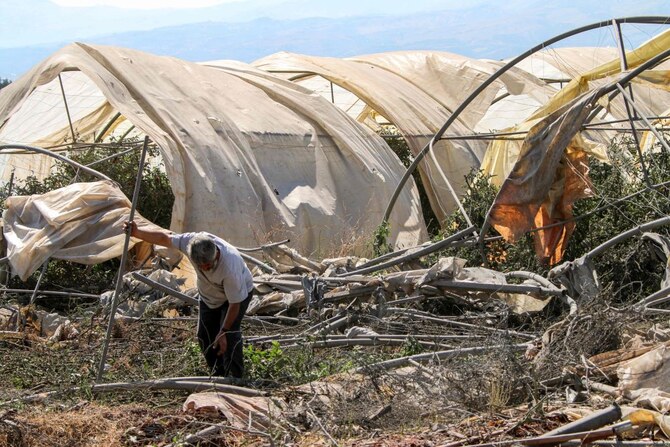
A man salvages the remains of a destroyed greenhouse after the overnight Israeli bombardment of Sarein, in the Bekaa valley, Lebanon, Aug. 20, 2024. (AFP)
2 / 2
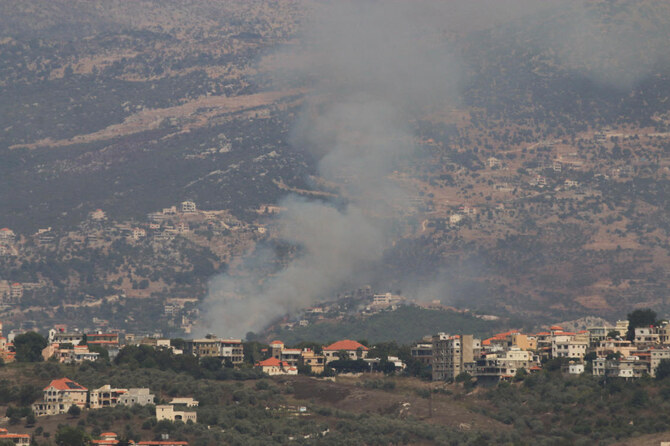
Smoke rises from Kfarhamam, amid cross-border hostilities between Hezbollah and Israeli forces, as pictured from Marjayoun, near the border with Israel, Lebanon, Aug. 17, 2024. (Reuters)
Short Url
Updated 20 August 2024
Follow

Hezbollah rains down rockets on Israeli barracks in response to airstrikes deep in Bekaa Valley

  • 14 civilians reportedly injured in attacks by Israeli forces on Monday night, including 4 Syrians and 2 Palestinians
  • Hezbollah MP says Lebanese front will remain active as long as Israel’s aggression against Gaza continues

BEIRUT: Hezbollah responded on Tuesday to intense Israeli attacks that targeted its weapon depots in the Bekaa Valley on Monday night by launching dozens of rockets at Israeli military sites.

The group said it attacked “the headquarters of the 210th Golan Division in the Nafah barracks, as well as the Artillery Battalion and the Armored Brigade of the 210th Division in the Yarden barracks, with intense rocket barrages,” and bombarded “the 146th Division headquarters in Ga’aton with salvos of Katyusha rockets.”

Sirens sounded in Kabri, Eilon, Avdon, Manot, Neve Ziv and Shtula in Western Galilee on Tuesday. Israeli media reported “the launch of 80 rockets from Lebanon toward the north (of Israel) since the morning, with several rockets landing in the Kabri area east of Nahariya.”

The Israeli army said it had detected “the launch of 55 rockets from southern Lebanon, some of which were intercepted, while the rest landed in open areas.” It added that “firefighting forces are battling several fires that broke out due to the latest rocket barrage on northern Israel.”

Upper Galilee Regional Council urged residents of settlements that were evacuated to remain in protected areas, amid fears of further “heavy shelling targeting unusual locations in the north following Monday’s airstrikes in Lebanon.”

The areas targeted by Israeli forces on Monday included the Qsarnaba plain, Tamnine El-Tahta, Sar’in and Al-Nabi Sheet. Images posted on social media of the scene of the attack in Tamnine El-Tahta showed a massive fire and burning objects flying in all directions for several minutes after the airstrike, and people were advised to avoid the area.

Eleven people were injured by the airstrikes in the northern Bekaa region, the Lebanese Ministry of Health said, including a Syrian woman and two Syrian girls, one of them 5 years old and the other 15.

Also on Monday night, Israel carried out strikes on Mashaa Al-Mansouri in southern Lebanon. Two Palestinian refugees, ages 17 and 18, reportedly were injured in the attack and taken to the Lebanese-Italian Hospital.

And shelling of Lebanese villages close to the border with Israel, including the town of Khiam, resulted in “injuries to a young Syrian national, who was treated at the governmental hospital in Marjeyoun,” the Public Health Emergency Operations Center in Lebanon said.

Hostilities between the Israeli military and Hezbollah have continued to intensify in recent days amid reports of difficulties during negotiations between Israel and Hamas for a ceasefire in Gaza and the exchange of prisoners.

Hezbollah MP Hassan Fadlallah said on Tuesday that “the front of Lebanon remains active as long as the (Israeli) aggression continues against Gaza.”

He added that “everyone today is waiting for the results of the outcome of the negotiations concerning the ceasefire in Gaza. What concerns us in Lebanon, and Hezbollah, is that the (Israeli) aggression on Gaza stops. From the outset, we have maintained that our position in Lebanon serves as a supportive front aimed at exerting pressure on the enemy to halt its attacks on Gaza.”


Arab and Islamic states reject Israel’s recognition of Somaliland

Updated 28 December 2025
Follow

Arab and Islamic states reject Israel’s recognition of Somaliland

  • Israel formally recognized Somaliland as an “independent and sovereign state” on Friday
  • Saudi Arabia on Friday expressed full support for sovereignty, unity, territorial integrity of Somalia

A group of foreign ministers from Arab and Islamic countries, alongside the Organisation of Islamic Cooperation (OIC), have firmly rejected Israel’s announcement of its recognition of the Somaliland region within Somalia.

In a joint statement issued on Saturday, the ministers condemned Israel’s decision, announced on December 26, warning that the move carries “serious repercussions for peace and security in the Horn of Africa and the Red Sea region” and undermines international peace and security, the Jordan News Agency reported.

The statement described the recognition as an unprecedented and flagrant violation of international law and the charter of the United Nations, which uphold the principles of state sovereignty, unity and territorial integrity, JNA added.

Israel formally recognized Somaliland as an “independent and sovereign state” and signed an agreement to establish diplomatic ties, as the region’s leader hailed its first-ever official recognition.

The ministers reaffirmed their full support for the sovereignty of Somalia, rejecting any measures that would undermine its unity or territorial integrity.

They warned that recognizing the independence of parts of states sets a dangerous precedent and poses a direct threat to international peace and security.

The statement also reiterated categorical opposition to any attempt to link the move with plans to displace the Palestinian people outside their land, stressing that such proposals are rejected “in form and substance.”

Alongside the Jordanian foreign ministry, the joint statement was issued by the foreign ministers of Egypt, Algeria, Comoros, Djibouti, The Gambia, Iran, Iraq, Kuwait, Libya, Maldives, Nigeria, Oman, Pakistan, Palestine, Qatar, Somalia, Sudan, Turkiye and Yemen, as well as the OIC.

Saudi Arabia on Friday expressed full support for the sovereignty, unity, and territorial integrity of Somalia, and expressed its rejection of the declaration of mutual recognition between Israel and Somaliland.