

CM orders probe into child marriages in Pakistan’s Sindh in wake of deadly 2022 floods

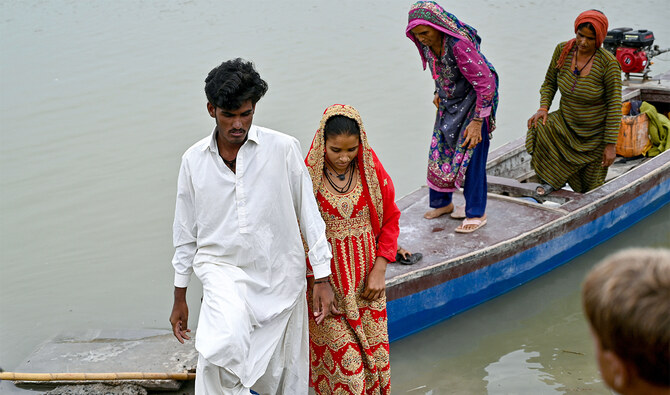
In this photograph taken on August 3, 2024 newly married underage monsoon bride Amina (2L), with their husband Mohammad Usman (L) arrives at the Khan Muhammad Mallah village in Main Nara Valley, Dadu district, Sindh province. (AFP)
Short Url
Updated 18 August 2024
Follow

CM orders probe into child marriages in Pakistan’s Sindh in wake of deadly 2022 floods

  • The high rate of marriages for underage girls had been inching lower in Pakistan in recent years
  • But after unprecedented floods in 2022, rights workers warn such weddings are now on the rise

KARACHI: The chief minister of Pakistan’s southern Sindh province has ordered an inquiry into dozens of child marriages in the Dadu district in the wake of deadly floods that hit the region two years ago, the Sindh CM’s office said on Sunday.

Pakistan’s high rate of marriages for underage girls had been inching lower in recent years, but after the unprecedented floods in 2022, rights workers warn such weddings are now on the rise due to climate-driven economic insecurity.

Many villages in the agricultural belt of Sindh have not recovered from the 2022 floods, which plunged a third of the country underwater, displaced millions and ruined harvests. Child marriages have particularly spiked in the Dadu district that for months resembled a lake, according to social activists. In Khan Mohammad Mallah village alone, 45 underage girls have become wives since the last monsoon — 15 of them in May and June this year.

Sindh CM Murad Ali Shah sought a report from the Hyderabad commissioner into these marriages in return for money given to families of the brides, inquiring about the social, financial and legal factors behind them.

“Form a committee for a detailed inquiry and furnish a report whether these girls hailed from flood-affected families,” Shah told the Hyderabad commission, according to the CM’s office.

“What is the condition of these married girls at present? Give a report from every aspect so that it can be resolved.”

Child marriages are common in parts of Pakistan, which has the sixth-highest number of girls married before the age of 18 in the world, according to government data published in December. The legal age for marriage varies from 16 to 18 in different regions, but the law is rarely enforced.

Parents of these young girls said they hurried the marriage of their daughters to save them from poverty, usually in exchange for money.

“Before the 2022 rains, there was no such need to get girls married so young in our area,” village elder Mai Hajjani, 65, told AFP this week. “They would work on the land, make rope for wooden beds, the men would be busy with fishing and agriculture. There was always work to be done.”

Pakistan is recognized as one of the most vulnerable countries to climate change effects in the world. The summer monsoon between July and September is vital for the livelihoods of millions of farmers and food security, but scientists say climate change is making them heavier and longer, raising the risk of landslides, floods and long-term crop damage.

In June, a senior UN official warned that an estimated 200,000 people in Pakistan could be affected by the upcoming monsoon season, which is expected to bring heavier rains than usual.

— With input from AFP


Pakistan says responding to Afghan ‘offensive operations’ after border fire as tensions escalate

Updated 26 February 2026
Follow

Pakistan says responding to Afghan ‘offensive operations’ after border fire as tensions escalate

  • Afghan Taliban spokesperson says “large-scale offensive operations” launched against Pakistani military bases
  • Pakistan says Afghan forces opened “unprovoked” fire across multiple sectors along shared border

ISLAMABAD: Afghanistan’s Taliban authorities said on Thursday they had launched “large-scale offensive operations” against Pakistani military bases and installations, prompting Pakistan to say its forces were responding to what it described as unprovoked fire along the shared border.

The escalation follows Islamabad’s weekend airstrikes targeting what it said were Tehreek-e-Taliban Pakistan (TTP) and Daesh militant camps inside Afghanistan in response to a wave of recent bombings and attacks in Pakistan. Islamabad said the strikes killed over 100 militants, while Kabul said dozens of civilians were killed and condemned the attacks as a violation of its sovereignty.

In a post on social media platform X, Afghan government spokesperson Zabihullah Mujahid said Afghanistan had launched “large-scale offensive operations” in response to repeated violations by the Pakistani military.


Pakistan’s Ministry of Information said Afghan forces had initiated hostilities along multiple points of the frontier.

“Afghan Taliban regime unprovoked action along the Pakistan–Afghanistan border given an immediate, and effective response,” the ministry said in a statement.

The statement said Pakistani forces were targeting Taliban positions in the Chitral, Khyber, Mohmand, Kurram and Bajaur sectors, claiming heavy Afghan casualties and the destruction of multiple posts and equipment. It added that Pakistan would take all necessary measures to safeguard its territorial integrity and the security of its citizens.


Separately, security officials said Pakistani forces had carried out counterattacks in several border sectors.

“Pakistan’s security forces are giving a befitting reply to the unprovoked Afghan aggression with full force,” a security official said, declining to be named. 

“The Pakistani security forces’ counter-attack destroyed Taliban’s hideouts and the Khawarij fled,” they added, referring to TTP militants. 

The claims from both sides could not be independently verified.

Cross-border violence has intensified in recent weeks, with Pakistan blaming a surge in suicide bombings and militant attacks on militants it says are based in Afghanistan. Kabul denies providing safe havens to anti-Pakistan militant groups.

The clashes mark the third major escalation between the neighbors in less than a year. Similar Pakistani strikes last year triggered weeklong clashes before Qatar, Türkiye and other regional actors mediated a ceasefire in October.

The 2,600-kilometer (1,600-mile) frontier, a key trade and transit corridor linking Pakistan to landlocked Afghanistan and onward to Central Asia, has faced repeated closures amid tensions, disrupting commerce and humanitarian movement. Trade between the two nations has remained closed since October 2025.