Flights and trains canceled in Tokyo area as a strong typhoon swerves nearby

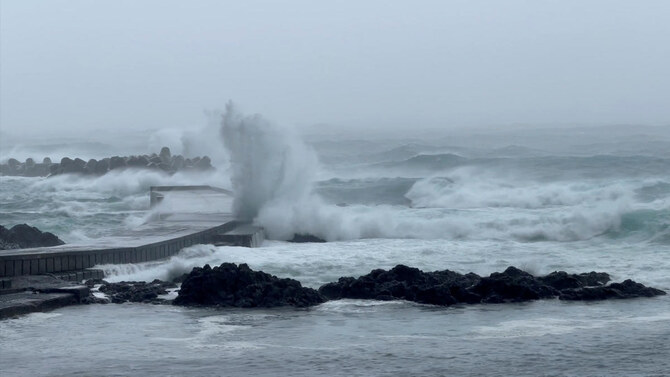
Waves crash amid Typhoon Ampil, in Hachijo, Tokyo Prefecture, Japan, August 16, 2024, in this screen grab obtained from a social media video. (REUTERS)
Short Url
Updated 16 August 2024
Follow

Flights and trains canceled in Tokyo area as a strong typhoon swerves nearby

  • Typhoon Ampil was forecast to reach the waters near Tokyo in the evening Friday then continue north, bringing stormy conditions to the northern Kanto and Tohoku regions early Saturday

TOKYO: Flights and trains in the Tokyo area were canceled Friday, and people were warned of strong winds, heavy rains and potential flooding and mudslides as a typhoon swerved near Japan on its way further north in the Pacific Ocean.
Typhoon Ampil was forecast to reach the waters near Tokyo in the evening then continue north, bringing stormy conditions to the northern Kanto and Tohoku regions early Saturday. It had sustained winds of 162 kph (101 mph) with higher gusts Friday morning and was moving north at 15 kph (9.3 mph), the Japan Meteorological Agency said. Ampil was not expected to make landfall and would weaken to a tropical storm by Sunday.
Tokyo’s Disneyland, usually open until 9 p.m., was closing early at 3 p.m. because of the typhoon. Yamato Transport, which makes Amazon and other deliveries in Japan, said no deliveries will be made in the Tokyo and nearby affected areas Friday and Saturday.
The Shinkansen bullet trains running between Tokyo and Nagoya were halted for the entire day, according to Central Japan Railway, a common response to typhoons here. Bullet trains serving northeastern Japan and some local Tokyo trains were suspended temporarily or switched to a slower schedule.
Dozens of departing and arriving flights were canceled at Tokyo’s two airports, Haneda and Narita, as well as at Kansai, Osaka and Chubu airports. The flight cancelations affect some 90,000 people, according to Japanese media reports. Several highways may also partly close to traffic.
Airports and train stations had been packed Thursday with people moving up their plans to avoid disruptions from the typhoon. Friday was drizzly and windy in Tokyo, although the intensity varied. Traffic and crowds out on the streets were sparse, mostly because of the Bon summer holiday period, not just the weather. Stores remained open.
Officials warned people to stay away from rivers and beaches and to be wary of winds strong enough to send objects flying.
“We foresee extremely fierce winds and extremely fierce seas,” said Shuichi Tachihara, JMA chief forecaster.
Japanese TV broadcasts showed Hachijo residents boarding up windows. Ampil moved past Hachijo by midday, as it headed northward. Store shelves for bread and instant noodles were empty.


Bolivia and Israel to restore ties severed over the war in Gaza

Updated 5 sec ago
Follow

Bolivia and Israel to restore ties severed over the war in Gaza

  • Paz's government eased visa restrictions on American and Israeli travelers last month
  • The Bolivian foreign ministry said its top diplomat would meet his Israeli counterpart in Washington later Tuesday to discuss the revival of bilateral ties

LA PAZ, Bolivia: Bolivia's new right-wing government said Tuesday that it would restore diplomatic relations with Israel, the latest sign of the dramatic geopolitical realignment underway in the South American country that was once among the most vocal critics of Israeli policies toward Palestinians.
The Bolivian foreign ministry said its top diplomat would meet his Israeli counterpart in Washington later Tuesday to discuss the revival of bilateral ties, which Bolivia's previous left-wing government severed two years ago over Israel's devastating campaign against Hamas in Gaza.
Bolivia said the effort came as part of a new foreign policy strategy under conservative President Rodrigo Paz aimed at “rebuilding Bolivia's international prestige, opening new economic opportunities and strengthening alliances that directly benefit the country and our citizens abroad."
Bolivian Foreign Minister Fernando Aramayo is in the midst of a whirlwind trip to Washington for meetings with American officials as his government works to warm long-chilly relations with the United States and unravel nearly two decades of hard-line, anti-Western policies under the Movement Toward Socialism, or MAS, party that left Bolivia economically isolated and diplomatically allied with China, Russia and Venezuela.
Paz's government eased visa restrictions on American and Israeli travelers last month.
In announcing his expected meeting with Aramayo on Monday, Israeli Foreign Minister Gideon Saar thanked Bolivia for scrapping Israeli visa controls and said he spoke to Paz after the center-right senator's Oct. 19 election victory to express “Israel’s desire to open a new chapter” in relations with Bolivia.
Paz entered office last month, ending the dominance of the MAS party founded by Evo Morales, the charismatic former coca-growing union leader who became Bolivia's first Indigenous president in 2006. Not long after taking power, Morales sent Israel's ambassador packing and cozied up to Iran over their shared enmity toward the U.S. and Israel.
When protests over Morales' disputed 2019 reelection prompted him to resign under pressure from the military, a right-wing interim government took over and restored full diplomatic relations with the U.S. and Israel as it sought to undo many of Morales’ popular policies.
But 2020 elections brought the MAS party back to power with the presidency of Luis Arce, who in 2023 once again cut ties with Israel in protest over its military actions in Gaza.
Other left-wing Latin American countries, like Chile and Colombia, soon made similar moves, recalling their ambassadors and joining South Africa’s genocide case against Israel before the United Nations’ highest judicial body.