- Freelancers complain of slow speeds as government moves to implement firewall to monitor and regulate content and social media
- Pakistan Software Houses Association (P@SHA) estimates financial losses due to slow Internet speed could be as high as $300 million
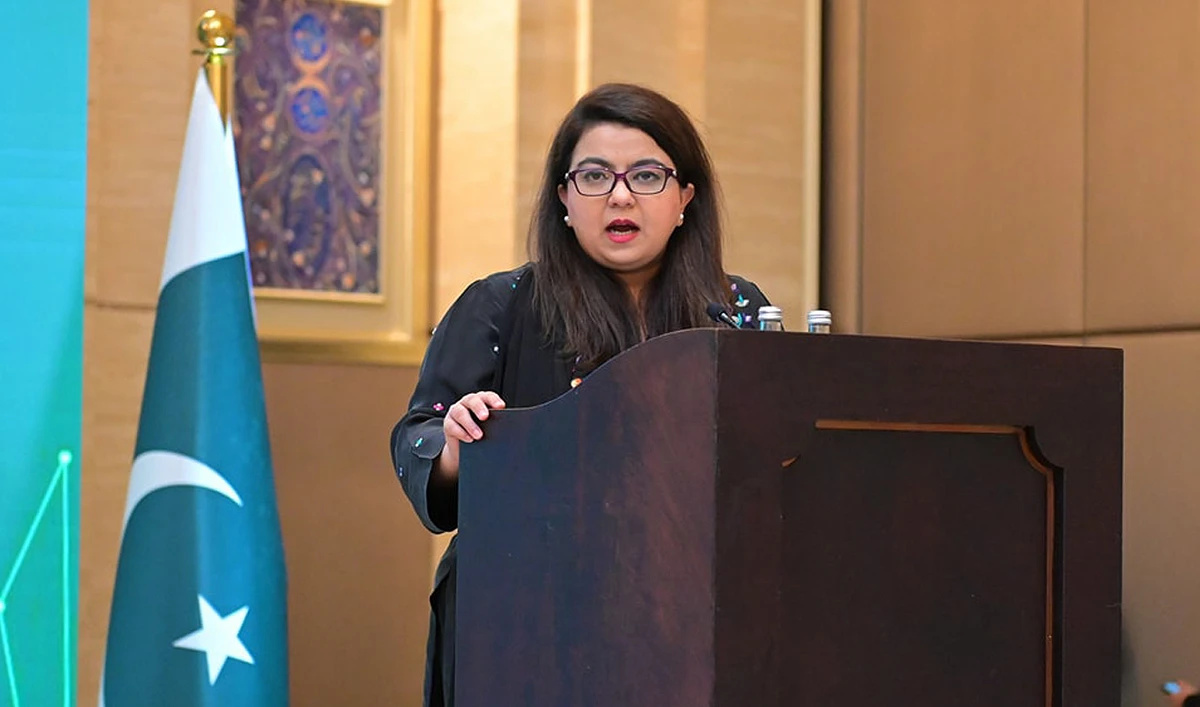
ISLAMABAD: Pakistan’s State Minister for Information Technology (IT) Shaza Fatima Khawaja said on Thursday her ministry was addressing complaints of “slow” Internet speed in the country, which a union of freelancers said had significantly hit the earnings of over 2.3 million people.
Internet speed has dropped by 30-40 percent over the past few weeks, the Wireless and Internet Service Providers Association of Pakistan (WISPAP) said this week, as the government moves to implement a nationwide firewall to block malicious content, protect government networks from attacks, and allow the government to identify IP addresses associated with what it calls “anti-state propaganda.” Khawaja has repeatedly responded to critics saying the government did not plan to use firewalls as a form of censorship.
A firewall is a network security device that monitors and filters incoming and outgoing network traffic based on predetermined security parameters. It acts as a barrier whose main purpose is to allow non-threatening traffic in and to keep dangerous and undesirable traffic out.
Pakistan’s Internet regulatory body, the Pakistan Telecommunication Authority (PTA) has the technological ability to block unwanted content and prevent the access of local users to specific websites but the installation of the firewall is expected to enhance its capability to filter and monitor Internet content on a wider scale.
“There have been complaints of slow Internet and I have asked the PTA to provide data of the last two weeks to look at the data traffic to know the speed issue,” Khawaja told reporters after attending a meeting of the Senate Standing Committee on Information Technology and Telecommunications.
“Internet should never be slow as the digital economy and digital governance depend on good Internet speed.”
When asked about the installation of a firewall, the minister said it was a cybersecurity matter and that countries around the world use the technology. Countries like China, Iran, Turkiye, and Russia have employed national firewalls for year to regulate Internet content, saying they aim to pinpoint and restrict sources of propaganda content
“Previously, the government was managing the web system but with increasing international cybersecurity attacks on the country, there is a growing need for the state to strengthen its ability to prevent these attacks,” Khawaja added.
Aisha Humera Chaudhry, the secretary of the IT and telecommunications ministry, explained during the standing committee meeting that broadband connections were not hit by low Internet speed but mobile users were facing Internet disruptions on their cellphones.
“The PTA is assessing the issue, and the ministry will be in a better position to provide an overview once the assessment is completed in two weeks,” she was quoted as saying in a statement issued by the senate secretariat after the meeting.
Ali Ihsan, Senior Vice Chairman of the Pakistan Software Houses Association (P@SHA), warned against the consequences of the firewall.
“The booming IT industry is facing a disaster, grappling with unprecedented operational disruptions that threaten the very foundation of Pakistan’s burgeoned tech sector,” he said in a statement, adding that prolonged Internet disruptions and erratic VPN performances were threatening a complete meltdown of business operations.
“These disruptions are not mere inconveniences but a direct, tangible, and aggressive assault on the industry’s viability – inflicting devastating financial losses estimated to reach $300 million, which can further increase exponentially,” he said.
The government’s ambiguity surrounding the firewall’s design and objectives had ignited distrust of Pakistani freelancers among their global clients, Ihsan said:
“They fear their proprietary data and privacy will be compromised, which only serves to erode the hard-earned trust and confidence in Pakistan’s IT capabilities.”
‘LOSING MORE AND MORE BUSINESS’
There are 19 million freelancers globally, out of which Pakistan has 2.37 million active freelancers. The South Asian nation ranks among the top four countries that offer freelance services, with key global platforms for freelance work being Upwork, Fiverr, and PeoplePerHour.
According to data from the central bank. Pakistani freelancers earned $397.3 million in foreign remittances during the fiscal year 2021-22. This amount is likely underreported as much of freelance income is received as home remittances.
“The businesses of over 2.3 million freelancers are suffering due to the slow Internet services,” Tufail Ahmed Khan, president of the Pakistan Freelancers Association (PAFLA), told Arab News.
“Not only freelancers but IT companies and e-commerce businesses are also affected by the significant degradation in Internet speed.”
He said Pakistani freelancers had earned over $350 million in 2023 while slow Internet speed was now making it difficult to complete projects online.
Khan said the most concerning aspect was that the government had given no timeline on when the issue would be resolved, with the uncertainty could damage Pakistani freelancers’ reputation among clients.
This week workers on Fiverr said the freelancing platform had made several accounts in Pakistan “unavailable” due to possible “Internet disruptions.”
“We are losing more and more business every day,” Khan lamented.
Asad Baig, executive director of the digital rights non-profit Media Matters for Democracy, said authorities were enacting laws to control the Internet rather than leveraging it for progress.
“They [government] should realize that the Internet is not only social media platforms, it is far beyond this,” Baig told Arab News. “And it is essential to give priority to this concept that in digital policymaking it is the only way to progress.”
Pakistani freelancers agreed, saying their earnings and reputation were both taking a hit due to the slow Internet speed.
Usman Mehmood, a freelance video animator since 2014, said slow Internet was disrupting timely communication with clients and completion of work.
“In our work time delivery of the project is essential, otherwise the client will move to [freelancers in] other countries, which is happening now,” Mehmood told Arab News. “It should be fixed at the earliest to save all the freelancer’s work.”
Kausar Aziz, who had worked as a freelance digital marketer since 2020, said slow Internet had hit her reputation and wasted money her clients had spent on advertising due to low visibility.
“I used to earn around Rs200,000 ($717) per month,” Aziz told Arab News, “but business is almost negligible for over a week.”