ADM Group to invest $250 million in manufacture of electric vehicles in Pakistan

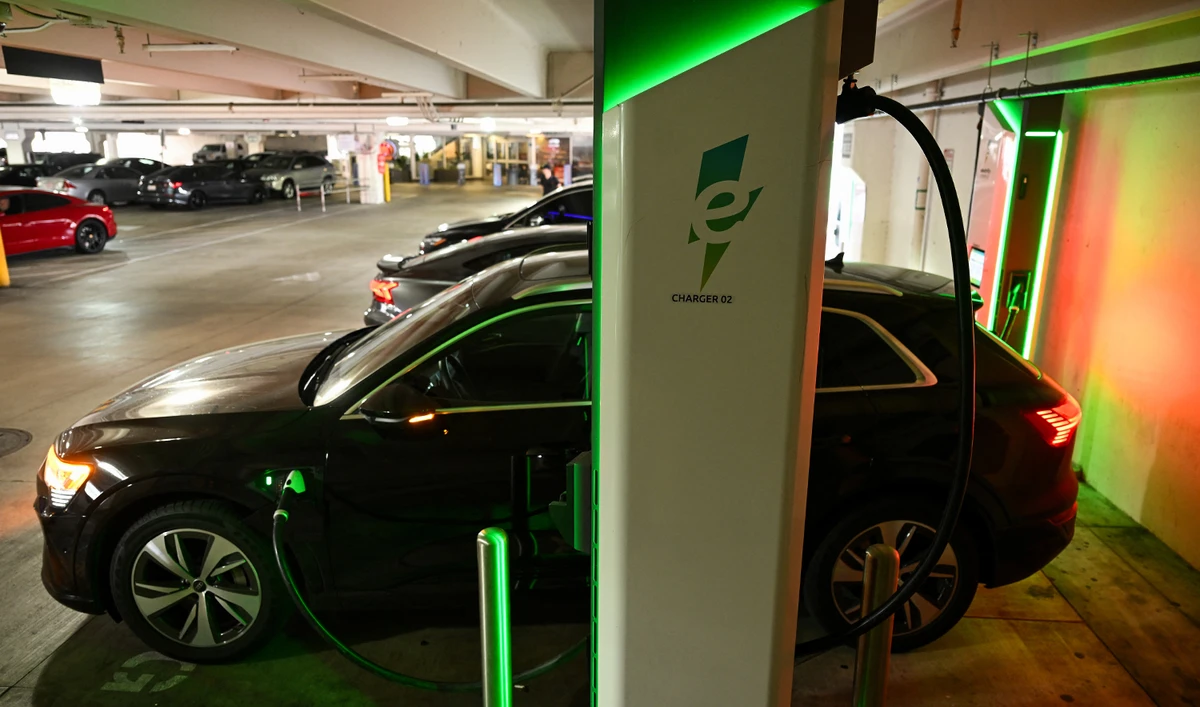
An electric Audi sports utility vehicle (SUV) charges at a public Electrify America EV DC fast charger in Los Angeles, California on May 16, 2024. (AFP/File)
Short Url
Updated 15 August 2024
Follow

ADM Group to invest $250 million in manufacture of electric vehicles in Pakistan

  • Pakistan’s urban areas exhibit some of the world’s highest levels of air pollution primarily due to vehicle emissions
  • Charging network stations to be established during first phase of project, manufacturing of vehicles in second 

ISLAMABAD: Investment company ADM Group has announced it would invest up to $250 million for the manufacturing of electric vehicles in Pakistan, state-run media reported on Thursday, in a move likely to boost technological advancements in the country’s automobile industry and curtail pollution. 

Pakistan’s urban areas exhibit some of the world’s highest levels of air pollution, primarily due to sub-2.5 μm particulate emissions. This issue significantly impairs both the country’s economy and the quality of life of its residents. Road transport is a significant contributor to air pollution as around 23 percent of Pakistan’s greenhouse gas emissions originate from vehicles.

Pakistan approved an ambitious National Electric Vehicles Policy (NEVP) in 2019 with the goal of electric vehicles comprising 30 percent of all passenger vehicles and heavy-duty truck sales by 2030, and an even more ambitious target of 90 percent by 2040. 

“ADM Group has announced an investment of 250 million dollars for the manufacturing of electric vehicles in Pakistan,” state broadcaster Radio Pakistan said in a report. 

It said the understanding was reached during a meeting between the Minister for Industries and Production Rana Tanveer Hussain and ADM Group Chief Executive Officer Yasir Bhambhani in Islamabad on Thursday. 

Bhambhani briefed Hussain that charging network stations would be established in the first phase of the project while electric vehicle manufacturing would commence in the second one. An electric vehicle will be able to cover a distance of 300km on one charge, state media reported. 

“EVs are being promoted on numerous fronts, including through new federal and provincial policies and by public commitments from automakers to convert their fleets to EVs,” ADM’s website quoting Bhambhani said. 

“However, there are still some fundamental issues that could affect the widespread adoption of EVs, including the absence of EV infrastructure in Pakistan.”

Meanwhile, Minister Hussain assured the government would provide all possible facilities to attract foreign direct investment in Pakistan, saying that electric vehicles were now a reality. 

ADM Group said on its website that electric car markets were seeing “exponential growth” in Pakistan as sales exceeded 10 million in 2022. 

“A total of 14 percent of all new cars sold were electric in 2022, up from around 9 percent in 2021 and less than 5 percent in 2020,” the group said. 

It said over 2.3 million electric cars were sold in Pakistan during the first quarter of 2023, about 25 percent more than in the same period last year.
Islamic military coalition, Pakistan to deepen cooperation to combat ‘terrorism’ — Pakistani military

Updated 02 February 2026
Follow

Islamic military coalition, Pakistan to deepen cooperation to combat ‘terrorism’ — Pakistani military

  • Islamic Military Counter Terrorism Coalition is a 43-member alliance that includes Pakistan, Saudi Arabia, Egypt, Jordan, UAE and other nations
  • The Pakistani military statement comes after a meeting between IMCTC secretary-general and the chief of Pakistani defense forces in Rawalpindi

ISLAMABAD: Pakistan and the Islamic Military Counter Terrorism Coalition (IMCTC) have reaffirmed their commitment to deepening cooperation, including intelligence sharing and capacity building, to jointly combat “terrorism” and “extremism,” the Pakistani military said on Monday.

The IMCTC is a 43-member military alliance that was formed on Saudi Arabia’s initiative in Dec. 2015 to consolidate Muslim countries’ efforts in countering “terrorism.”

A 17-member IMCTC delegation is visiting Pakistan from Feb. 2-6 to conduct a training at National University of Sciences and Technology on “Re-integration and Rehabilitation of Extremist Elements,” according to the Pakistani military.

On Monday, IMCTC Secretary-General Maj. Gen. Mohammed bin Saeed Al-Moghedi held a meeting with Chief of Pakistani Defense Forces Field Marshal Asim Munir to discuss cooperation among IMCTC member states.

“During the meeting, matters of mutual interest were discussed, with particular emphasis on regional security dynamics and enhanced cooperation in counter-terrorism efforts,” the Inter-Services Public Relations (ISPR), the Pakistani military’s media wing, said in a statement.

“Both sides reaffirmed their shared commitment to combating terrorism and extremism through collaborative strategies, intelligence sharing, and capacity building among member states.”

The IMCTC features Pakistan, Saudi Arabia, Türkiye, Afghanistan, Egypt, Jordan, Qatar, Palestine, UAE, Bangladesh and other nations. In 2017, Pakistan’s former army chief Gen. (retd) Raheel Sharif was appointed as the IMCTC commander-in-chief.

During discussions with Major General Al-Moghedi, Field Marshal Munir appreciated the role of IMCTC in fostering stability and promoting coordinated counterterrorism initiatives across the Islamic world, according to the ISPR.

The IMCTC secretary-general acknowledged Pakistan’s significant contributions and sacrifices in the fight against militancy and lauded the professionalism of Pakistan’s armed forces.

“The meeting underscored the resolve of both sides to further strengthen institutional collaboration for peace, stability, and security in the region,” the ISPR added.

Pakistan enjoys cordial ties with most Muslim countries around the world, particularly Gulf Cooperation Council countries. In Sept. 2025, Pakistan signed a landmark defense pact with Saudi Arabia according to which an act of aggression against one country will be treated as an act of aggression against both.