

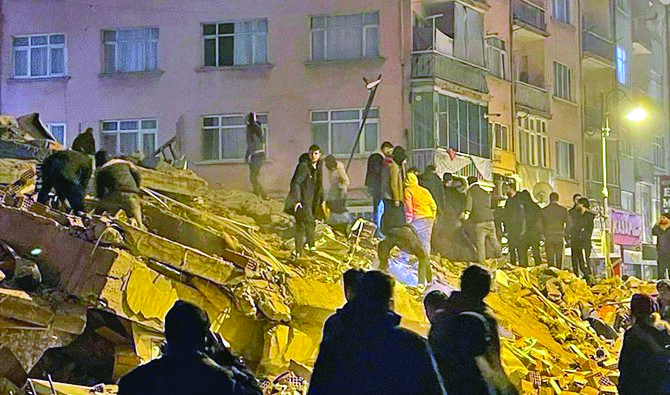
Earthquake aftershocks hit Hama in western Syria

Short Url
Updated 14 August 2024
Follow

Earthquake aftershocks hit Hama in western Syria

  • Clean-up begins after 4.8 magnitude quake, tremors felt across Jordan and Lebanon

JEDDAH: Aftershocks struck the city of Hama in western Syria on Tuesday as the clean-up began after a 4.8 magnitude earthquake the night before.

About 65 people were injured as they fled in panic after the quake, nearly 70 received hospital treatment for shock, and the tremors were felt across Jordan and Lebanon.

“My son was sleeping, I don’t know how I grabbed him and got out of the house,” said Nasser Duyub, a state employee in Salamiya, 30 km east of Hama city.

Jordan reported a 3.9 magnitude aftershock less than an hour after the initial quake, and Syria’s National Earthquake Center said monitoring stations recorded 13 tremors east of Hama city until Tuesday morning.
Many people in Syria and Lebanon thought the initial quake was an Israeli airstrike. In Syria, others had flashbacks to February 2023, when a 7.8 magnitude earthquake killed more than 50,000 people — mostly in Turkiye, but thousands also died in northern Syria. That earthquake caused widespread destruction in both countries.
“It was the same sound, as if it was coming out of the earth,” said Umm Hamzah, who lives in Damascus. “I got dizzy just like last time, but the scare was worse because I knew what happened in the previous quake.”


Morocco to secure 60% of water needs from desalination

Nizar Baraka
Updated 14 sec ago
Follow

Morocco to secure 60% of water needs from desalination

  • Rabat boosts investment in facilities powered by renewable energy, minister tells Marrakech conference

MARRAKECH: Morocco, which has endured seven years of drought, plans to supply 60 percent of its drinking water from treated seawater by 2030, up from 25 percent, its water minister said, as Rabat accelerates investment in desalination plants powered by renewable energy.

The push is crucial to ensure a steady water supply and to maintain Morocco’s status as a key producer and exporter of fresh produce amid climate change, as droughts have dried up some of its main water reservoirs and depleted underground resources.

FASTFACT

The plant will have a capacity of 350 million cubic meters and will supply urban centers in Morocco’s food basket as well as farmlands.

The North African country plans to produce 1.7 billion cubic meters of desalinated water annually by 2030 from projects under construction and plants for which it will hold tenders starting next year, Nizar Baraka said on the sidelines of the World Water Congress in Marrakech.
The largest plant — with planned investment of about 10 billion dirhams ($1 billion) — will be located near Tiznit, 615 km south of the capital Rabat. 
It will have a capacity of 350 million cubic meters and will supply urban centers in the country’s food basket as well as farmlands, he said.
“Studies are underway as part of preparations for the plant’s tender, to be announced by mid next year,” Baraka said.
Besides the northern cities of Nador and Tangier, plants are also planned in Rabat in partnership with the French group Veolia, as well as in Tantan, where the government is considering building a port dedicated to green hydrogen and ammonia exports, Baraka said.
Morocco currently operates 17 desalination plants producing 345 million cubic meters annually. 
Four additional plants are under construction with a combined capacity of 540 million cubic meters, scheduled to be ready by 2027, including a major facility in Casablanca, the country’s most populous city.
“All new desalination plants will be powered by renewable energy,” Baraka said.
Morocco has also faced rising temperatures and worsening evaporation in dams. 
To counter this, it installed floating solar panels on a dam near Tangier to reduce evaporation, which accounts for 30 percent of the country’s surface water loss, according to the minister.
“The experiment will be expanded to include dams in the south and mountainous regions,” Baraka said.