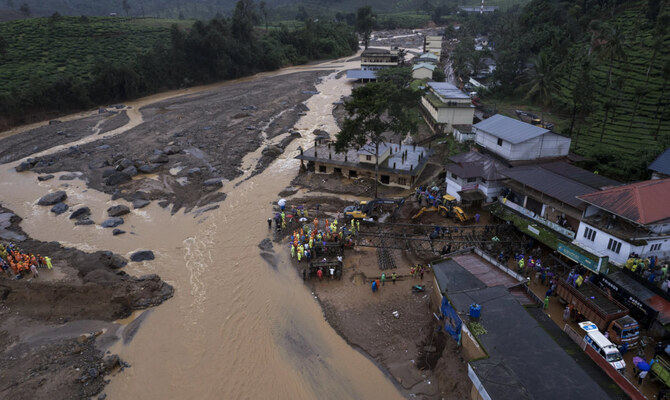
BENGALURU, India: The heavy rains that resulted in landslides killing hundreds in southern India last month were made worse by human-caused climate change, a rapid analysis by climate scientists found Tuesday.
The study by the World Weather Attribution, a group of scientists who use established climate models to quickly determine whether human-caused climate change played a part in extreme weather events around the world, found that the 15 centimeters (5.91 inches) of rain that fell in a 24-hour period July 29-30 was 10 percent more intense because of global warming. The group expects further emissions of planet-heating gases will result in increasingly frequent intense downpours that can lead to such disasters.
Nearly 200 people were killed and rescuers are still searching for more than 130 missing people in Kerala state, one of India’s most popular tourist destinations.
“The Wayanad landslides are another catastrophic example of climate change playing out in real time,” said Mariam Zachariah, a climate scientist at Imperial College of London and one of the authors of the rapid study.
Last month’s rainfall that caused the landslides was the third-heaviest in Kerala state since India’s weather agency began record-keeping in 1901.
Last year over 400 people died due to heavy rains in the Indian Himalayan state of Himachal Pradesh. Multiple studies have found that India’s monsoon rains have become more erratic as a result of climate change. “Until the world replaces fossil fuels with renewable energy, monsoon downpours will continue to intensify, bringing landslides, floods and misery to India,” said Zachariah.
India’s southern state Kerala has been particularly vulnerable to climate change-driven extreme weather. Heavy rainfall in 2018 flooded large parts of the state, killing at least 500 people, and a cyclonic storm in 2017 killed at least 250 people including fishers who were at sea near the state’s coasts.
“Millions of people are sweltering in deadly heat in the summer. Meanwhile, in monsoons, heavier downpours are fueling floods and landslides, like we saw in Wayanad,” said Arpita Mondal, a climate scientist at the Indian Institute of Technology Bombay and one of the study’s authors. Earlier this year another study by the same group found that deadly heat waves that killed at least 100 people in India were found to have been made at least 45 times more likely due to global warming.
India, the world’s most populous country, is among the highest current emitters of planet-heating gases and is also considered to be among the most vulnerable regions in the world to climate impacts.
“When it rains now, it rains heavily. In a warmer world, these extreme events will be more frequent and we cannot stop them. However, we can try to establish early warning systems for landslides and also avoid any construction activity in landslide-prone regions,” said Madhavan Rajeevan, a retired senior official at India’s Ministry of Earth Sciences who is from Kerala state.
Tuesday’s study also recommended minimizing deforestation and quarrying, while improving early warning and evacuation systems to help protect people in the region from future landslides and floods. The study said the Wayanad region had seen a 62 percent decrease in forest cover and that that may have contributed to increased risks of landslides during heavy rains.
“Even heavier downpours are expected as the climate warms, which underscores the urgency to prepare for similar landslides in northern Kerala,” said Maja Vahlberg, climate risk consultant at Red Cross Red Crescent Climate Center who was also an author of the study.

Study finds rains that led to deadly Indian landslides were made worse by climate change
Short Url
https://arab.news/9w9tt
Study finds rains that led to deadly Indian landslides were made worse by climate change
- “The Wayanad landslides are another catastrophic example of climate change playing out in real time,” said Mariam Zachariah, a climate scientist at Imperial College of London and one of the authors of the rapid study
Cuba pays tribute to soldiers killed in Maduro capture
- President Miguel Diaz-Canel and Castro, the 94-year-old retired former Cuban leader, were present in full military uniform to receive the soldiers’ remains
- Twenty-three Venezuelan soldiers were also killed in the US strike that saw Maduro and his wife whisked away to stand trial in New York
HAVANA: Cuba paid tribute on Thursday to 32 soldiers killed in the US military strike that ousted Venezuelan leader Nicolas Maduro, in a ceremony attended by revolutionary leader Raul Castro.
Havana, under pressure from US President Donald Trump, had decreed two days of tribute for the men, some of whom had been assigned to Maduro’s protection team.
Twenty-one of the soldiers were from the Cuban interior ministry, which oversees the intelligence services, officials have said. The others were from the military.
President Miguel Diaz-Canel and Castro, the 94-year-old retired former Cuban leader, were present in full military uniform to receive the soldiers’ remains early Thursday.
Their urns, draped in Cuban flags, were unloaded from a plane at Havana’s Jose Marti International Airport, according to footage broadcast on state TV.
At the event, Interior Minister General Lazaro Alberto Alvarez expressed the country’s respect and gratitude for the soldiers he said had “fought to the last bullet” during US bombings and a raid by US special forces who seized Maduro and his wife from their Caracas residence on January 3.
“We do not receive them with resignation; we do so with profound pride,” the minister added, and said the United States “will never be able to buy the dignity of the Cuban people.”
The soldiers’ bodies were then transported in Jeeps to the Ministry of the Revolutionary Armed Forces, with Cubans lining the streets and applauding the procession.
Residents of the capital can pay their respects throughout the day, which will close with a gathering outside the US embassy in Havana.
‘Manipulation’
The homage serves as an opportunity for Cuba to make a display of national unity at a time it is batting away pressure from US President Donald Trump.
Trump on Sunday urged Cuba to “make a deal,” the nature of which he did not divulge, or face the consequences.
The Republican president, who says Washington is now effectively running Venezuela, has vowed to cut off all oil and money that Caracas had been providing to ailing Cuba.
Cuba, which is struggling through its worst economic crisis in decades, has reacted defiantly to the US threats even as it reels from the loss of a key source of economic support.
Havana has dismissed as “political manipulation” a US announcement of humanitarian aid for victims of Hurricane Melissa, which hit last October and killed nearly 60 people across the Caribbean.
“The US government is exploiting what might seem like a humanitarian gesture for opportunistic purposes and political manipulation,” Cuba’s foreign ministry said in a statement in response.
It added Washington had not been in touch about the delivery, which it would welcome “without conditions.”
Jeremy Lewin, the senior US official for foreign assistance, on Thursday cautioned Havana not to “politicize” the help.
“We look at this as the first, the beginning of what we hope will be a much broader ability to deliver assistance directly to the Cuban people,” he said.
US-Cuba relations have been tense for decades but hit a new low after the US capture of Maduro and his wife.
Twenty-three Venezuelan soldiers were also killed in the US strike that saw Maduro and his wife whisked away to stand trial in New York on drug-trafficking charges.
Havana, under pressure from US President Donald Trump, had decreed two days of tribute for the men, some of whom had been assigned to Maduro’s protection team.
Twenty-one of the soldiers were from the Cuban interior ministry, which oversees the intelligence services, officials have said. The others were from the military.
President Miguel Diaz-Canel and Castro, the 94-year-old retired former Cuban leader, were present in full military uniform to receive the soldiers’ remains early Thursday.
Their urns, draped in Cuban flags, were unloaded from a plane at Havana’s Jose Marti International Airport, according to footage broadcast on state TV.
At the event, Interior Minister General Lazaro Alberto Alvarez expressed the country’s respect and gratitude for the soldiers he said had “fought to the last bullet” during US bombings and a raid by US special forces who seized Maduro and his wife from their Caracas residence on January 3.
“We do not receive them with resignation; we do so with profound pride,” the minister added, and said the United States “will never be able to buy the dignity of the Cuban people.”
The soldiers’ bodies were then transported in Jeeps to the Ministry of the Revolutionary Armed Forces, with Cubans lining the streets and applauding the procession.
Residents of the capital can pay their respects throughout the day, which will close with a gathering outside the US embassy in Havana.
‘Manipulation’
The homage serves as an opportunity for Cuba to make a display of national unity at a time it is batting away pressure from US President Donald Trump.
Trump on Sunday urged Cuba to “make a deal,” the nature of which he did not divulge, or face the consequences.
The Republican president, who says Washington is now effectively running Venezuela, has vowed to cut off all oil and money that Caracas had been providing to ailing Cuba.
Cuba, which is struggling through its worst economic crisis in decades, has reacted defiantly to the US threats even as it reels from the loss of a key source of economic support.
Havana has dismissed as “political manipulation” a US announcement of humanitarian aid for victims of Hurricane Melissa, which hit last October and killed nearly 60 people across the Caribbean.
“The US government is exploiting what might seem like a humanitarian gesture for opportunistic purposes and political manipulation,” Cuba’s foreign ministry said in a statement in response.
It added Washington had not been in touch about the delivery, which it would welcome “without conditions.”
Jeremy Lewin, the senior US official for foreign assistance, on Thursday cautioned Havana not to “politicize” the help.
“We look at this as the first, the beginning of what we hope will be a much broader ability to deliver assistance directly to the Cuban people,” he said.
US-Cuba relations have been tense for decades but hit a new low after the US capture of Maduro and his wife.
Twenty-three Venezuelan soldiers were also killed in the US strike that saw Maduro and his wife whisked away to stand trial in New York on drug-trafficking charges.
© 2026 SAUDI RESEARCH & PUBLISHING COMPANY, All Rights Reserved And subject to Terms of Use Agreement.


