

Pakistan’s capital bans horns, whistles ahead of Independence Day to prevent noise pollution 

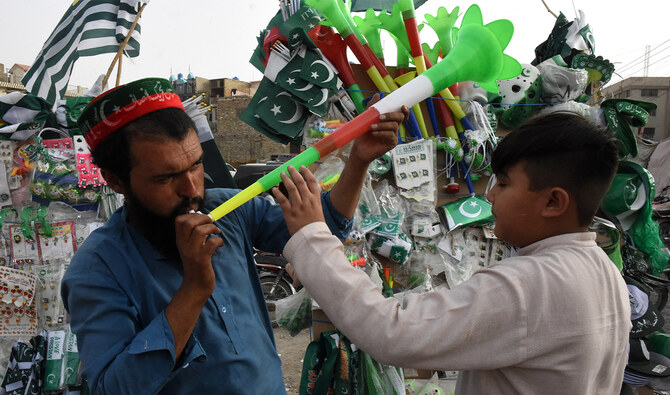
boy purchases a blow horn in a market on the eve of Pakistan's Independence Day celebrations in Quetta on August 13, 2023. (AFP/File)
Short Url
Updated 13 August 2024
Follow

Pakistan’s capital bans horns, whistles ahead of Independence Day to prevent noise pollution 

  • Order came into effect on Aug. 8 for ten days, notification by Islamabad’s district magistrate says
  • Magistrate says decision taken to uphold public peace and tranquility and discourage “public nuisance”

ISLAMABAD: The administration in Pakistan’s capital has banned the sale and purchase of horns and whistles for ten days ahead of Pakistan’s Independence Day celebrations on Aug. 14, an official notification said, to deter people from disturbing “public peace and tranquility.”

Thousands of shops and makeshift stalls in various parts of the country sell vuvuzela horns, whistles and other Independence Day paraphernalia ahead of Aug. 14 every year. A notification released last Thursday by Islamabad’s district magistrate but reported by local media on Monday said it had been noted that people were selling horns and whistles on the capital’s roads which was disturbing the flow of traffic. 

A vuvuzela is a plastic horn, brightly colored and seen in abundance at sporting events around the world and at Independence Day celebrations in Pakistan. The horns can be really loud and generate a lot of noise. 

“I do hereby prohibit the stock, sale, purchase and use of horns/whistles in Islamabad, which is likely to disturb public peace and tranquility and also cause public nuisance within the revenue limits of Islamabad District,” the notification read, signed by Islamabad’s Additional District Magistrate Usman Ashraf. 

The order, issued on Aug. 8, said it was to come into force immediately and would stay in effect till ten days. 

According to the state-run Associated Press of Pakistan (APP), Islamabad’s deputy commissioner has directed all assistant commissioners to launch a crackdown on hawkers selling horns across various parts of the city.

“In the past few days, several operations were carried out in different areas, including I-8, Lehtrar Road, Ghori Town, and Kural,” APP reported. “These operations led to the confiscation of horns from various stalls, sending a clear message that the sale and purchase of horns would not be tolerated.”

Islamabad’s Deputy Commissioner Irfan Nawaz also called on citizens to avoid using horns and asked stall owners to stop selling them.

“Using or selling a toy horn can land you in legal trouble,” he warned on social media platform X. 

In 2022, a citizen fed up of the noise generated by the vuvuzelas, moved the Lahore High Court (LHC) seeking a ban on plastic toy horns. The court, however, rejected his plea since it was filed after Aug. 14, when Independence Day celebrations had ended. 

In August 2023, a judicial magistrate in Karachi ordered authorities to take stern action against people selling plastic toy horns, citing noise pollution as the main reason. 


Pakistan says $50 million meat export deal with Tajikistan nearing finalization

Updated 5 sec ago
Follow

Pakistan says $50 million meat export deal with Tajikistan nearing finalization

  • Islamabad expects to finalize agreement soon after Dushanbe signals demand for 100,000 tons
  • Pakistan is seeking to expand agricultural trade beyond rice, citrus and mango exports

ISLAMABAD: Tajikistan has expressed interest in importing 100,000 tons of Pakistani meat worth more than $50 million, with both governments expected to finalize a supply agreement soon, Pakistan’s food security ministry said on Tuesday.

Pakistan is trying to grow agriculture-based exports as it seeks regional markets for livestock and food commodities, while Tajikistan, a landlocked Central Asian state, has been expanding food imports to support domestic demand. Pakistan currently exports rice, citrus and mangoes to Dushanbe, though volumes remain small compared to national production, according to official figures.

The development came during a meeting in Islamabad between Pakistan’s Federal Minister for National Food Security and Research Rana Tanveer Hussain and Ambassador of Tajikistan Yusuf Sharifzoda, where agricultural trade, livestock supply and food-security cooperation were discussed.

“Tajikistan intends to purchase 100,000 tons of meat from Pakistan, an import valued at over USD 50 million,” the ambassador said, according to the ministry’s statement, assuring full facilitation and that Islamabad was prepared to meet the demand.

The statement said the two sides agreed to expand cooperation in meat and livestock, fresh fruit, vegetables, staple crops, agricultural research, pest management and standards compliance. Pakistan also proposed strengthening coordination on phytosanitary rules and establishing pest-free production zones to support long-term exports.

Pakistan and Tajikistan have long maintained political ties but bilateral food trade remains below potential: Pakistan produces 1.8 million tons of mangoes annually but exported just 0.7 metric tons to Tajikistan in 2024, while rice exports amounted to only 240 metric tons in 2022 out of national output of 9.3 million tons. Pakistan imports mainly ginned cotton from Tajikistan.