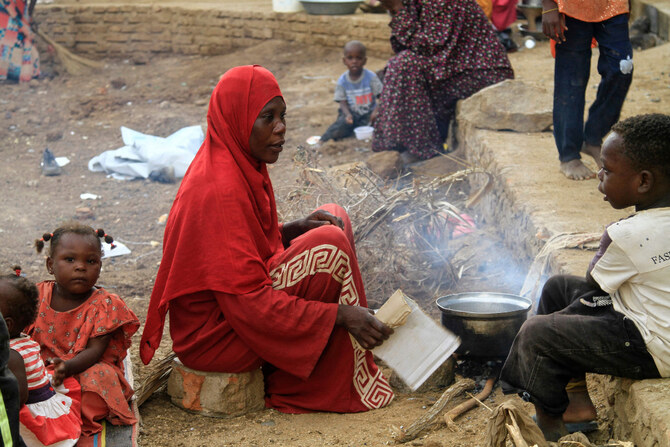
KASSALA: Amna Hussein sat grieving in a disaster relief tent in eastern Sudan, where she fled with her children after deadly floods displaced thousands in a country already reeling from war.
“My father died in the floods,” Hussein said in Kassala, a state on the border with Eritrea.
Sudan has experienced an intense rainy season since last month, with intermittent torrential flooding mainly in the country’s north and east.
Authorities have not released an updated death toll, but 34 people have died in the northern town of Abu Hamad alone, according to the Sudanese Red Crescent.
“All our houses have collapsed. Mine has been totally destroyed. We’re sitting in the street with nowhere to go,” flood victim Umm Ayman Zakarya Adam told AFP in Abu Hamad.
Authorities in Kassala on Friday issued an “urgent call” to the international community, asking for “immediate assistance to rescue victims” of the flooding.
They said that in Kassala “thousands of people have been affected by the floods which have destroyed many homes.”
Every year between May and October peak flow on the Nile is accompanied by torrential rains, destroying homes, wrecking infrastructure and claiming lives, both directly and through water-borne diseases.
The impact is expected to be worse this year after nearly 16 months of fighting that has displaced millions of people into flood zones.
In Wadi Halfa, in the north of the country, near the Egyptian border, “around 3,000 homes and health facilities were severely damaged,” according to local authorities.
“I’m speaking to you from a hilltop where my family and dozens of others took shelter last night after we were completely surrounded by rising waters,” said Mohammed Othman, a resident of Wadi Halfa, speaking to AFP by phone.
Flood-hit communities
More than 73,000 Sudanese have been affected by the floods, according to the United Nations Office for the Coordination of Humanitarian Affairs (OCHA).
Among those, over 21,000 have been displaced and 14,300 had their homes destroyed.
In Kassala, despite health authorities spraying insecticide at the displacement camps, an AFP journalist reported that swarms of flies were making living conditions even more difficult for the displaced.
A doctor in Kassala, who spoke on condition of anonymity, reported a rise in cases of diarrhea, particularly among children.
Medical worker have said this may indicate a rise in cholera, which health authorities have struggled to control with the war decimating Sudan’s health care system.
Since April of last year, a war between the Sudanese army, led by General Abdel Fattah Al-Burhan, and the paramilitary Rapid Support Forces (RSF), commanded by his former deputy General Mohamed Hamdan Dagalo, has resulted in tens of thousands of deaths and displaced millions of people both within and outside of Sudan.
Both sides are accused of war crimes, including the deliberate targeting of civilians and blocking of aid, worsening the country’s already stark humanitarian crisis.
According to the UN, more than 260,000 people have been displaced to Kassala state by the war.
Massive displacement
Omar Babiker and his family took refuge in Kassala after the RSF arrived on their doorstep in Sudan’s central Al-Jazira state.
The floods forced Babiker to move again to a camp for the displaced, where he is still vulnerable to the rains.
“The floods caught up with us when the waters surrounded our tents,” he told AFP.
In Aroma, a town 40 kilometers (25 miles) to the east of Kassala, floods submerged entire houses, forcing residents to take refuge on a roadside.
Humanitarian organizations have warned that the rainy season could isolate entire regions, making rescue efforts even more difficult.
“Some have been displaced three or four times since the start of the conflict. They have lost their belongings, including food rations,” said Olga Sarrado, spokesperson for the UN refugee agency (UNHCR).
They “are facing significant challenges in accessing clean water and sanitation facilities, increasing the risk of waterborne diseases,” she added.
To the west of Kassala, white tents stretch out over five square kilometers (two square miles).
“These tents don’t protect us from the rain,” said Fathiya Mohammed, a displaced mother trying to light a fire despite the ever-present dampness.
Like others in her situation, Mohammed counts on a single daily meal distributed by a kitchen staffed by volunteers.
“We know it’s not enough, but it’s all we can provide,” a volunteer said.


![]()

Deadly floods in war-torn Sudan displace thousands
Short Url
https://arab.news/jcp3j
Deadly floods in war-torn Sudan displace thousands
- Authorities in Kassala on Friday issued an “urgent call” to the international community, asking for “immediate assistance to rescue victims”


Latest updates



Recommended


© 2026 SAUDI RESEARCH & PUBLISHING COMPANY, All Rights Reserved And subject to Terms of Use Agreement.