

Traders end protest against taxes at northern border pass linking Pakistan to China

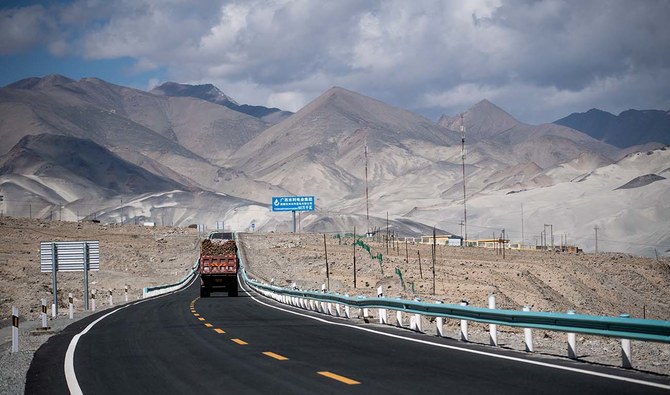
This picture taken on June 27, 2017 shows a truck driving along the China-Pakistan Friendship Highway before the Karakorum mountain range near Tashkurgan in China's western Xinjiang province. (AFP/File)
Short Url
Updated 11 August 2024
Follow

Traders end protest against taxes at northern border pass linking Pakistan to China

  • Protesters blocked high-altitude Khunjerab Pass connecting Pakistan to China for 17 days over taxes on Chinese imports
  • Taxes will only be applicable on imports from China that are transported to other regions, says GB information minister 

KHAPLU, Gilgit-Baltistan: Traders in the northern Gilgit-Baltistan region on Sunday called off a 17-day sit-in protest against taxes on imports at an important border pass linking Pakistan to China, following successful negotiations with the government that will pave the way for trade to resume at the key crossing. 
Trade and transportation at the high-altitude Khunjerab Pass connecting Pakistan and China remained suspended since July 26 after traders staged a sit-in protest at the Sost dry port against taxes on Chinese imports. 
On July 20, the GB Chief Court declared illegal the collection of income tax, sales tax and additional sales tax by Pakistani revenue authorities on goods imported from China through the Khunjerab Pass. 
Protesters accused the federal government of violating the court’s orders and collecting taxes on imports that arrived through the pass.
“The customs department has accepted the GB Chief Court’s order and the unanimous resolution of the GB assembly,” Imran Ali, president of the GB Chamber of Commerce and Industry, told Arab News via a text message. 
“So now, we have announced to call off the protest.” 
Muhammad Iqbal, president of the GB Importers and Exporters Association, said a three-member team representing the traders met GB Chief Minister Hajji Gulber Khan and Minister for Kashmir Affairs and GB Amir Muqam in Islamabad to resolve the issue. 
“And they promised to fulfill our demands after assurances with the FBR,” Iqbal said. “From today, the border is open for all kinds of trade and transport.”
Bakhtiar Muhammad, a spokesperson for the Federal Board of Revenue (FBR) said the customs department was willing to implement the GB court’s interim order subject to the provision of monetary security during the case proceedings to safeguard government revenue. 
“Traders finally agreed to provide post-dated cheques as security and customs negotiated a standard operating procedure for the clearance, to which they agreed,” Muhammad said. 
 GB Information Minister Eman Shah shared details of the agreement, saying that local traders in GB would not be taxed for imports through the Khunjerab Pass. 
“However, a checkpost will be installed at the Thakot Bridge by customs where all taxes will be applicable on imported things being transported to another region,” he revealed.
Ninety-six percent of trade between Pakistan and China consists of China’s exports to Pakistan, while Pakistan’s share of exports to China is only 4 percent, as per the Trade Development Authority of Pakistan (TDAP).

The main items imported from China into Pakistan include electronic items, shoes, garments and spare parts while Pakistan exports gemstones, dry fruits, medicinal herbs and some clothing items to the neighboring country. 


Pakistan, UK discuss regional security, cross-border attacks as senior official visits Islamabad

Updated 20 January 2026
Follow

Pakistan, UK discuss regional security, cross-border attacks as senior official visits Islamabad

  • British envoy for Afghanistan Richard Lindsay’s visit comes at a time of a surge in militancy in Pakistan’s border regions
  • Pakistani diplomat says both sides reviewed broader security challenges, emphasized coordination to address ‘shared concerns’

ISLAMABAD: Pakistani and British officials have discussed regional security challenges and cross-border attacks during talks in Islamabad, a Pakistani diplomat said on Tuesday, during a visit of the United Kingdom’s Afghanistan envoy, Richard Lindsay, to the Pakistani capital.

Pakistan and the UK regularly cooperate on counterterrorism and security, with a focus on intelligence-sharing to combat militant activity. Lindsay’s visit comes at a time of a rise in militancy in Pakistan’s western provinces, which border Afghanistan.

Mohammad Sadiq, Pakistan’s special representative for Afghanistan, said the discussions in Islamabad focused on the regional security situation, particularly the urgent challenge posed by cross-border attacks.

“We also exchanged views on the latest regional security developments and broader security challenges,” he said on X. “We emphasized the importance of continued cooperation and coordination to address shared concerns and promote regional stability.”

Islamabad frequently accuses Afghanistan of allowing its soil and India of backing militant groups, such as the Tehreek-e-Taliban Pakistan (TTP) and the Balochistan Liberation Army (BLA), for attacks against Pakistan. Kabul and New Delhi deny this.

In recent years, Pakistan and the UK have engaged with each other on counterterrorism and cross-border crimes as part of bilateral cooperation.

Both sides held the second round of the Pakistan-UK Counter Terrorism Dialogue in London in February last year, reviewing global and regional threats and exchanging best practices. Over the years, armed forces of both countries have also maintained close cooperation, particularly in counterterrorism efforts and professional military training.