

Pakistan hopes to ‘deepen cooperation’ with Bangladesh under Nobel laureate Yunus 

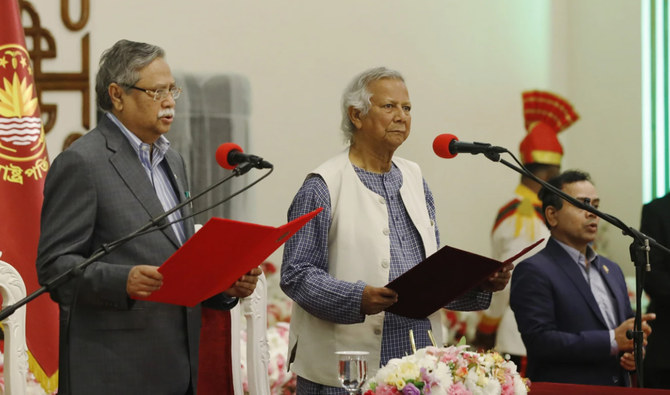
Bangladesh’s figurehead President Mohammed Shahabuddin administers the oath of office to Nobel laureate Muhammad Yunus, right, as the head of Bangladesh’s interim government, in Dhaka on August 8, 2024. (AP)
Short Url
Updated 09 August 2024
Follow

Pakistan hopes to ‘deepen cooperation’ with Bangladesh under Nobel laureate Yunus 

  • Yunus takes over caretaker government after weeks of violence forced PM Hasina to quit and flee to neighboring India
  • Bangladesh was born out of a war between India and Pakistan in 1971 in which nearly 3 million people were killed

ISLAMABAD: Prime Minister Shehbaz Sharif on Friday congratulated Nobel Peace laureate Muhammad Yunus on taking charge of Bangladesh’s caretaker government, saying he hoped to work with the new leader to “deepen cooperation” between the two South Asian nations.
Yunus took the reins of government on Thursday after weeks of violence that forced Prime Minister Sheikh Hasina to quit and flee to neighboring India. 
Pakistan and Bangladesh share a complex history, having been a single country known as East and West Pakistan until Bangladesh was born in 1971 after a war of liberation backed by Pakistan’s arch-rival and neighbor India. Nearly three million people were killed in the conflict.
Ties reached a new low in 2016 when Bangladesh executed several leaders of its Jamaat-e-Islami party on charges of committing war crimes in 1971. Pakistan called the executions and trials “politically motivated,” arguing that the convicts were being punished for taking a pro-Pakistan stance during the war. 
“Heartiest felicitations to Professor Muhammad Yunus on his swearing-in as Chief Adviser of the Government of the People’s Republic of Bangladesh. Wishing him great success in guiding Bangladesh toward a harmonious and prosperous future,” Prime Minister Sharif said on X. 
“I look forward to working with him to deepen cooperation between Pakistan and Bangladesh in the days ahead.”

Known as the “banker to the poor,” Yunus is the pioneer of the global microcredit movement. The Grameen Bank he founded won the 2006 Nobel Peace Prize for helping lift millions from poverty by providing tiny loans to the rural poor who are too impoverished to gain attention from traditional banks.
As chief adviser of the caretaker government, he is, however, tasked with bringing stability back to the country which witnessed some of its worst violence in decades, and then hold fresh parliamentary elections.
“The brutal, autocratic regime is gone,” Yunus said in a televised address to the nation after taking charge on Thursday. “Tomorrow, with the rising sun, democracy, justice, human rights, and full freedom of fearless expression will be enjoyed by all, regardless of party affiliation. That is our goal.”
Hasina’s flight from the country after weeks of deadly protests triggered jubilation and violence as crowds stormed and ransacked her official residence. Over 300 people were killed in clashes from July up until Hasina’s ouster. She had ruled for 20 of the last 30 years after winning a fourth term in January.
With inputs from Reuters


Pakistani court sentences TLP leader for 35 years over incitement against ex-chief justice

Updated 16 December 2025
Follow

Pakistani court sentences TLP leader for 35 years over incitement against ex-chief justice

  • The case stems from a 2024 speech targeting former Chief Justice of Pakistan Qazi Faez Isa over a blasphemy ruling
  • Conviction follows the government’s move to proscribe Tehreek-e-Labbaik Pakistan after clashes with police this year

ISLAMABAD: A Pakistani court this week sentenced a leader of the religio-political party Tehreek-i-Labbaik Pakistan (TLP) to 35 years’ imprisonment on multiple charges for inciting hate against former Chief Justice of Pakistan Qazi Faez Isa.

Peer Zaheer ul Hasan Bukhari made the remarks in a 2024 speech at the Lahore Press Club against the former chief justice for issuing a judgment in a case involving a man named Mubarak Sani under the blasphemy laws, a member of a minority religious community whose death sentence was overturned.

Authorities said Bukhari’s comments amounted to incitement to violence, after which police registered a case against him under various terrorism-related provisions as well as charges of inciting hatred.

The cleric was handed multiple jail terms on a range of charges, with the longest being 10 years of rigorous imprisonment, amounting to a total of 35 years.

“All the sections of imprisonment awarded to the convict shall run concurrently,” Anti-Terrorism Court Judge Arshad Javed said in a letter to the Kot Lakhpat Central Jail superintendent.

A collective fine of Rs600,000 ($,150) was also imposed on the TLP party leader under the provisions of the Anti-Terrorism Act.

The move follows Pakistan’s decision in October to ban the TLP and designate it a proscribed organization under the Anti-Terrorism Act after violent clashes between its supporters and law enforcement in Punjab.

The unrest erupted as demonstrators attempted to travel from Lahore to Islamabad, saying they wanted to stage a pro-Palestine rally outside the US Embassy.

However, officials said TLP supporters were armed with bricks and batons, arguing their intention was to stir violence similar to earlier marches toward the federal capital.

The clashes between TLP supporters and police resulted in the deaths of five people, including two policemen, and injured more than 100 officers and dozens of protesters.

Led by Saad Hussain Rizvi, the TLP is known for its confrontational street politics and mass mobilizations.

Since its emergence in 2017, the party has repeatedly organized sit-ins and marches toward Islamabad, often triggering violent confrontations and prolonged disruptions on major routes to the capital.