



RIYADH: Saudi Arabia’s education sector is undergoing a strategic transformation as it shifts its focus toward specialized fields like artificial intelligence, robotics and nuclear energy.
Driven by the Vision 2030 economic diversification plan, this marks a decisive step in equipping the Kingdom’s future workforce with the high-demand skills needed to secure the jobs of tomorrow.
Mansoor Ahmed, executive director of the Middle East and North Africa region at Colliers, the Canada-based professional services and management company, says the shift towards AI and technology is creating new job opportunities and driving higher education reforms.

“Graduates with expertise in these areas will fill high-demand roles, helping to reduce youth unemployment,” Ahmed told Arab News.
Saudi Arabia’s National Strategy for Data and Artificial Intelligence, launched in 2020, seeks to attract $20 billion in investments by 2030 and cultivate a workforce of 20,000 AI and data specialists.
Ahmed says the emergence of this highly skilled tech workforce will in turn help attract foreign investment, “positioning Saudi Arabia as a potential leader in innovation.”
AI could add more than $320 billion to the Middle East economy. A PWC analysis predicts Saudi Arabia is expected to have the largest gains in absolute terms, worth $135.2 billion, and the UAE will see the largest overall impact at 14 percent of its anticipated 2030 gross domestic product.
“The development of nuclear power plants and the integration of AI across various sectors will generate specialized roles in engineering, data analysis and machine learning,” said Ahmed. “This underscores the need to prioritize education in technology, AI, robotics and nuclear energy.”
Opinion
This section contains relevant reference points, placed in (Opinion field)
Saudi Arabia has affirmed its commitment to future tech by becoming a hub for global events and forums such as LEAP, the Global AI Summit, and the International Exhibition and Conference for Artificial Intelligence and Cloud Computing.
However, if the Kingdom hopes to lead in these specialized fields, it must first close the gap between market demand and educational output.
A report produced by Colliers found the current enrollment distribution in the Kingdom’s public universities “lacks alignment with the employee market,” with students still favoring humanities and Islamic studies.
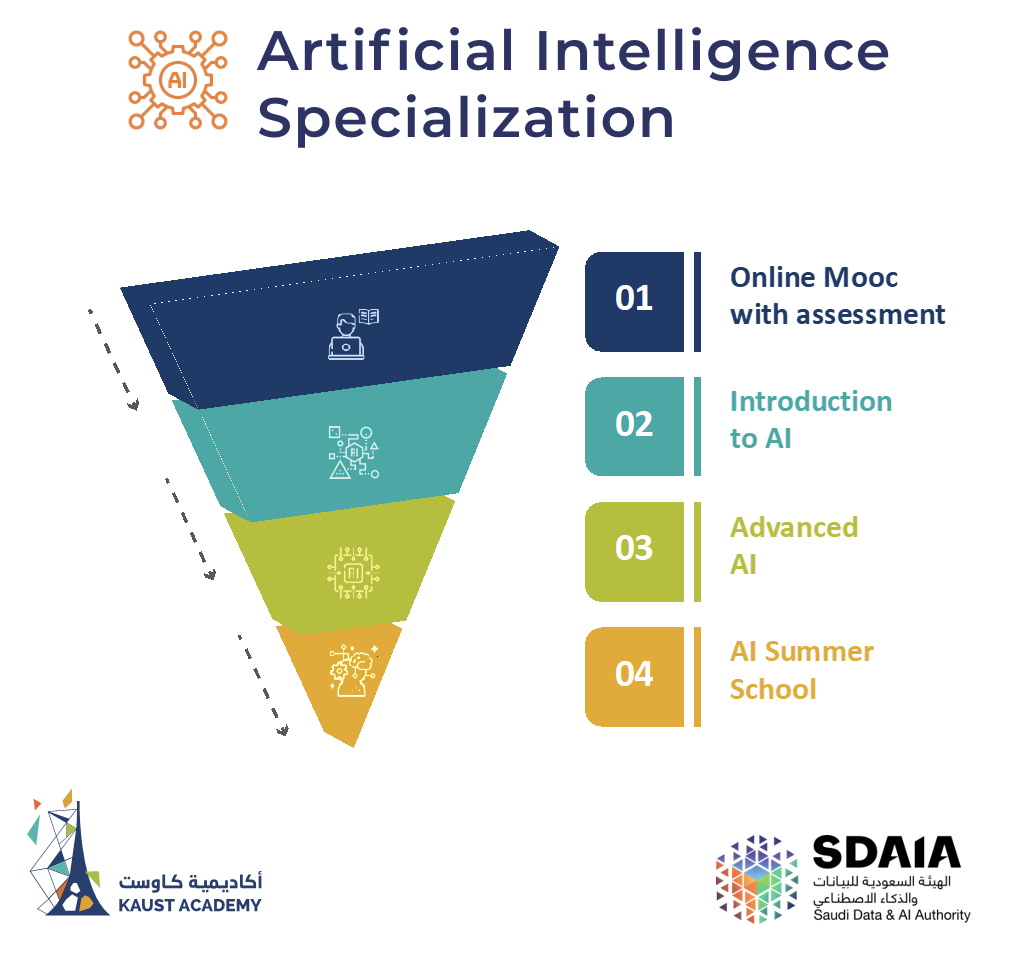
That is now changing. King Abdullah University of Science and Technology has an Artificial Intelligence Initiative focused on research and graduate level education, while KAUST Academy focuses on talent development in AI with programs targeting outside learners.
“KAUST aims to address this gap by offering specialized training and development programs in areas that are in high demand, helping students transition from traditional fields of study to more market-aligned disciplines,” Sultan Albarakati, director of KAUST Academy, told Arab News.
“We are focusing on upskilling a broad range of undergraduate students to prepare them for future job markets.”
DID YOUKNOW?
Saudi Arabia’s National Strategy for Data and Artificial Intelligence seeks to attract $20 billion in investments by 2030.
The Kingdom aims to cultivate a workforce of 20,000 AI and data specialists by the end of the decade.
AI could add more than $320 billion to the Middle East economy, with Saudi Arabia alone gaining $135.2 billion.
Supported by the Saudi Authority for Data and Artificial Intelligence, the KAUST Academy’s AI program covers the entire field, from essentials to advanced level, with projects allowing students to demonstrate the knowledge they acquire.
The program focuses on improving skills in key areas such as deep learning libraries, optimization, linear algebra, machine learning, computer vision, artificial intelligence applications, Python programming and large-scale deep learning.
To support AI research in Saudi Arabia, Silicon Valley tech giant Google recently awarded five seed grants to KAUST faculty members. The grants, which total $100,000, will fund projects focused on multilingual, multimodal machine learning, specifically generative and large language models.
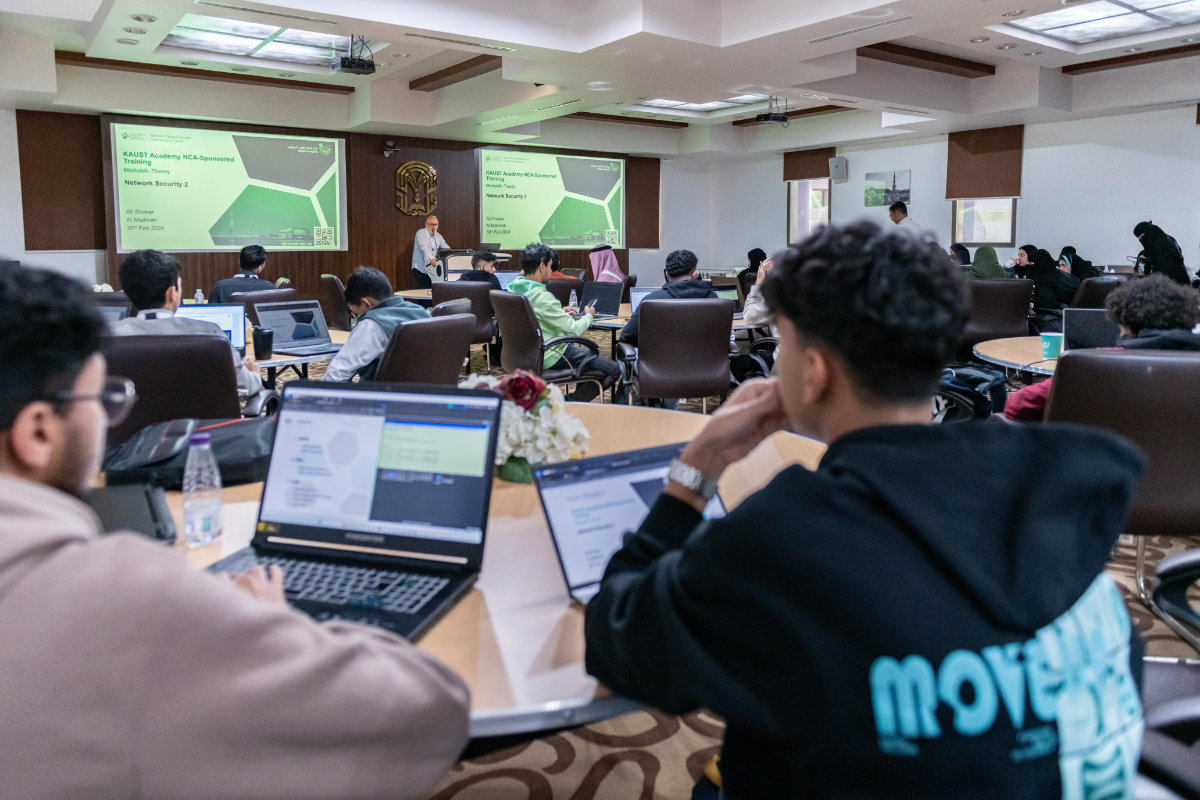
KAUST Academy focuses on talent development in AI with programs targeting outside learners. (Supplied)
Ahmed says the Kingdom’s investment in AI spans multiple sectors, integrating into healthcare, robotics, manufacturing, and service industries — introducing new roles that require a blend of technical and analytical skills.
“This cross-industry application will significantly expand job opportunities for graduates,” he said.
AI is expected to transform the world of work over the coming years. Some 23 percent of jobs are expected to change by 2027, with 69 million new jobs created and 83 million eliminated, according to the World Economic Forum’s Future of Jobs Report 2023.
To ensure alignment of educational outputs with labor market needs, Saudi Arabia’s Human Capability Development Program has set out to review higher education degrees based on their recent and expected employability results.
“Training in these high-demand skills will equip Saudi citizens for success in a tech-driven economy, with the HCDP emphasizing critical thinking, problem-solving and technical expertise,” said Ahmed.


keywords


