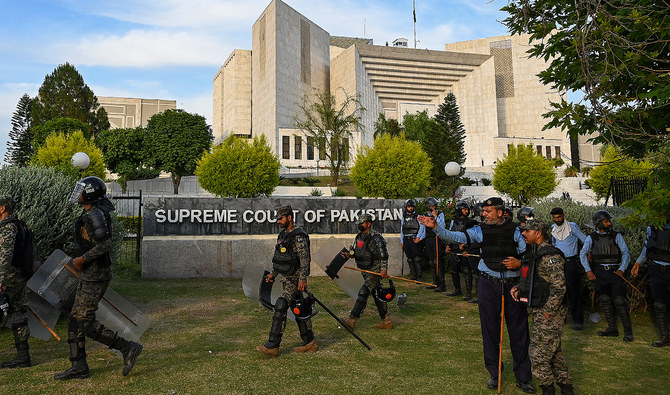
ISLAMABAD: Former Prime Minister Imran Khan’s Pakistan Tehreek-e-Insaf (PTI) party filed a petition in the Supreme Court on Wednesday, challenging amendments to the election law that could prevent the allocation of reserved seats to the party, which previously secured a favorable verdict from the top court on the matter.
PTI candidates had to contest the Feb. 8 general elections as independents after the party was stripped by the election commission of its symbol on technical grounds. They won the most seats in the polls, but the commission ruled they were not entitled to reserved parliamentary seats for women and minorities that are allocated in proportion to the number of seats a political party wins in general elections.
Last month, Pakistan’s Supreme Court ruled that the PTI was indeed eligible for over 20 extra reserved seats in parliament. The court said the PTI was a political party for the purpose of the Feb. 8 polls and those who contested as independents because the PTI lost its election symbol were in fact PTI candidates.
However, the country’s coalition administration adopted a bill seeking amendments to the Elections Act, 2017, which was largely viewed as an attempt to deprive PTI of getting additional seats.
“The plea filed under Article 184(3) of the Constitution by PTI Chairman Gohar Khan via lawyer Barrister Salman Akram Raja [has urged] the apex court to declare the Elections (Second Amendment) Bill, 2024, null and void,” Pakistan’s Geo News TV reported.
The development comes only a day after the bill was adopted by Pakistan’s National Assembly and Senate.
PTI Chairman Barrister Gohar Khan vowed to challenge the amendements in the court while speaking at the National Assembly, hoping the top court judges would set aside the “illegal and unconstitutional” legislation.
He recognized during his speech that parliament was supreme and had the power to make laws. However, he noted it was the Supreme Court’s prerogative to interpret the constitution.
The Elections (Second Amendment) Bill says if a candidate does not submit a declaration of his affiliation with a political party to the returning officer before seeking the allotment of an election symbol, he or she shall be “deemed to be considered as an independent candidate and not a candidate of any political party.”
Another amendment says if a political party fails to submit its list for reserved seats within the prescribed time period, it would not be eligible for reserved seats at a later stage. A third amendment says a winning independent candidate’s decision to join a political party after elections was irrevocable.
After the election, PTI-backed candidates were forced to join the Sunni Ittehad Council, or SIC party, to claim their share of reserved seats since the election commission said independents were not eligible for them.
Pakistan has reserved seats for women and religious minorities to ensure greater inclusiveness in the legislative process on both national and provincial levels.


![]()

Imran Khan’s party files Supreme Court petition against Pakistan election law on reserved seats
Short Url
https://arab.news/be65p
Imran Khan’s party files Supreme Court petition against Pakistan election law on reserved seats
- Amendments made in parliament were widely viewed as government’s attempt to deprive Khan’s PTI of these seats
- Supreme Court recognized PTI’s reserved seats share after candidates backed by it won the most seats in elections
Latest updates


© 2026 SAUDI RESEARCH & PUBLISHING COMPANY, All Rights Reserved And subject to Terms of Use Agreement.