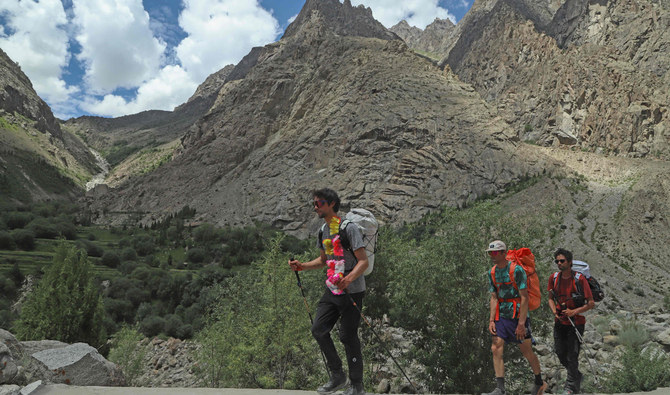
ISLAMABAD: A record number of 9.3 million people visited tourist destinations in Pakistan’s northwestern Khyber Pakhtunkhwa (KP) province during May, June and July this year, an official statement announced on Tuesday.
This was despite heavy monsoon downpours that caused landslides and were expected to hamper tourist activities in the region.
Torrential rains in the country killed at least 24 people last week in KP, with the provincial disaster management authority urging people to exercise caution.
In the past, tourism in the region was also affected by militant violence.
“A record number of people visited tourist destinations in the province this year,” KP’s Home and Tribal Affairs Department said. “From May 1 to July 31, more than 9.3 million tourists visited the province.”
The details were shared in a meeting chaired by Zahid Chanzeb, the adviser to the KP chief minister on culture and tourism.
He urged all stakeholders interested in adventure tourism to register with the province’s tourist services wing.
Chanzeb also instructed the authorities to update the data on the province’s tourism website and mobile application.
In March, a night tourism event in the city of Peshawar allowed tourists to explore the rich history of the city, organized by a local group called “Tour Da Pekhawar,” marking the city’s first night tourism event.


Record 9.3 million tourists flock to Pakistan’s northwest between May through July
https://arab.news/njgqj
Record 9.3 million tourists flock to Pakistan’s northwest between May through July

- Khyber Pakhtunkhwa asks those involved in ‘adventure tourism’ to register with official wing
- The province also arranged the first night tourism event in Peshawar earlier this year in March

Pakistan’s Mahnoor Omer named among TIME’s ‘Women of the Year’ for 2026
- Omer moved a Pakistani court against the so-called ‘period tax’ in Sept. 2025 which has since sparked a national debate
- Taxes on sanitary pads in Pakistan can add up to 40 percent to retail price, UNICEF says only around 12 percent women use such products
ISLAMABAD: Pakistani women’s rights activist Mahnoor Omer, who fought against taxes on menstrual products, has been named among the TIME magazine’s ‘Women of the Year’ for 2026.
Omer’s efforts have been recognized alongside 16 activists, artists, athletes and businesswomen in the TIME’s Women of the Year 2026 list, including Olympic gold medalist Sydney McLaughlin-Levrone and Oscar-nominated filmmaker Chloe Zhao.
Dissatisfied with the efforts to educate Pakistani girls about sexual violence, Omer founded the Noor Foundation at the age of 14 and held her own workshops with village girls about everything from climate change to menstruation, according to the TIME magazine.
Two years later, a conversation with a domestic worker about the price of pads made her realize that not everyone could afford these essentials. She moved a court against the so-called “period tax” in Sept. 2025 and the case has sparked a national debate on the subject, considered a taboo by many in Pakistan, since its first hearing late last year.
“A decade and one law degree after her interest in activism was sparked, Omer, now 25, is putting her passion and expertise to work in the name of gender equity,” TIME wrote about Omer on its website.
Taxes imposed on sanitary products in Pakistan can add up to 40 percent to the retail price. UNICEF estimates just 12 percent of women in the country use commercially produced pads or tampons. The alternative, using cloth, risks health impacts including rashes and infections, and can make it impossible for girls to attend school while menstruating.
Omer’s suit, which awaits the government response, has sparked a national discussion. She says she spoke about menstruation to her father and male cousins, who thanked her for standing up for their daughters.
The 25-year-old, who is currently enrolled in a master’s degree in gender, peace, and security at the London School of Economics, sees this case as just the first of many.
“I’m not free until every woman is free,” she was quoted as saying by TIME. “I want to leave no stones unturned in terms of what I can do with the next few decades, as a lawyer for the women in my country and gender minorities in general.”


