

Oil Updates – prices rebound 1% on concerns wider Middle East conflict may cut supply

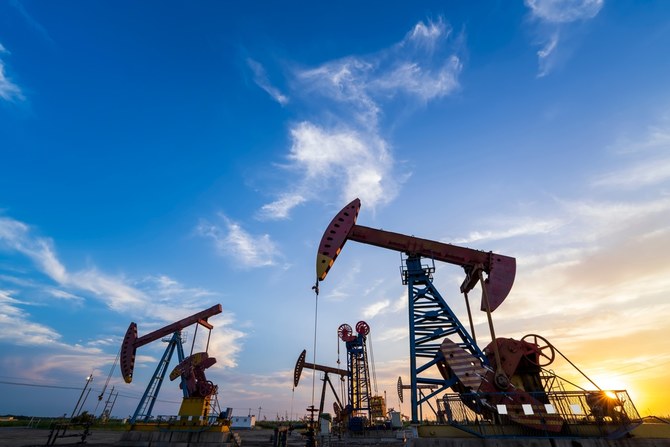
Brent crude futures gained 76 cents, or 1 percent, to $77.06 a barrel by 8:38 a.m. Saudi time. Shutterstock
Short Url
Updated 20 August 2024
Follow

Oil Updates – prices rebound 1% on concerns wider Middle East conflict may cut supply

  • Fear of wider Middle East conflict leads to fresh buying
  • US passes message to Iran not to escalate

TOKYO/SINGAPORE: Oil prices rebounded by 1 percent on Tuesday, paring the previous session’s loss, on supply concern amid an escalating Middle East conflict, stronger US services sector data and a cut in production at Libya’s Sharara oilfield.

Brent crude futures gained 76 cents, or 1 percent, to $77.06 a barrel by 8:38 a.m. Saudi time, while US West Texas Intermediate crude futures climbed 92 cents, or 1.26 percent, to $73.86.

On Monday, both benchmarks fell about 1 percent against a backdrop of falling global stock markets.

Oil’s slide was limited by mounting concern that Iran, a key Middle Eastern producer, may retaliate against Israel and the US for the assassination of a Hamas leader in Tehran and an Israeli attack that killed a Hezbollah commander in Lebanon, potentially leading to a wider regional war.

On Monday, at least five US personnel were injured in an attack against a military base in Iraq, US officials told Reuters. It was unclear whether the attack was linked to the retaliation threats.

The US has been urging countries to convey to Iran that escalation is not in its interest, a State Department spokesperson said on Monday.

“Oil seems to have clawed back some of its losses as broader concerns of a possible escalation in Middle Eastern conflict continue to add (to) apprehensions in (the) oil market. The possibility of an all-out war in (the) Middle East is getting real, threatening global supplies,” Priyanka Sachdeva, a senior market analyst at Phillip Nova in Singapore, said in an email.

Oil was also supported by overnight data showing service sector activity in the US, the world’s biggest oil consumer, rebounded from a four-year low in July.

Price gains also occurred amid a broader rally in Asian equity markets after they plunged on Monday.

“The broad-based recovery in risk sentiments and more resilient US services sector data offer some support for prices,” said IG market strategist Yeap Jun Rong in an email.

“Concerns around US growth risks are eased by resilience in US services activities, but it may have to take more to reassure markets of a stronger global demand outlook for oil.”

Worries over lower production at Libya’s 300,000 barrel-per-day Sharara oil field buoyed prices further. Output at the field, one of the country’s largest, has fallen by around 20 percent due to protests.

These production troubles have offset some of the earlier macro bearishness in the market, said ING analysts in a client note.


ACWA Power inks $400m deal to develop desalination plant in Azerbaijan 

Updated 28 December 2025
Follow

ACWA Power inks $400m deal to develop desalination plant in Azerbaijan 

RIYADH: Saudi utility giant ACWA Power has signed a public-private partnership agreement valued at SR1.5 billion ($400 million) to develop Azerbaijan’s first large-scale Caspian Sea water reverse osmosis desalination plant. 

In a Tadawul statement, ACWA Power said the agreement was signed with the government of Azerbaijan, represented by the Azerbaijan State Water Resources Agency as the public partner, and Caspian Sea Azerbaijan Project Co. in its capacity as the project company. 

The development aligns with ACWA Power’s expansion strategy as it seeks to establish itself as a key global player in renewable energy, water desalination, and green hydrogen through a growing portfolio of large-scale projects at home and abroad. 

In the Tadawul statement, ACWA Power stated: “The Public Private Partnership Agreement along with a series of agreements were signed to deliver Azerbaijan’s first large-scale Caspian Sea Water Reverse Osmosis Desalination Plant.”  

According to the statement, the contract term spans 27.5 years, including the construction period. 

The agreement covers the design, engineering, construction, financing, ownership, operation, and maintenance of the desalination plant, with ACWA Power holding a 100 percent shareholding in the project company. 

The financial impact of the contracted revenues is expected to be reflected after the early commercial operation date, which will be announced at the time of financial close. The company added that no related parties are involved in the transaction. 

Earlier this month, ACWA Power signed a cooperation framework agreement with the African Development Bank to enhance collaboration on power generation and water desalination projects across Africa. 

Under the agreement, the two parties will work together to identify, develop, and finance sustainable energy and water initiatives, with a target investment of up to $5 billion between 2025 and 2030. 

In December, ACWA Power also completed the refinancing of the Rabigh 3 Independent Water Project in Saudi Arabia’s western region. 

Rabigh 3 is a seawater desalination plant with a capacity of 600,000 cubic meters of potable water per day, using reverse osmosis technology. 

The company said the refinancing was executed through a capital-markets-led approach, anchored by the issuance of a long-term senior secured project bond.