

British minister cites Islamophobia as motivation for far-right violence in UK

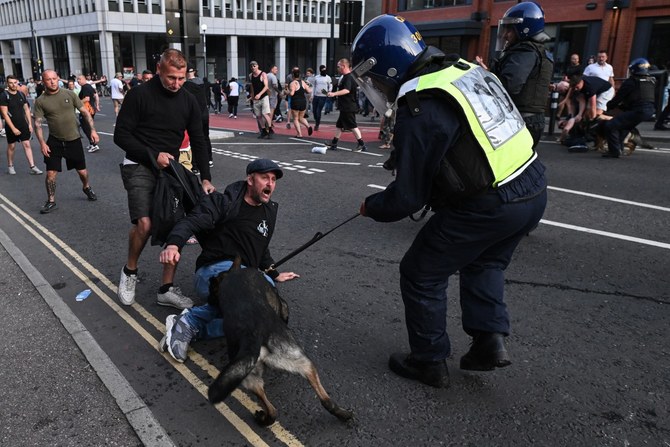
The UK’s home secretary on Monday pointed to Islamophobia for the first time as a motivation for far-right violence in several cities that has seen widespread damage and nearly 400 arrests. (AFP)
Short Url
Updated 05 August 2024
Follow

British minister cites Islamophobia as motivation for far-right violence in UK

  • Amnesty chief wants action on ‘root cause’ of racism

LONDON: The UK’s home secretary on Monday pointed to Islamophobia for the first time as a motivation for far-right violence in several cities that has seen widespread damage and nearly 400 arrests.

Yvette Cooper was appearing on ITV’s morning television show “This Morning” and was asked why the Labour government had not used the term when talking about the violence, which broke out on Tuesday following a stabbing in which three children were killed.

“You’re right that there has been a range of different things driving this, including far-right extremism,” Cooper told the program.

“We have certainly seen some targeted attacks on mosques, and that clearly reflects Islamophobia, and people shouldn’t be targeted for their faith or for the color of their skin.

“We’ve also seen some looting, some response of local criminals just getting involved at the periphery on streets as well. None of these people speak for Britain,” she added.

Cooper’s department, the Home Office, said over the weekend it would deploy extra police and security for mosques under new emergency measures, The Telegraph reported.

A suspended Labour MP, Zarah Sultana, also appeared on “This Morning” and pushed the government to do more to call out hatred against Muslims.

“This question about naming it as Islamophobia is really important, because that allows us to shape our response,” she said.

“If we’re not identifying what is happening, the language that is being used and what this is about, we’re not going to be able to address this fundamentally,” she added.

Also on Monday, the head of Amnesty International UK said the government must get serious about tackling the “root cause of racism that plagues” British society.

“The widespread violence and hate crimes we’ve witnessed over the last few days are utterly unacceptable,” Sacha Deshmukh said.

“It’s disgusting to see hotels housing people seeking sanctuary set on fire, mosques and businesses attacked, and people targeted because of the color of their skin, their faith or their country of origin,” he added.

He said the violence was inspired by the rhetoric of politicians who had “scapegoated” refugees and migrants.

“Events of the last few days have been reported as ‘anti-immigration protests’ or ‘pro-British demonstrations’ and they should not be labeled as such. What we are seeing are clearly violent racist attacks targeting specific communities,” he said.

“Above all, the government must address the root causes of racism, Islamophobia and xenophobia that plagues our society — and this includes actively calling out and addressing the dangerous rhetoric of politicians and commentators on social media and elsewhere.”


Afghan government says Pakistan strikes Kabul and border provinces

Updated 4 min 47 sec ago
Follow

Afghan government says Pakistan strikes Kabul and border provinces

  • A Pakistani security official, speaking on condition of anonymity, confirmed that Pakistan struck overnight
  • Islamabad last month launched a wave of air strikes on its neighbor, an operation it says is targeting militancy

KABUL: Afghan authorities said on Friday that Pakistan had carried out new strikes on Kabul and border provinces, killing four people in the capital.

A Pakistani security official, speaking on condition of anonymity, confirmed that Pakistan struck overnight, adding their forces targeted the Pakistani Taliban militant group, known as TTP.

Islamabad last month launched a wave of air strikes on its neighbor, an operation it says is targeting militancy following growing attacks in Pakistan.

But the Taliban government has denied any involvement or the use of Afghan territory for militancy.

Khalil Zadran, the spokesman for Kabul police, said four people had been killed and 15 wounded in the bombardment that hit homes in the capital, with women and children among the victims.

Taliban government spokesman Zabihullah Mujahid posted on X that Pakistani strikes also hit the southern province of Kandahar, as well as eastern Paktia and Paktika, which border Pakistan.

In Kandahar, which is home to the administration’s supreme leader Hibatullah Akhundzada, air strikes hit a fuel depot for airline Kam Air, near the airport.

This company supplies fuel to civilian airlines and United Nations aircraft.

Pakistan insists it has not killed any civilians in the conflict. Casualty claims from both sides are difficult to verify independently.

Afghan and Pakistani forces have also clashed repeatedly at the border in recent weeks, hampering trade and forcing nearby residents to leave their homes.

‘Open war’

The United Nations’ mission in Afghanistan (UNAMA) has said that 56 civilians have been killed in Afghanistan, including 24 children, by Pakistani military operations between February 26 and March 5.

About 115,000 people were forced to leave their homes, according to the UN refugee agency.

Fighting between the two countries intensified on February 26, when Afghanistan launched an offensive along the frontier, in retaliation for earlier Pakistani air strikes targeting the TTP.

Pakistan then declared “open war” against the Taliban authorities, bombing the capital, Kabul, on February 27.

Since then, clashes have increased in border regions, including overnight Wednesday to Thursday that the Afghan authorities said killed four members of the same family in Khost province.

The Taliban government said on Thursday that four members of the same family, including two children, were killed by Pakistani artillery and mortar fire in eastern Afghanistan.

Seven people had been killed in Afghanistan since Tuesday as a result of cross-border clashes between the two sides, according to the authorities in Kabul.

Deputy government spokesman Hamdullah Fitrat said the latest deaths happened early Thursday in the village of Sadqo in Khost province, accusing Pakistan of deliberately targeting civilian homes and nomads’ tents.