
ISLAMABAD: Former Prime Minister Imran Khan’s Pakistan Tehreek-e-Insaf (PTI) party will hold a rally in the federal capital, Islamabad, in the last week of August or first week of September, a top official of the party said on Monday.
Last month, the PTI announced it was postponing a public rally planned in Islamabad because the district administration had revoked permission. The gathering on the outskirts of the Pakistani capital was meant to put pressure for the release of Khan, who has been in jail since last August. All four convictions handed down to him ahead of a parliamentary election in February have either been suspended or overturned but he remains in jail on new charges. Khan says all legal cases against him are politically motivated.
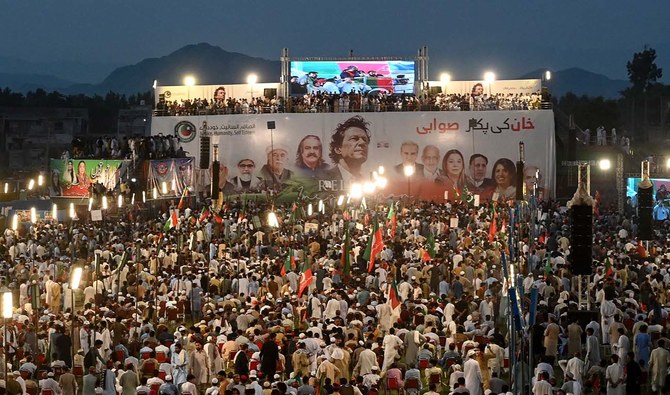
“I am making an announcement here as Chief Minister of Khyber Pakhtunkhwa,” Ali Amin Gandapur, a senior member of the PTI, said on Monday as he addressed a rally in the northwestern town of Swabi.
“I am announcing that in the last week of August or September first week on the weekend, we will hold a rally in Islamabad.”
He said if the party was not given permission, or a no-objection certificate, to hold the rally in a designated spot, it would hold it at D-Chowk, a large town square located on the junction of Jinnah Avenue and Constitution Avenue in Islamabad, which houses several important government buildings like the Presidency, Prime Minister’s Office, Parliament and Supreme Court.
“If they don’t give us an NOC, god willing the rally will be held at D-Chawk,” Gandapur said. “We will have a rally in Islamabad, which is also my federal capital, it is also the federal capital of Khyber Pakhtunkhwa.”
The PTI, which aims to mobilize the public for the release of its leader, has been struggling to hold rallies across the country since August last year, when Khan was arrested on graft charges. The party says it is facing a state-backed crackdown and the mass arrest of its members and supporters for standing by Khan. Pakistani authorities deny the allegations.
The crackdown against the PTI began after alleged supporters of the party attacked and damaged government and military installations on May 9, 2023, after Khan’s brief arrest that day in a graft case. The attacks took place a little over a year after Khan fell out with Pakistan’s powerful military, blaming the institution for colluding with his political rivals to oust him from office in a parliamentary vote in April 2022. The military rejects the allegations.
Hundreds of PTI workers and leaders were arrested following the May 9 riots and many remain behind bars as they await trial. The military has also initiated army court trials of at least 103 people accused of involvement in the violence. Many close Khan aides have since deserted him, due to what is widely believed to be pressure from the army, which denies interfering in politics.
Khan has recently made a “conditional” offer of talks to the army, if “clean and transparent” elections were held and the “bogus” cases against his supporters were dropped.
The military, which has repeatedly said Khan and his party were behind the May 9 attacks, has ruled out any talks with him.