

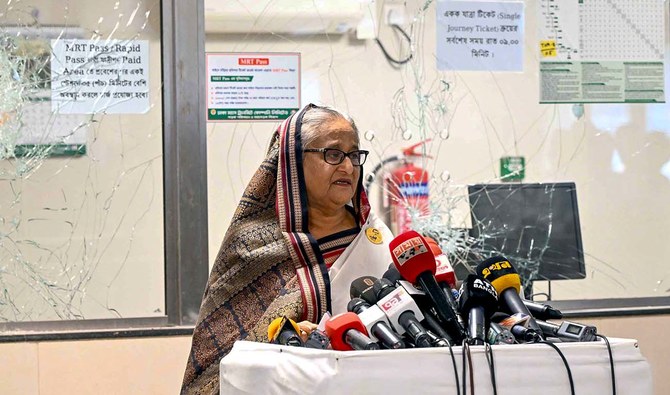

DHAKA: Bangladesh Prime Minister Sheikh Hasina resigned and fled the country on Monday, ending 15 years in power as thousands of demonstrators defied a nationwide curfew and stormed her official residence.
In a televised address, Bangladesh’s military chief Waker-Uz-Zaman announced he was assuming control at a “critical time for our country” and confirmed that Hasina has left Dhaka for a “place of safety,” as local media reported neighboring India as her initial destination.
“I am taking responsibility now and we will go to the president and ask to form an interim government to lead the country in the meantime,” he said.
Zaman said the army would stand down and that an investigation would be launched into the deadly crackdowns that fueled outrage against the government.
“Keep faith in the military, we will investigate all the killings and punish the responsible … I have ordered that no army and police will indulge in any kind of firing,” he said.
“Now, the students’ duty is to stay calm and help us.”
After the army confirmed Hasina’s resignation, thousands of people poured into the capital’s streets in jubilation and shouted slogans. Television visuals showed masses storming Hasina’s official residence in the capital, pumping fists, making victory signs, and removing furniture and other household items.
Hasina had ruled Bangladesh since 2009 and was elected for a fourth consecutive term in a January vote that was boycotted by her main opponents, sparking concerns over how free and fair the vote was.
She was forced out by weeks of protests that started out peacefully but turned into deadly clashes with security forces, leading to communications blackout, curfews, and around 300 deaths.
Students were the ones leading earlier protests that began in July to demand reforms to a quota system for government jobs, which the Supreme Court eventually scaled back. But as the rallies turned deadly and authorities attempted to quell the violence with force, the movement escalated into a campaign to oust Hasina.
At least 11,000 people have been arrested in recent weeks, with the unrest leading to closure of schools and universities across the South Asian nation and authorities issuing a shoot-on-sight curfew at one point.
Student activists called for a march to Dhaka on Monday in defiance of the latest curfew to press for Hasina’s resignation. This comes after nearly 100 people, including over a dozen police officers, were killed on Sunday following a fresh wave of deadly clashes across the country.
“SECOND REVOLUTION”
Hasina, 76, was one of the world’s longest ruling female leaders and has played a pivotal role in Bangladesh’s politics, a nation of about 170 million people that declared its independence in 1971.
She is the daughter of Sheikh Mujibur Rahman, the country’s charismatic founding leader, who was killed in 1975 in a military coup when Ms. Hasina was 28. She served as prime minister from 1996 to 2001 and regained power in 2009.
Under her leadership, Bangladesh became one of the fastest-growing economies in the region, with World Bank estimates showing that more than 25 million people in the country have been lifted out of poverty in the last two decades.
But critics say she has grown increasingly autocratic and called her a threat to the country’s democracy, with many saying that the recent unrest reflected a broader discontent against her rule.
“Bengalis have witnessed the second revolution in its history of 52 years since independence,” Prof. A.S.M. Amanullah, a professor of sociology at Dhaka University, told Arab News.
Amanullah said the students had demanded “total reform” of the country, and said all of the nation’s institutions were corrupt, with the government of the last 15 years to blame.
“It is the people’s power. It is a voice to the rest of the world. It is a voice to the rest of the Indian subcontinent,” Amanullah said.
“If you work against your people, whatever you may be, whoever you may be, you cannot sustain in the long run.”


