

As Forbes ranks Karachi ‘second riskiest’ city for tourists, some residents can’t help but agree

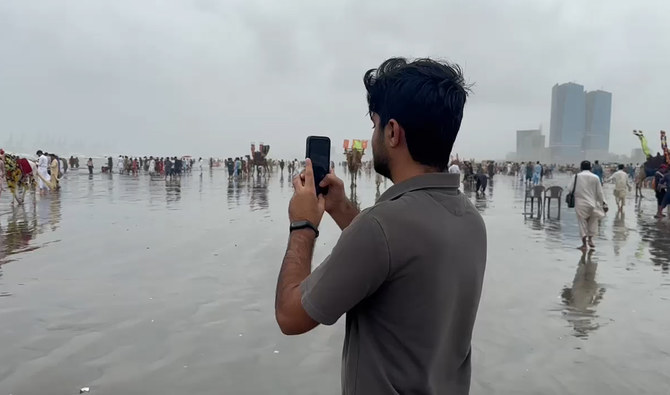
Infal Zafar, local tourist from Punjab province, takes photo at the beach during an interview with Arab News in Karachi on August 3, 2024. (AN Photo)
Short Url
Updated 04 August 2024
Follow

As Forbes ranks Karachi ‘second riskiest’ city for tourists, some residents can’t help but agree

  • According to data from police, 72 people were killed in street crimes in the first half of this year
  • Karachi’s newly appointed police chief blames “media overhype” for the city’s negative image

KARACHI: Haseeb Ullah Malik received this advice from his father two weeks ago as he prepared to leave for a trip to Karachi from Islamabad: 
“Don’t argue, just hand over your cellphone and wallet if you’re confronted by street criminals.”
After all, Malik was traveling to a city that was last month ranked by Forbes as the second-riskiest city for tourists, with a rating of 93.12 out of 100, second only to Venezuela’s Caracas, which had a score of 100, while Myanmar’s Yangon ranked third with a score of 91.67 out of 100.
Karachi, a metropolis of 20 million that hosts the stock exchange and central bank, has for decades been beset by armed violence. While an armed campaign led by the military against gangs and suspected militants in the city brought down crime rates after 2013, violence and crime rates have been on the rise again since last year, with shooting deaths in muggings and robberies once again becoming a daily headline. 


Police stand guard on a street during an interview with Arab News in Karachi on August 3, 2024. (AN Photo)

According to data from police, 72 people were killed in street crimes in Karachi in the first half of this year.
“I have heard on the news that there are incidents of phone snatchings in Karachi and if you argue, they shoot you,” Malik, the tourist from Islamabad, told Arab News.
Karachi resident Muhammad Masood Ahmed Usmani agreed.
“The perception of Karachi has become very negative. In all of the world, Karachi is considered a hotspot for crime, this is how it is understood,” Usmani told Arab News. 
“There is a lot of crime. Cars are being snatched, motorcycles are being stolen, people’s lives are being lost.”
“MEDIA OVERHYPE”
Karachi’s newly appointed police chief, Additional Inspector-General Javed Alam Odho, admitted crime in the city had increased but challenged the Forbes’ rating, blaming “media overhype” for the city’s negative image.
“It’s just hearsay that we’ve fallen behind cities like Timbuktu and Khartoum in Sudan,” Odho told Arab News. “I don’t think their [Forbes] rating is rational or logical.”
But Kashif Mushtaq, a prominent crime reporter in Karachi, disagreed with Odho, saying the media’s coverage of crime in Karachi reflected the ground realities. 
“I believe that what’s happening [on the ground] is exactly what the media is showing,” Mushtaq said. “And since it’s being highlighted, as it is the [commercial] hub [of the country], we [media] perhaps show it more.”


Kashif Mushtaq, a prominent crime reporter, works on his laptop at the Karachi Press Club during an interview with Arab News in Karachi on August 4, 2024. (AN Photo)

But some tourists have had a different experience. 
Infal Zafar, a local tourist from Punjab, said there was crime everywhere in the world and Karachi was no exception. 
“If you look at the news about street crime, many incidents are reported even from New York where people are killed,” he said. “But in Karachi, there are many places where you don’t feel scared. For example, I am here at Clifton Beach, it feels like I was in a completely free environment. There is no fear of anything. My mobile is in my pocket, and I am with my family.”
Muhammad Sufiyan, another visitor from Pakistan’s eastern city of Faisalabad, also said his nerves had been calmed after visiting several areas in the metropolis.
“From what we had heard in the media about violence, killings, and such things, it’s not like that at all in Karachi,” Sufyan told Arab News as he visited Sea View beach, arguably the city’s most popular hangout spot on weekends. 
“There is peace here, there are no issues.”
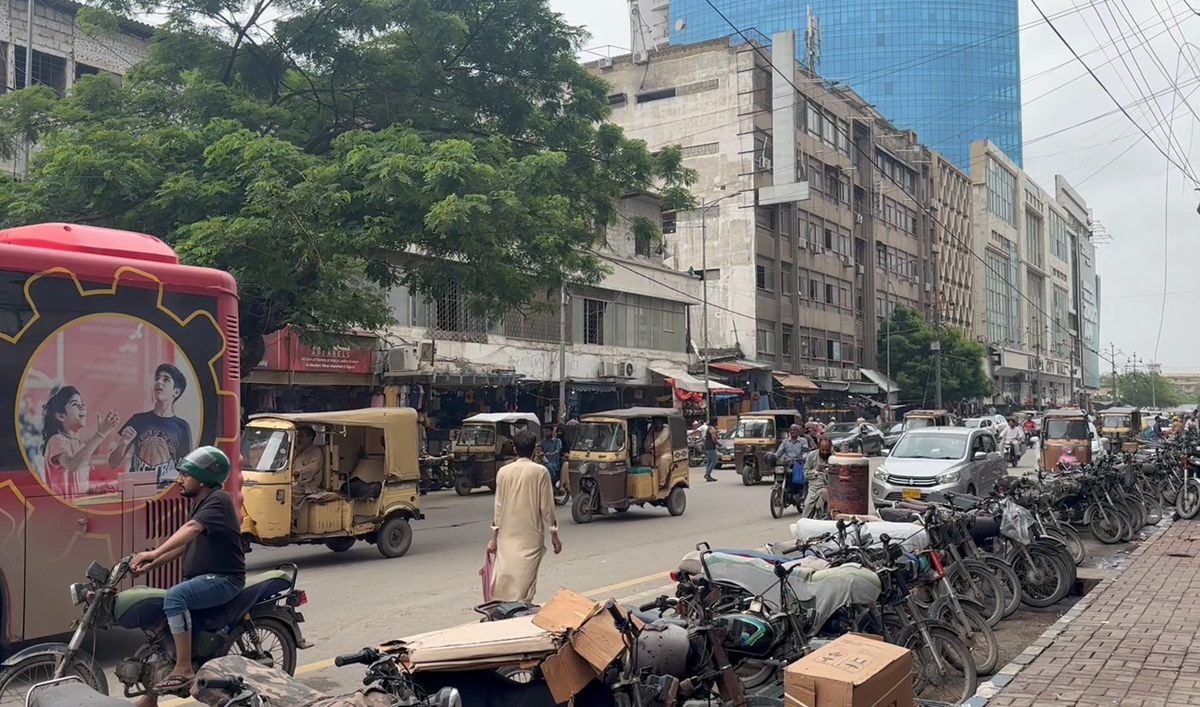


Commuters passing Zainab Market in Pakistan’s port city of Karachi on August 3, 2024. (AN Photo)


Pakistan stocks recover as oil supply fears ease after Islamabad seeks Red Sea route— analyst

Updated 05 March 2026
Follow

Pakistan stocks recover as oil supply fears ease after Islamabad seeks Red Sea route— analyst

  • Pakistan has sought Saudi help to secure oil supplies via Red Sea port after Iran’s closure of Strait if Hormuz
  • Analyst says higher crude oil prices, expectations of IMF releasing next loan tranche also triggered bullish activity

ISLAMABAD: Pakistani stocks marked a sharp recovery when trading closed on Thursday, as institutional activity increased following Islamabad’s move to seek crude oil supplies through the Red Sea port eased oil supply fears, a financial analyst said. 

Pakistani stocks have recorded a sharp decline this week, with the benchmark KSE-100 index recording its largest-ever single-day decline on Monday when it plunged 16,089 points. Escalating conflict in the Middle East triggered panic selling at the Pakistani bourse, forcing a temporary trading halt on Monday. 

The KSE-100 index, however, gained 3.49 percent or 5,433.46 points to close at 161,210.67 when trading ended on Thursday, up from the previous close of 155,777.21 points, according to Pakistan Stock Exchange’s (PSX) data.

Pakistan’s Petroleum Minister Ali Pervaiz Malik met Saudi Ambassador Nawaf bin Said Al-Malki on Wednesday to discuss Iran’s closure of the key Strait of Hormuz, which has threatened Pakistan’s energy supply. Roughly 20 percent of the global oil and gas supply passes through the route. Saudi Arabia indicated it could facilitate shipments through the Red Sea port of Yanbu, offering an alternative route if Gulf shipping lanes remain disrupted, the petroleum ministry said on Wednesday. 

“Stocks staged a sharp recovery at PSX amid institutional activity on easing fuel supply fears after KSA [Kingdom of Saudi Arabia] commits oil supplies through the Red Sea port,” Ahsan Mehanti, chief executive officer at Arif Habib Commodities, told Arab News.

He said higher global crude oil prices and expectations of the International Monetary Fund releasing its next tranche of the $7 billion loan for Pakistan also helped bullish activity at the PSX.

An IMF mission was in Pakistan to hold talks on the third review of a $7 billion Extended Fund Facility multi-year program, and for the second review of the $1.4 billion Resilience and Sustainability Facility this week.

However, the delegation left for Türkiye amid tensions in the Gulf. Pakistani officials have said talks are likely to continue virtually in the coming days. 

Pakistani brokerage Topline Securities said in its daily market review report that strong institutional buying “turned the tide” on Thursday after the market’s recent overreaction to regional issues.

The report added that Hub Power Company (HUBC), Oil & Gas Development Company (OGDC), Fauji Fertilizer Company (FFC), Engro Corporation (ENGROH), and Meezan Bank Limited (MEBL) collectively contributed 2,197 points to the KSE benchmark’s gain.

Topline Securities said 723 million shares were traded on Thursday, with K-Electric Limited (KEL) stealing the spotlight as more than 1.17 billion shares changed hands.

Pakistani investors are closely monitoring developments in the Gulf, particularly around energy routes and further retaliatory actions, as the conflict’s trajectory remains uncertain.