

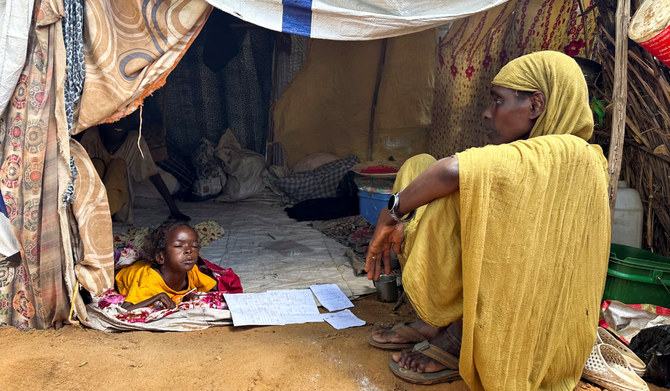

WASHINGTON: The newly confirmed famine at one of the sprawling camps for war-displaced people in Sudan’s Darfur region is growing uncontrolled as the country’s combatants block aid, and it threatens to grow bigger and deadlier than the world’s last major famine 13 years ago, US officials warned on Friday.
The US Agency for International Development, the UN World Food Program and other independent and government humanitarian agencies were intensifying calls for a ceasefire and aid access across Sudan. That’s after international experts in the Famine Review Committee formally confirmed Thursday that the starvation in at least one of three giant makeshift camps, holding up to 600,000 people displaced by Sudan’s more than yearlong war, had grown into a full famine.
BACKGROUND
The last major famine, in Somalia, was estimated to have killed a quarter of a million people in 2011, half of them children under 5 years old.
Two US officials briefed reporters on their analysis of the crisis on Friday following the famine finding, which is only the third in the 20-year history of the Famine Review Committee. The US officials spoke on the condition of anonymity as the ground rules for their general briefing.
The last major famine, in Somalia, was estimated to have killed a quarter of a million people in 2011, half of them children under 5 years old.
The blocks that Sudan’s warring sides are putting on food and other aid for the civilians trapped in the Zamzam camp are realizing “the worst fears of the humanitarian community,” one of the US officials said.
War in the northern African country erupted in April 2023 when two rival generals, both with international backers, suddenly opened a deadly battle for control of Sudan’s capital, sidelining an existing civilian transitional government that Sudanese had hoped would bring stability to the country. On one side, the Rapid Support Forces, or RSF, grew out of the Janjaweed militias notorious for their mass attacks, rape and forced displacement of civilians in Darfur in 2003.
As most of the world paid attention to conflicts in Ukraine and Gaza and the larger Middle East, the Sudanese war quickly grew into the world’s largest humanitarian crisis, with 11 million displaced. Unlike the earlier war, acute hunger is almost countrywide.
Aid workers were last able to get humanitarian relief to the trapped civilians at the camps in Darfur in April. The RSF has the area under siege and is accused of attacking hospitals, camps and other civilian targets.
World Food Program director Cindy McCain urged the international community in a statement after the famine declaration to work for a ceasefire. “It is the only way we will reverse a humanitarian catastrophe that is destabilizing this entire region of Africa,” she said.
USAID Director Samantha Power stressed the famine was entirely man-made. Both sides, “enabled by external patrons, are using starvation as a weapon of war,” she said in a statement.
The US officials Friday pointed to Washington as the largest source of aid — the little that gets through — for Sudan. They countered questions about why the Biden administration was not using air drops or any of the other direct interventions by the US military to get food to people in Darfur that they were in Gaza, saying the terrain in Sudan was different.
The United States and Saudi Arabia have invited the two sides for ceasefire talks in Switzerland in August. The RSF leader said it planned to attend, while the military-controlled Sudanese government stated that any negotiation before implementing the Jeddah Declaration “wouldn’t be acceptable to the Sudanese people.”
The Jeddah Declaration of Commitment to Protect Civilians passed last year meant to end the conflict, but neither side committed to its objectives.
International experts use set criteria to confirm the existence of famines. Formal declarations of famines are usually made by the countries themselves or the United Nations, and politics often slows such declarations.


