

Filipino-American teens run mobile library to support literacy in Mindanao

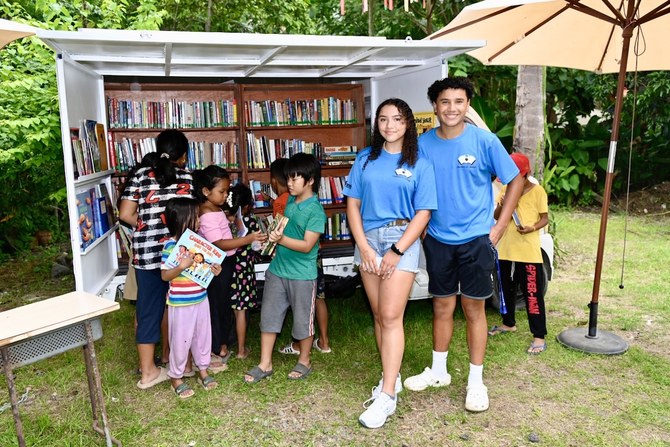
Arianna and Oliver Horsup launch their mobile library Chapters of Change in Misamis Oriental province, Philippines, June 27, 2024. (David Horsup)
Short Url
Updated 02 August 2024
Follow

Filipino-American teens run mobile library to support literacy in Mindanao

  • Grandchildren of Filipino journalist Ben Emata Jr. set up mobile library in his home province Misamis Oriental
  • Launched on June 27, the mobile library has over 5,000 books and hopes to reach 300 children a week

MANILA: Brought up in the US, Arianna and Oliver Horsup knew their grandfather was one of the pioneers of Philippine community journalism, but it was only last year, during a trip to his ancestral province, that they learned more and found a way to honor his legacy.

When they traveled across the impoverished rural areas of Misamis Oriental in Northern Mindanao, they realized how other children had limited access to quality education and often had to walk far to even get to their schools. The teenagers thought they could help by bringing educational materials straight to their homes.

Chapters of Change, a mobile library with over 5,000 books in its inventory, began its journey on June 27, from Cagayan de Oro, the hometown of their late grandfather, Ben Emata Jr.

A reporter and editor, Emata ran the local publication Mindanao Reporter, which was shut down during a press clampdown under martial law in 1972.

“Oliver and Arianna knew that their grandfather, Ben Emata, Jr., was a renowned journalist in the area. He was the only journalist who was on local TV, radio and newspaper at the time. They were surprised to find that locals and reporters still remember him fondly,” the teenagers’ father, David Horsup, told Arab News.

“When we visited the rural areas of Misamis Oriental, Oliver and Arianna noticed that the schools were few and far between. They asked how children went to school. We informed them that in certain areas, children have to walk great distances to attend school. Arianna wanted to find a way to help others break the cycle of poverty for generations by increasing access to literature, specifically, in English comprehension.”

When the Horsups returned home from their trip, Arianna spent the rest of her summer researching how to establish a charity. Chapters of Change was registered in Texas in July last year.

The 15-year-old also handpicked members of the board, which included family members and people from her community, including her former Filipino middle school teacher.

Chapters of Change also became a literacy partner under the Barbara Bush Literacy Foundation in the US, which helped the charity in its early stages by exposing it to a network of other nonprofit organizations.

“It has also provided our organization with a degree of credibility, which is helpful, especially when dealing with corporations,” David said.

“Once we obtained the necessary certifications to become a charity at the state and federal level, we immediately set in motion several fundraising events. Our goal was to acquire and retrofit a vehicle to create the Chapters of Change mobile library.”

Most of the books were donated by famous children’s book authors in the US from schoolbook drives, while the organization approached businesses for sponsorships and ran a GoFundMe page to set the library up.

At the moment, Chapters of Change is run on the ground by a Misamis Oriental-based board member, a lawyer and philanthropist who mobilizes a group of volunteers, with plans to hire a full-time library manager in the next few months.

The mobile library aims to eventually reach 300 children a week when it reaches full operations, stopping at one village or school a day where children can borrow books and return them when the mobile library returns. The organization is working out a route for the mobile library to regularly drop by, allowing children to routinely check out and return books.

As a high school freshman back in Houston, Arianna, 15, and her younger brother are learning the ins and outs of running a charity while balancing their teenage lives.

“Our vision is to improve literacy,” Arianna told Arab News.

“I try to make time based on my priorities and section my time for education, sports, volunteering, and personal (things). It was hard having to cut time from my personal life, but it was well worth it!”


India accelerates free trade agreements against backdrop of US tariffs

Updated 21 December 2025
Follow

India accelerates free trade agreements against backdrop of US tariffs

  • India signed a CEPA with Oman on Thursday and a CETA with the UK in July 
  • Delhi is also in advanced talks for trade pacts with the EU, New Zealand, Chile 

NEW DELHI: India has accelerated discussions to finalize free trade agreements with several nations, as New Delhi seeks to offset the impact of steep US import tariffs and widen export destinations amid uncertainties in global trade. 

India signed a Comprehensive Economic Partnership Agreement with Oman on Thursday, which allows India to export most of its goods without paying tariffs, covering 98 percent of the total value of India’s exports to the Gulf nation. 

The deal comes less than five months after a multibillion-dollar trade agreement with the UK, which cut tariffs on goods from cars to alcohol, and as Indian trade negotiators are in advanced talks with New Zealand, the EU and Chile for similar partnerships. 

They are part of India’s “ongoing efforts to expand its trade network and liberalize its trade,” said Anupam Manur, professor of economics at the Takshashila Institution. 

“The renewed efforts to sign bilateral FTAs are partly an after-effect of New Delhi realizing the importance of diversifying trade partners, especially after India’s biggest export market, the US, levied tariff rates of up to 50 percent on India.” 

Indian exporters have been hit hard by the hefty tariffs that went into effect in August. 

Months of negotiations with Washington have not clarified when a trade deal to bring down the tariffs would be signed, while the levies have weighed on sectors such as textiles, auto components, metals and labor-intensive manufacturing. 

The FTAs with other nations will “help partially in mitigating the effects of US tariffs,” Manur said. 

In particular, Oman can “act as a gateway to other Gulf countries and even parts of Eastern Europe, Central Asia, and Africa,” and the free trade deal will most likely benefit “labor-intensive sectors in India,” he added. 

The chances of concluding a deal with Washington “will prove to be difficult,” said Arun Kumar, a retired economics professor at the Jawaharlal Nehru University.

“With the US, the chances of coming to (an agreement) are a bit difficult, because they want to get our agriculture market open, which we cannot do. They want us to reduce trade with Russia. That’s also difficult for India to do,” he told Arab News.  

US President Donald Trump has threatened sanctions over India’s historic ties with Moscow and its imports of Russian oil, which Washington says help fund Moscow’s ongoing war with Ukraine.

“President Trump is constantly creating new problems, like with H-1B visa and so on now. So some difficulty or the other is expected. That’s why India is trying to build relationships with other nations,” Kumar said, referring to increased vetting and delays under the Trump administration for foreign workers, who include a large number of Indian nationals. 

“Substituting for the US market is going to be tough. So certainly, I think India should do what it can do in terms of promoting trade with other countries.” 

India has free trade agreements with more than 10 countries, including comprehensive economic partnership agreements with South Korea, Japan, and the UAE.

It is in talks with the EU to conclude an FTA, amid new negotiations launched this year for trade agreements, including with New Zealand and Chile.  

India’s approach to trade partnerships has been “totally transformed,” Commerce and Industry Minister Piyush Goyal said in a press briefing following the signing of the CEPA with Oman, which Indian officials aim to enter into force in three months. 

“Now we don’t do FTAs with other developing nations; our focus is on the developed world, with whom we don’t compete,” he said. “We complement and therefore open up huge opportunities for our industry, for our manufactured goods, for our services.”