LONDON: Former BBC TV news presenter Huw Edwards, a household name in Britain, pleaded guilty on Wednesday to three counts of making indecent pictures of children.
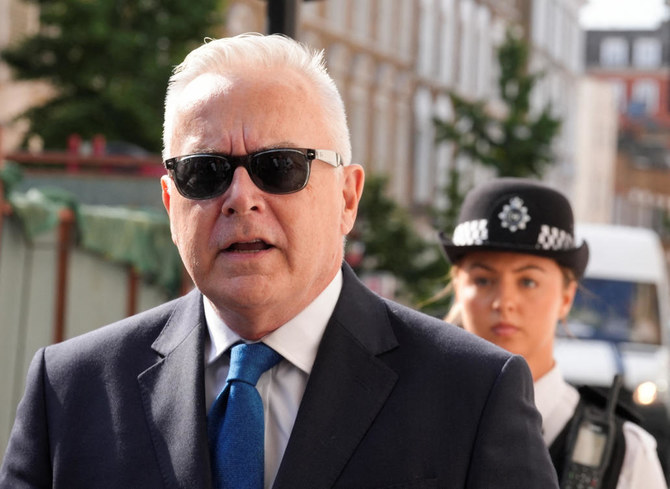
Edwards, 62, who was the BBC’s highest paid journalist and top news anchor until he quit in April, had arrived at London’s Westminster Magistrates’ Court wearing sunglasses through a throng of photographers and camera crews.
After confirming his identity, he was asked if he wished to indicate a plea to the three charges, which relate to three different categories of indecent images. Edwards said: “Guilty.”
Judge Paul Goldspring said Edwards would be sentenced on Sept. 16.
During the 25-minute hearing, prosecutor Ian Hope said the 41 still or moving images had been sent to Edwards by an adult male on WhatsApp between December 2020 and August 2021.
Hope added that seven of the 41 images were of the most serious kind and that two of that seven were pornographic videos of a child possibly aged seven and nine years old.
Edwards’ lawyer Philip Evans emphasized that the charges to which his client had indicated guilty pleas related only to images that were sent to him via WhatsApp.
“There is no suggestion in this case that Mr.Edwards has in any way made, in the traditional sense of the word, any images in any physical way or created any images of any sort,” Evans said.
Edwards, who announced the death of Queen Elizabeth to the nation in 2022 and led coverage of elections, royal weddings and the 2012 Olympics, has not been on TV screens for a year and the court appearance was his first in public since then.
He quit in April on medical advice after newspaper allegations last year that he had paid a young person thousands of pounds for sexually explicit photos.

Ex-BBC news presenter Huw Edwards pleads guilty to indecent child pictures charges
https://arab.news/rh3jj
Ex-BBC news presenter Huw Edwards pleads guilty to indecent child pictures charges
- The Welsh journalist pleaded guilty to all three counts
- Sentence to be indicated on Sept. 16
Media watchdog urges probe after gunmen attack home of Pakistani journalist
- Ihsan Khattak’s home came under fire by gunmen in February
- CPJ, 17 rights groups say legal and other changes causing ‘fear’
LONDON: Media watchdog the Committee to Protect Journalists on Friday urged Pakistani authorities to investigate a shooting attack on the home of journalist Ihsan Khattak.
On Feb. 12, at about 9:45 p.m., unidentified gunmen opened fire on the main gate of Khattak’s house in Kotka Jandar Khel village in Khyber Pakhtunkhwa’s Bannu district. The assailants fled and Khattak was not injured.
“Pakistani authorities must thoroughly investigate the attack on Ihsan Khattak’s home, identify the gunmen, and hold them to account,” said the CPJ’s Asia-Pacific Director Beh Lih Yi.
“Khyber Pakhtunkhwa has become increasingly dangerous for journalists and this type of brazen intimidation cannot stand. Journalists must be able to work safely so they can provide the public with information.”
Khattak, a Bannu-based correspondent for ARY News and former president of the Bannu Press Club, has faced threats before.
On Feb. 5, three armed men on a motorbike followed him from a reporting assignment, forcing him to speed away in his car, he told the CPJ.
In 2017, after receiving threats from an unknown caller, he relocated to Islamabad. He said the threats resumed after he returned to Bannu in 2023.
Bannu Deputy Inspector General of Police Sajjad Khan told the CPJ that an investigation had been opened into the shooting and that police were committed to ensuring journalists’ security.
The incident comes as the CPJ and 17 other press freedom and human rights groups this week urged Prime Minister Shehbaz Sharif to take urgent steps to “uphold the country’s constitutional and international obligations” to protect media freedom.
They warned that recent legal and institutional changes, combined with “persistent failures” to hold perpetrators accountable, have deepened a climate of fear for journalists.
Pakistan, ranked 158th in the 2025 press freedom index, is considered one of the world’s most dangerous countries for journalists, with growing self-censorship, digital controls and widespread impunity for attacks on media workers.
The appeal also follows a sharp escalation in regional tensions: on Friday, Pakistan said it had carried out strikes on Taliban government forces in several Afghan cities — its first direct attacks on its former allies —describing the situation as “open war.”


