Pakistan eyes advanced manufacturing technologies in next stage of corridor project with China

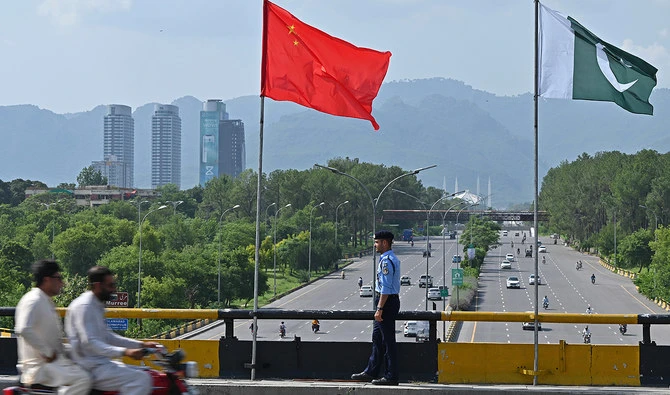
In this file photo, taken on July 30, 2023, a policeman stands guard under the national flags of China and Pakistan along a road, during the visit of Chinese Vice Premier He Lifeng last month, in Islamabad. (AFP/File)
Short Url
Updated 31 July 2024
Follow

Pakistan eyes advanced manufacturing technologies in next stage of corridor project with China

  • Pakistan’s planning minister says China will help train 200,000 Pakistani youth annually in IT skills
  • Ahsan Iqbal says Pakistan’s future depends on increasing exports from $30 billion to $100 billion

ISLAMABAD: Pakistan’s Planning Minister Ahsan Iqbal on Wednesday expressed optimism the next phase of the China-Pakistan Economic Corridor (CPEC) would bring advanced manufacturing technologies to the country that would help strengthen its industrial base and create more employment opportunities.
CPEC, a collection of multibillion-dollar infrastructure projects in Pakistan funded by China, is a major part of Beijing’s Belt and Road Initiative, aimed at increasing trade and stimulating economic growth across Asia and beyond.
The first phase of the corridor project primarily concentrated on addressing Pakistan’s energy shortage and included the construction of roads and railways to improve connectivity.
The second phase, often referred to as CPEC 2.0, aims to develop special economic zones, improve transportation networks and the promote industrial cooperation between China and Pakistan to foster economic development.
“CPEC 2.0 represents a broader and more ambitious scope,” Iqbal said while addressing an event in Islamabad. “This new phase will bring advanced manufacturing technologies to Pakistan, enhance our industrial base and create numerous job opportunities for our youth.”
Iqbal said the focus in the next CPEC stage was going to shift beyond infrastructure development to industrial relocation, agricultural modernization, cooperation in science and technology, job creation and enhancing the socioeconomic well-being of people.
He maintained Pakistan wanted to improve food security and uplift farmers’ livelihood through CPEC 2.0, adding it would ensure a sustainable and prosperous future for the agriculture sector by adopting modern production techniques and technologies.
He also noted that China-Pakistan cooperation in the fields of science and technology would drive innovation, fostering a knowledge-based economy in the latter country that would be able to compete globally.
“With the help of China, we will have 200,000 youth trained annually in information technology-related skills that will provide Pakistan the human resource that is necessary to leverage the full potential of our youth to make Pakistan an information powerhouse,” he added.
The minister hoped that CPEC 2.0 would help attract foreign direct investment in export-oriented industries, making Pakistan a reliable destination for exports.
“Our future lies in how fast we go from $30 billion to $100 billion export and creating a sound macroeconomic platform,” he added.
Iqbal explained the trust of international investors depended on four prerequisites that every successful economy had to achieve.
“These are establishing peace, ensuring political stability, safeguarding the continuity of economic policies and demonstrating continuous commitment to reform,” he added.
The minister said the development of Gwadar Port and Free Trade Zone under CPEC 2.0 could further promote regional connectivity and economic integration.
He reiterated the next CPEC stage would herald a shift from a government-to-government model to a business-to-business framework, inviting greater private sector participation and involvement.
Pakistan discovers new oil, gas reserves in push to cut costly imports

Updated 5 sec ago
Follow

Pakistan discovers new oil, gas reserves in push to cut costly imports

  • Exploration firm announces modest discovery of 225 barrels of oil, 1.01 MMSCFD of gas per day
  • Multiple discoveries together could boost domestic production and reduce reliance on imports

ISLAMABAD: Pakistan has announced a modest discovery of new oil and gas reserves in its northwestern Khyber Pakhtunkhwa (KP) province, state media reported on Friday, amid the country efforts to boost exploration to cut costly imports.

Pakistan faces a widening energy gap due to rising demand and limited domestic output, forcing reliance on costly fuel imports that expose the economy to global price swings. Its petroleum, oil, and lubricants import bill fell 4.39 percent to $9.046 billion in July 2025-January 2026.

The discovery was made at Lumshiwal Formation of Baragzai X-01 exploratory well. During Cased Hole Drill Stem Test (CHDST-04) conducted in the Hangu and Lumshiwal formations, the well produced 225 barrels of oil per day (BOPD) and 1.01 million standard cubic feet per day (MMSCFD) of gas through a 32/64’’ choke at a wellhead flowing pressure of 190 psig.

“Baragzai X-01 (Slant) was spudded on December 30, 2024, as an exploratory well to assess the hydrocarbon potential of multiple formations, including Lockhart, Hangu, Lumshiwal, Samana Suk, Shinawari, Datta and Kingriali.

The well was successfully drilled to a total depth of 5,170 meters into the Kingriali Formation,” the state-run APP news agency reported, citing the Oil and Gas Development Company (OGDC).

“Based on wireline log evaluations, three earlier cased hole drill stem tests were conducted in the Kingriali, Datta, and Samana Suk plus Shinawari formations, which also resulted in oil and gas discoveries. The latest test over Lumshiwal further confirms the commercial viability and hydrocarbon prospectivity of the block.”

The discovery was made under the Nashpa Exploration License. OGDC has a 65 percent working interest in the license, in partnership with Pakistan Petroleum Limited (30 percent) and Government Holdings Private Limited (5 percent).

“This discovery will strengthen Pakistan’s energy security by enhancing indigenous hydrocarbon production,” the exploration firm said. “It will add to the reserves base of OGDC and its joint venture partners while contributing toward narrowing the country’s energy supply-demand gap.”

Pakistan has reported several oil and gas discoveries recently. Although modest individually, their combined potential could boost domestic production and reduce reliance on imported energy.

In January, a discovery regarding an exploratory well, flowing at the rate of 4,100 barrels of oil per day (BOPD) and 10.5 million standard cubic feet per day (MMSCFD) of gas, was made in Kohat. In September 2025, Pakistan Petroleum Limited announced a discovery in Attock district, while Mari Energies reported a new gas find in North Waziristan.

Pakistan’s Sindh province dominates gas production with a 62 percent share and contributes 40 percent to oil output, while Khyber Pakhtunkhwa accounts for 41 percent of crude oil production. Punjab produces 18 percent of the nation’s oil, and Balochistan contributes just one percent, according to Topline Securities.