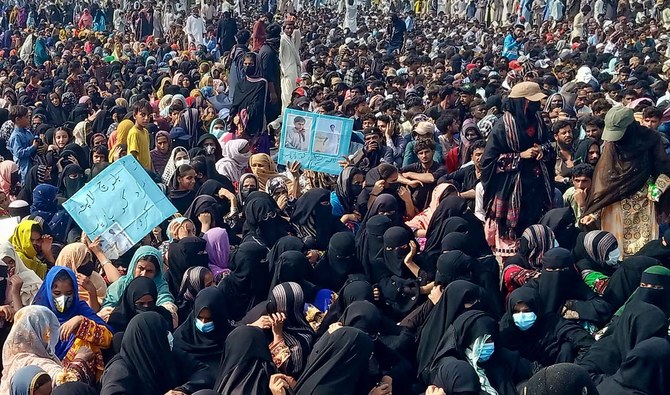

ISLAMABAD/QUETTA: A Pakistani sepoy was killed and 16 other soldiers, including an officer, were injured in attacks by a “violent mob in garb of so-called Baloch Raji Muchi,” the military said, referring to an ethnic rights protest movement in the southwestern province of Balochistan.
The Baloch Yakjehti Committee (BYC), which advocates for the rights of the ethnic Baloch people, summoned the ‘Baloch Raji Muchi,’ or Baloch National Gathering, in Balochistan’s Gwadar port city on Sunday against alleged human rights abuses, extra-judicial killings and enforced disappearances in Balochistan that rights activists and the families of victims blame on Pakistani security forces. The government and security agencies deny involvement.
On Saturday, more than a dozen protesters who were en route to Gwadar for Sunday’s gathering were injured in clashes with security forces in the Mastung district, officials and protesters said, amid a shutdown of Internet, mobile phone and broadband services in parts of Balochistan. Gulzar Dost Baloch, a BYC member who was leading a caravan in Quetta, said supporters were leaving Mastung for Gwadar when “security forces attacked the buses with straight gun fire.” The BYC says one protester was killed in the clashes.
But in a statement released on Monday, the Pakistani military’s media wing said a Pakistan soldier was killed and 16 others were injured in “unprovoked assaults by the violent protesters.”
“Fake and malicious propaganda is being spread on social media using doctored pictures and videos by the propagandists to gain sympathy and support for the unlawful violent march,” the army said.
“The violent actions of the mob are unacceptable and those responsible will be brought to justice. All citizens are urged not to fall prey to the propaganda, remain calm and peaceful, and to cooperate with law enforcement agencies in maintaining public safety and order,” the military added, vowing that it would thwart any “attempts of sabotaging peace and stability of Balochistan.”
Shortly after the army’s statement, the BYC said on X the Pakistani Army and paramilitary FC soldiers had “launched another brutal and violent attack on the peaceful Baloch National Gathering sit-in in Gwadar” and were firing “indiscriminately upon peaceful protesters.” It reported “multiple injuries and the arrest of hundreds,” which could not be independently verified by Arab News.
“FOREIGN HAND“
Pakistan’s Balochistan province, which borders Iran and Afghanistan, is the site of a low-level insurgency for the last two decades by separatists who say they are fighting what they see as the unfair exploitation of the province’s wealth by the federation. The Pakistani state denies the allegation and says it works for the uplift of the impoverished province. The government and army have often blamed neighbors India, Afghanistan and Iran of stoking tensions in Balochistan and funding the insurgency, which they deny.
On Friday, authorities blocked all entry and exit points of the provincial capital of Quetta, and imposed Section 144 of the Code of Criminal Procedure, that prohibits the assembly of four or more people, in parts of the province as BYC supporters attempted to leave for the Gwadar protest, which is being led by activist Dr. Mahrang Baloch. Protesters subsequently staged sit-ins on key highways in Quetta, Mastung, Kech and Turbat districts.
On Monday, the BYC gave the provincial government 48 hours to release all its detained members or else it would expand its ongoing protests, now in their third day, across Balochistan.
“If the government doesn’t accept our demands, we will expand our protests across Balochistan,” Beberg Baloch, a BYC leader who is leading the protests in Mastung, told Arab News on Monday, adding that the group wanted all its arrested members released within 48 hours and provincial highways opened so people could move freely to protest sites.
Deputy Commissioner Quetta Saad Bin Asad said on Monday 22 people had been arrested in the provincial capital as they were disrupting traffic by blocking a main road.
Gwadar, situated along the Arabian Sea, lies at the heart of China-Pakistan Economic Corridor (CEPC), under which Beijing has funnelled tens of billions of dollars into massive transport, energy and infrastructure projects in Pakistan. But the undertaking has been hit by Islamabad struggling to keep up its financial obligations as well as attacks on Chinese targets by militants in Balochistan and elsewhere in the country.
Balochistan Home Minister Meer Ziaullah Langove said the latest protests were a “conspiracy” against CPEC, alleging a “foreign hand” in instigating the protests.
“Despite being attacked by the protesters, people of Balochistan, police, and security forces have shown restraint to maintain peace,” Langove told Arab News.
“The government considers the protesters as our brothers and sisters, we have to treat them with respect and we are ready to talk with them,” Langove added. “But defaming the state and [playing] personal politics on these [rights] issues has escalated the tensions.”
Meanwhile, life in various cities of Balochistan remained at a standstill for a third consecutive day, with protesters still blocking highways N-25 Quetta- Karachi, M-8 Turbat- Hoshab and a coastal highway that connects Gwadar with Pakistan’s commercial hub of Karachi.