Pakistan government vows action after death threats to top judge over ‘blasphemy’ accusations

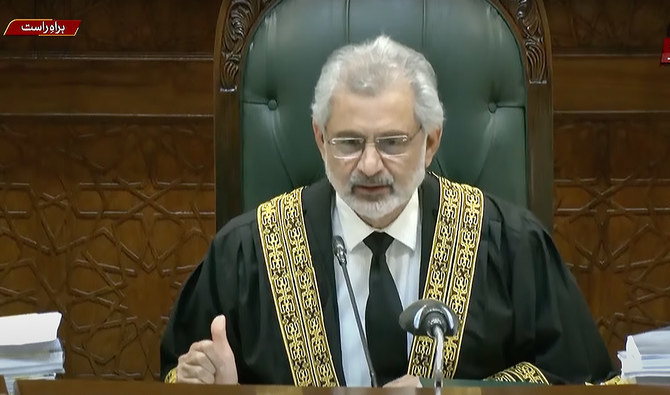
A screengrab taken on October 11, 2023 from PTV News shows Pakistan's chief justice Qazi Faez Isa announcing the verdict on the petitions against the Supreme Court (Practice and Procedure) Act 2023 in Islamabad, Pakistan. (PTV News/News)
Short Url
Updated 29 July 2024
Follow

Pakistan government vows action after death threats to top judge over ‘blasphemy’ accusations

  • Recent video shows right-wing Tehreek-e-Labbaik Pakistan leader offering reward for anyone who kills chief justice
  • Police case filed against TLP Vice Emir Pir Zaheerul Hasan Shah, other party members for incitement to violence

ISLAMABAD: Pakistani Defense Minister Khawaja Asif on Monday warned that the state would take action against leaders of an ultraconservative religious-political group for issuing death threats against the country’s top judge over allegations he had committed blasphemy, with police registering a case against several party members. 

The development comes a day after the release of a video by a leader of the Tehreek-e-Labbaik Pakistan (TLP) party in which he was heard announcing a reward of Rs1,00,00,000 [$35,953] for anyone who killed Chief justice Qazi Faez Isa. 

In February this year, hundreds of supporters from religious groups led by the TLP rallied to protest against what they said were blasphemous remarks by Isa in a case against a member of the minority Ahmadi community. Following the protests, the Supreme Court had released a statement calling the “impression” of blasphemy “absolutely wrong” and deploring the “vicious campaign” against Isa.

The protests were held after Isa granted bail to a member of the minority Ahmadi community who has been accused of blasphemy for distributing Islamic literature and been in jail for 13 months.

“I think there isn’t a bigger [example] of contempt of religion than to issue such statements in the name of a religion [Islam] which is one of mercy and blessings,” Asif told reporters at a news conference, commenting on the TLP member’s death threat against Isa. 

“The state will take action over it because this is all based on lies … The state will not accept dictation from any group in the name of religion, politics or someone’s self-interests.”

Planning Minister Ahsan Iqbal, who addressed the press conference with Asif, said issuing death threats was an act of “rebellion” not only against Pakistan’s constitution but also against Islam. 

“Pakistan has its courts, it has its law, and no person or group is allowed to issue fatwas [religious rulings] for anyone’s murder,” he said. “Because the right to reward or punish rests with the judiciary in a state.”

Iqbal accused the TLP of inciting hatred for political gains and urged the people of Pakistan not to pay heed to the party. 

A police report seen by Arab News showed a case had been filed on Sunday against TLP Vice Emir Pir Zaheerul Hasan Shah and other party members for incitement to violence against the chief justice. The police report invokes provisions of the Anti-Terrorism Act, and others related to spreading religious hatred and anarchy, pressuring and threatening the higher judiciary, interference in state affairs, obstructing in performance of legal duties, among others.

Human rights groups say Pakistan’s harsh blasphemy laws are often misused to settle personal scores, and mere accusations have led to violence and mob justice in the past. 


UN torture expert decries Pakistan ex-PM Khan’s detention

Updated 12 December 2025
Follow

UN torture expert decries Pakistan ex-PM Khan’s detention

  • Khan’s party alleges government is holding him in solitary confinement, barring prison visits
  • Pakistan’s government rejects allegations former premier is being denied basic rights in prison

GENEVA: Pakistan’s former prime minister Imran Khan is being held in conditions that could amount to torture and other inhuman or degrading treatment, the United Nations’ special rapporteur on torture warned Friday.

Alice Jill Edwards urged Pakistan to take immediate and effective action to address reports of the 73-year-old’s inhumane and undignified detention conditions.

“I call on Pakistani authorities to ensure that Khan’s conditions of detention fully comply with international norms and standards,” Edwards said in a statement.

“Since his transfer to Adiala Jail in Rawalpindi on September 26, 2023, Imran Khan has reportedly been held for excessive periods in solitary confinement, confined for 23 hours a day in his cell, and with highly restricted access to the outside world,” she said.

“His cell is reportedly under constant camera surveillance.”

Khan an all-rounder who captained Pakistan to victory in the 1992 Cricket World Cup, upended Pakistani politics by becoming the prime minister in 2018.

Edwards said prolonged or indefinite solitary confinement is prohibited under international human rights law and constitutes a form of psychological torture when it lasts longer than 15 days.

“Khan’s solitary confinement should be lifted without delay. Not only is it an unlawful measure, extended isolation can bring about very harmful consequences for his physical and mental health,” she said.

UN special rapporteurs are independent experts mandated by the Human Rights Council. They do not, therefore, speak for the United Nations itself.

Initially a strong backer of the country’s powerful military leadership, Khan was ousted in a no-confidence vote in 2022, and has since been jailed on a slew of corruption charges that he denies.

He has accused the military of orchestrating his downfall and pursuing his Tehreek-e-Insaf (PTI) party and its allies.

Khan’s supporters say he is being denied prison visits from lawyers and family after a fiery social media post this month accusing army leader Field Marshal Asim Munir of persecuting him.

According to information Edwards has received, visits from Khan’s lawyers and relatives are frequently interrupted or ended prematurely, while he is held in a small cell lacking natural light and adequate ventilation.

“Anyone deprived of liberty must be treated with humanity and dignity,” the UN expert said.

“Detention conditions must reflect the individual’s age and health situation, including appropriate sleeping arrangements, climatic protection, adequate space, lighting, heating, and ventilation.”

Edwards has raised Khan’s situation with the Pakistani government.