

Pakistan backs goal of $2 trillion intra-Commonwealth trade by 2030

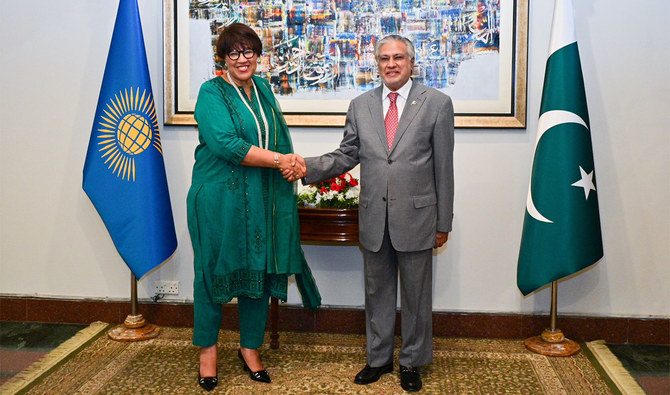
Secretary general of the Commonwealth of Nations, Patricia Scotland (left), meets Pakistani Deputy Prime Minister Ishaq Dar at Foreign Office of Pakistan in Islamabad, Pakistan on July 29, 2024. (MOFA/X)
Short Url
Updated 29 July 2024
Follow

Pakistan backs goal of $2 trillion intra-Commonwealth trade by 2030

  • Commonwealth secretary general Patricia Scotland on five-day visit to Pakistan
  • Scotland is first woman to hold the post of Commonwealth secretary general

ISLAMABAD: Deputy Prime Minister Ishaq Dar on Monday expressed Pakistan’s support for the Commonwealth’s goal to boost trade between member states to $2 trillion by 2030 as the South Asian nation struggles to position itself as a regional trade hub. 

Commonwealth secretary general Patricia Scotland kicked off a five-day visit to Pakistan with a meeting with Dar in Islamabad, with discussions focusing on climate change, women and youth empowerment, development and education. The two leaders also spoke about the Commonwealth Connectivity Agenda for Trade and Investment (CCA), established at the 2018 Commonwealth Heads of Government Meeting, where Commonwealth leaders committed to the vision of increasing intra-Commonwealth trade to $2 trillion by 2030, as well as expanding intra-Commonwealth investment. 

CAA is a platform for countries to exchange best practices and experiences to trade and investment and undertake domestic reforms through digitalization. 

“Pakistan supports the Commonwealth target of increasing trade between member countries to two trillion [dollars] by 2030. It envisions itself as a regional hub for trade,” Dar said on Monday while addressing a joint presser with Scotland. 

“Madam’s vision of two trillion intra-Commonwealth trade is praiseworthy and achievable.”

Speaking about regional connectivity and trade efforts, Dar said Pakistan was working with Uzbekistan for railway connectivity between the two countries and in dialogue with Turkmenistan regarding the proposed Turkmenistan to India pipeline called TAPI. 

Turkmenistan, a Central Asian republic sitting on the world’s fourth-largest natural gas reserves, wants to build the pipeline as part of its plans to diversify sales from Soviet-era master Russia to energy-hungry markets in Asia and Europe. The idea of the 1,700-km (1,056-mile) TAPI pipeline was first raised in the mid-1990s, but has never been realized.

Pakistan and India, which would consume most of the gas supplied via the pipeline, have previously said they are close to signing a supply deal with Turkmenistan. Previous timeframes have passed without an agreement being struck.

Pakistan hopes to leverage its strategic geopolitical position and enhance its role as a pivotal trade and transit hub connecting the landlocked Central Asian republics with the rest of the world. In recent months, there has been a flurry of visits, investment talks, and economic activity between Pakistan and Central Asian states and meetings with leaders from Uzbekistan, Azerbaijan, Tajikistan, and Turkmenistan.


China condemns Islamabad suicide blast, pledges support for Pakistan

Updated 5 sec ago
Follow

China condemns Islamabad suicide blast, pledges support for Pakistan

  • Suicide blast targeting imambargah in Pakistan’s capital this week killed at least 32, injured 150
  • Chinese foreign ministry says Beijing supports Pakistan in safeguarding its national security, people

ISLAMABAD: China’s foreign ministry spokesperson on Sunday condemned the Islamabad suicide bombing this week that killed 32 people and injured several others, expressing support for Pakistan in safeguarding its national security and protecting its people. 

Officials confirmed at least 32 people were killed and 150 injured on Friday when a suicide blast targeted the Qasr-e-Khadijatul Kubra mosque and imambargah in the Tarlai Kallan area located on Islamabad’s outskirts. 

The blast occurred during Friday prayers, when mosques around the country are filled with worshippers. A regional Daesh affiliate said one of its members had targeted the mosque by detonating an explosive vest. 

“China is deeply shocked by the deadly explosion in Pakistan’s capital Islamabad and the heavy casualties it has inflicted,” the Chinese foreign ministry spokesperson’s statement said.

“China strongly condemns the attack, opposes any form of terrorism and firmly supports the Pakistani government in safeguarding national security and stability and protecting the safety of the people.”

Pakistan’s Interior Minister Mohsin Naqvi said on Saturday that law enforcement agencies carried out raids in the northwestern cities of Peshawar and Nowshera after the bombing. He said four of the facilitators of the attack were subsequently arrested.

“The main mastermind is related to Daesh, and he is now under our custody,” the minister said. “All the planning and training of this incident had been done by Daesh inside Afghanistan.”

Friday’s mosque blast was the deadliest in Islamabad since a 2008 suicide bombing at the Marriott Hotel that killed 63 people and wounded more than 250. 

In November 2025, a suicide bomber struck outside a court in the capital, killing 12 people.

Pakistan’s military and civilian government have long accused the Afghan Taliban government of sheltering militants on Afghan soil. Islamabad says these militants launch attacks from sanctuaries in Afghanistan against Pakistan. 

Afghanistan has repeatedly rejected these allegations, accusing Islamabad of blaming Kabul for its security failings.  

Pakistan also blames India for funding and supporting militants who launch these attacks against it. New Delhi has rejected these allegations from Islamabad.