LONDON: Britain’s new left-leaning government said Sunday that the nation is “broke and broken,” blaming the situation on its predecessors ahead of a major speech on the state of the public finances that is widely expected to lay the groundwork for higher taxes.
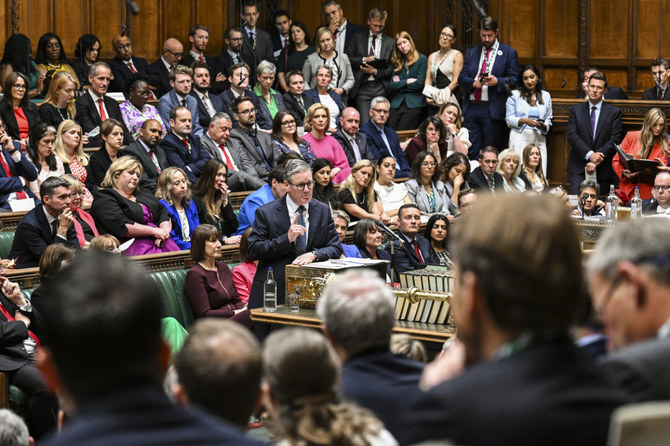
In a sweeping assessment three weeks after taking power, Prime Minister Keir Starmer’s office professed shock at the situation they inherited after 14 years of Conservative Party rule, while releasing a department-by-department analysis of the perceived failures of the previous government.
The critique comes a day before Treasury chief Rachel Reeves is expected to outline a 20-billion-pound ($26 billion) shortfall in public finances during a speech to the House of Commons.
“We will not shy away from being honest with the public about the reality of what we have inherited,’’ Pat McFadden, a senior member of the new Cabinet, said in a statement. “We are calling time on the false promises that British people have had to put up with and we will do what it takes to fix Britain.”
Starmer’s Labour Party won a landslide election victory earlier this month following a campaign in which critics accused both major parties of a “conspiracy of silence” over the scale of the financial challenges facing the next government.
Labour pledged during the campaign that it wouldn’t raise taxes on “working people,” saying its policies would deliver faster economic growth and generate the additional revenue needed by the government. The Conservatives, meanwhile, promised further tax cuts in the autumn if they were returned to office.
As proof that the previous government wasn’t honest about the challenges facing the country, Starmer’s office pointed to recent comments from former Treasury chief Jeremy Hunt confirming that he wouldn’t have been able to cut taxes this year if the Conservatives had been returned to power.
Those comments came in an interview with the BBC in which Hunt also accused Labour of exaggerating the situation to justify raising taxes now that they’ve won the election.
“The reason we’re getting all this spin about this terrible economic inheritance is because Labour wants to raise taxes,” Hunt said on July 21. “If they wanted to raise taxes, all the numbers were crystal clear before the election. … They should have levelled with the British public.”
The government on Sunday released an overview of the spending assessment Reeves commissioned shortly after taking office. She will deliver the complete report to Parliament on Monday.
Those findings led the new government to accuse the Conservatives of making significant funding commitments for this financial year “without knowing where the money would come from.’’
It argued that the military had been “hollowed out’’ at a time of increasing global threats and the National Health Service was “broken,’’ with some 7.6 million people waiting for care.
And despite billions spent to house migrants and combat the criminal gangs ferrying migrants across the English Channel on dangerous inflatable boats, the number of people making the crossing is still rising, Starmer’s office said. Some 15,832 people have crossed the Channel on small boats already this year, 9 percent more than during the same period in 2023.
“The assessment will show that Britain is broke and broken — revealing the mess that populist politics has made of the economy and public services,” Downing Street said in a statement.
The quandary the government finds itself in should be no surprise, said Paul Johnson, the director of the Institute for Fiscal Studies, an independent think tank focused on Britain’s economic policies.
At the start of the election campaign, the institute said that the UK was in a “parlous fiscal position” and the new government would have to either raise taxes, cut spending or relax the rules on public borrowing.
“For a party to enter office and then declare that things are ‘worse than expected’ would be fundamentally dishonest,” the IFS said on May 25. “The next government does not need to enter office to ‘open the books.’ Those books are transparently published and available for all to inspect.”


![]()

UK is ‘broke and broken,’ new government says as it prepares to tackle shortfall in public finances
Short Url
https://arab.news/9g6ng
UK is ‘broke and broken,’ new government says as it prepares to tackle shortfall in public finances
- Three weeks after taking power, PM Keir Starmer’s office professed shock at the situation they inherited after 14 years of Conservative Party rule
- “We are calling time on the false promises that British people have had to put up with and we will do what it takes to fix Britain,” said senior cabinet official Pat McFadden


Latest updates


© 2026 SAUDI RESEARCH & PUBLISHING COMPANY, All Rights Reserved And subject to Terms of Use Agreement.