QUETTA: More than a dozen protesters, who were en route to Gwadar to protest “rights abuses” in Pakistan’s Balochistan province, were injured in violence in the Mastung district, officials and protesters said on Sunday, amid a shutdown of Internet, mobile phone and broadband services.
The protesters were on way to Gwadar to attend ‘Baloch Raji Muchi,’ or Baloch National Gathering, summoned by Baloch Yakjehti Committee (BYC), which advocates for ethnic Baloch rights, to rally the masses against alleged human rights violations and heavy deployment of security forces in the southwestern province.
Pakistan’s Balochistan province, which borders Iran and Afghanistan, is the site of a low-level insurgency for the last two decades by separatists, who say they are fighting what they see as unfair exploitation of the province’s wealth by the federation. The Pakistani state denies the allegation.
The BYC said its supporters, including women and children who wanted to travel to Gwadar, came under attack in the Mastung district on Saturday and had since camped in Mastung, Quetta and Turbat, blocking traffic on key highways connecting Balochistan with other provinces for a second consecutive day on Sunday.
Gulzar Dost Baloch, a BYC member who was leading a protest in Quetta, said thousands of their members and supporters were leaving Mastung for the Gwadar coastal city, when “security forces attacked the buses with straight gun fire” on Saturday afternoon.
“Fourteen BYC members were injured in the attack and one who received a head injury is in serious condition and being treated at Trauma Center in Quetta,” Baloch told Arab News. “The government and security forces placed hurdles on highways in Mastung and Quetta to intercept BYC caravans, which were going to attend the Baloch National Gathering.”
The Balochistan government rejected the BYC’s claims of firing on caravans going to attend the gathering in Gwadar.
“The government will take action against people spoiling peace in the province,” Shahid Rind, a government spokesman said in a statement, describing the Gwadar rally as a “conspiracy” to disturb peace in the province.
“We have invited the BYC for talks with the government but they are not ready to talk,” he added.
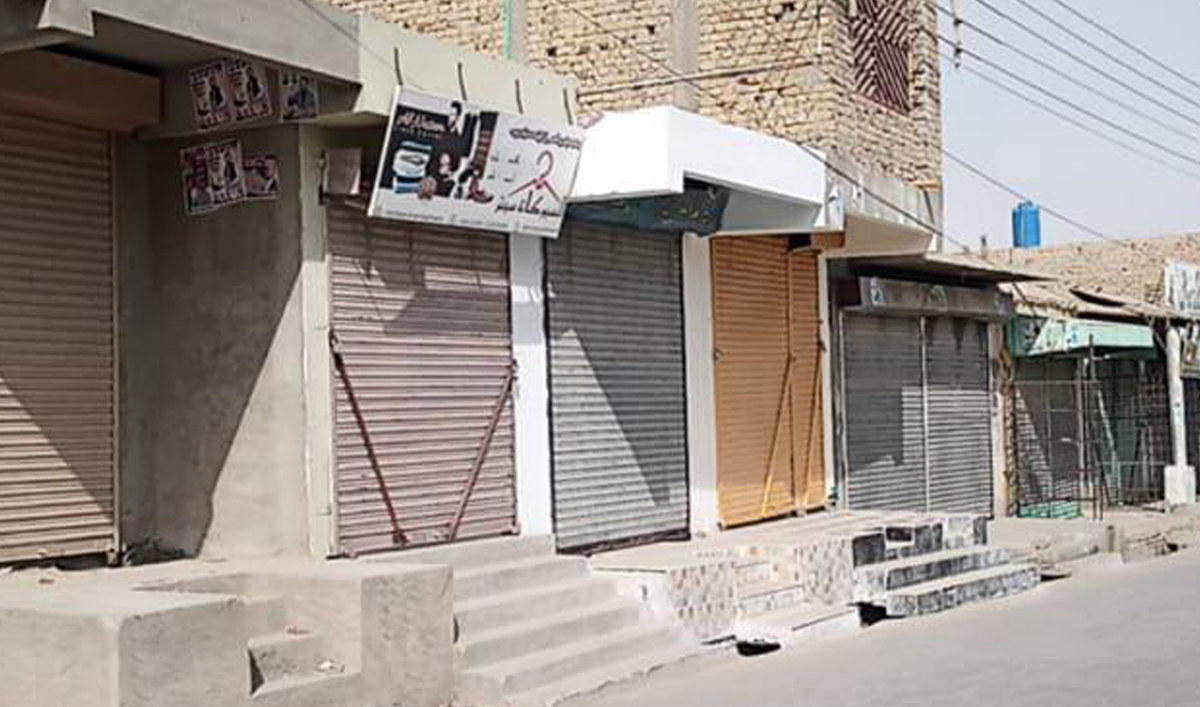
Local business community observes shutter down strike in Nushki on July 28, 2024, amid Baloch Yakjehti Committee protest against alleged human rights violations and heavy deployment of security forces in Balochistan. (AN Photo)
Arbab Awais Kasi, a spokesman at the Nawab Ghous Bakhsh Raisani Hospital in Mastung, confirmed that 14 wounded persons had been brought to the hospital and four of them had been critically injured and referred to Quetta for better medical care.
When asked, Kasi refused to confirm whether all or some of the injured persons had suffered gunshot wounds.
Gwadar, situated along the Arabian Sea, lies at the heart of China-Pakistan Economic Corridor (CEPC), under which Beijing has funneled tens of billions of dollars into massive transport, energy and infrastructure projects in Pakistan.
Amnesty International, a global human rights watchdog, said it was “alarmed at the use of unlawful and unnecessary force” against the protesters and called on the Pakistani authorities to immediately lift the Internet shutdown in Balochistan, and fulfil their obligations under domestic and international human rights law.
“Amnesty is alarmed at the use of unlawful and unnecessary force against the participants of the Baloch National Gathering by security forces yesterday,” it said on X. “It is a blatant violation of people’s right to freedom of peaceful assembly.”
The Human Rights Commission of Pakistan (HRCP) said it was “gravely concerned” about the situation unfolding in Balochistan, particularly in Gwadar, Mastung and Turbat, as Baloch citizens continued attempting to gather for the protest.
“We have received reports of violence against protesters, resulting in injuries, and alleged attempts by state authorities to intimidate leaders of the @BalochYakjehtiC into calling off the gathering, including through arrests and enforced disappearances,” it said on X.
“While it is difficult to confirm all such reports, given the connectivity blackout in parts of the province, HRCP calls urgently on the federal and provincial governments not to repeat past mistakes and instead to constitute a high-level parliamentary delegation to meet Baloch representatives and listen carefully to their demands. In any event, as citizens of Pakistan, the protesters should not be denied their constitutional right to assemble peacefully.”
Arab News attempted to contact Dr. Mahrang Baloch, who leads the BYC, and other protest leaders who had reached Gwadar to get their comments and know the situation in the port city, but they could not be reached because of Internet and mobile service suspension.
“There has been a complete blackout of Internet in Gwadar and Kech districts since Friday evening and mobile service is likely to be suspended today,” Dr. Mahrang told Arab News on Saturday.
On Sunday, a complete shutter-down strike was observed in Mastung, Kalat and Nushki districts of Balochistan and businesses remained largely closed on the call of BYC over violence against Baloch protesters in Mastung.