

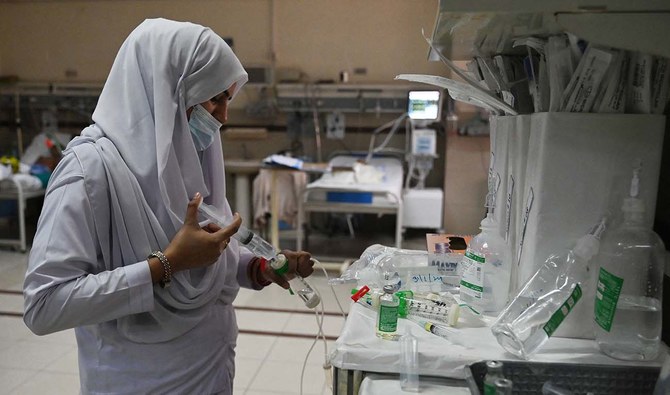
On World Hepatitis Day, Pakistan PM announces nationwide campaign against disease

A nurse prepares a vaccine to treat a child at the Children's Hospital in Lahore on January 31, 2024.
Short Url
Updated 28 July 2024
Follow

On World Hepatitis Day, Pakistan PM announces nationwide campaign against disease

  • Pakistan currently has 10 million out of 60 million hepatitis C cases worldwide, says Sharif 
  • Says Pakistani citizens will have free access to screening and treatment for hepatitis C

ISLAMABAD: Pakistan’s Prime Minister Shehbaz Sharif announced a nationwide campaign against hepatitis on Sunday on the occasion of World Hepatitis Day, as governments and health organizations raise awareness about the disease and its implications on millions around the globe today. 

Every July 28 the World Health Organization (WHO) and partners mark World Hepatitis Day to increase awareness and understanding of viral hepatitis and the diseases it causes. Hepatitis is an inflammation of the liver that is caused by a variety of infectious viruses and noninfectious agents leading to a range of health problems, some of which can be fatal.

In a statement issued by his office, Sharif lamented that Pakistan has a “very high burden” of hepatitis C infection, pointing out that the country currently has 10 million infected cases out of 60 million hepatitis C cases globally. He said it is feared Pakistan would see an epidemic of liver cancer if necessary actions to prevent and eliminate viral hepatitis are not taken. 

“The government stands firm in its dedication to overcome the challenges posed by hepatitis,” Sharif said. “I am pleased to announce a nationwide campaign aimed at eradicating hepatitis C.”

Sharif said as part of this campaign, his government would focus on decentralizing testing and treatment centers, ensuring that services provided are tailored to the needs of Pakistani citizens in alignment with the Global Strategy. 

“I reassure every citizen of our great nation, Pakistan, will have free access to screening and treatment facilities for hepatitis C,” he said. 

Sharif said the government’s core objective remains to uplift the health and well-being of people suffering from hepatitis while simultaneously reducing the impact it has on work productivity, preventing liver cancer, and averting premature death.

“On this World Hepatitis Day, let us stand united in our efforts to raise awareness, support those affected by viral hepatitis, and work toward a future free from the burden of this disease,” he said. 

“Together, we can make a difference and build a healthier and more prosperous nation.”


Pakistan reviews austerity measures amid Middle East crisis, urges strict nationwide implementation

Updated 11 March 2026
Follow

Pakistan reviews austerity measures amid Middle East crisis, urges strict nationwide implementation

  • Deputy Prime Minister Ishaq Dar chairs review meeting of austerity steps
  • Officials briefed on salary cuts, school closures, four‑day week, petrol conservation

ISLAMABAD: Pakistan’s government on Wednesday assessed progress on a sweeping set of austerity measures introduced to mitigate the country’s economic strain from sharply rising global oil prices and supply disruptions linked to the ongoing war in the Middle East.

Prime Minister Shehbaz Sharif this week announced a series of austerity steps, including a four‑day work week for government offices, requiring 50  percent of staff to work from home, cutting fuel allowances for official vehicles by half, grounding up to 60  percent of the government fleet and closing all schools for two weeks to conserve fuel amid the global oil crisis.

The measures were unveiled in response to global oil market volatility triggered by the conflict involving the United States, Israel and Iran, which has disrupted supply routes such as the Strait of Hormuz and pushed crude prices sharply higher, straining Pakistan’s heavily import‑dependent energy sector.

“The meeting stressed the importance of strict and transparent adherence to the austerity measures, promoting fiscal responsibility and prudent use of public resources,” Deputy Prime Minister and Foreign Minister Senator Mohammad Ishaq Dar said in a statement.

He was chairing a meeting of the Committee for Monitoring and Implementation of Conservation and Additional Austerity Measures, constituted under the directions of the PM, bringing together federal and provincial officials to review execution of the broad cost‑cutting plan. 

Dar emphasized the government’s commitment to enforcing the PM’s austerity steps nationwide. The committee’s review also covered reductions in departmental expenditure, deductions from salaries of senior officials earning over Rs. 300,000 ($1,120), and coordination with provincial administrations to ensure uniform implementation of the plan.

Participants at the meeting reiterated that all ministries and divisions must continue strict monitoring and reporting, with transparent oversight mechanisms, as Pakistan navigates the economic pressures from the prolonged Middle East crisis and its fallout on global energy and trade markets.