

Protesters camped in Islamabad for third day demand slashing petroleum levy, prices of essentials 

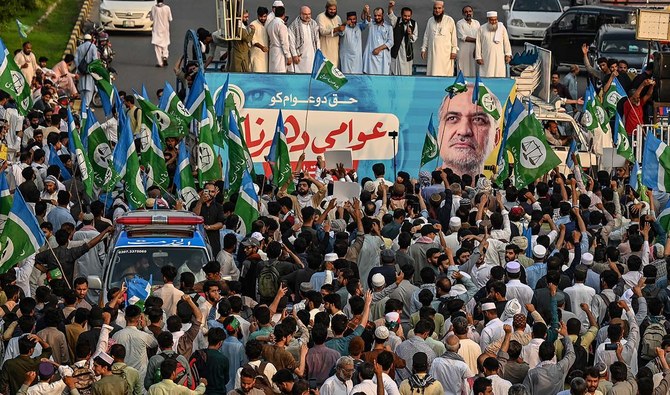
Activists and supporters of the Jamaat-e-Islami (JI) party take part in a demonstration against the country's rising inflation in Islamabad on July 26, 2024. (AFP)
Short Url
Updated 28 July 2024
Follow

Protesters camped in Islamabad for third day demand slashing petroleum levy, prices of essentials 

  • Thousands of Jamaat-e-Islami supporters have camped in Rawalpindi for a sit-in against inflation, new taxes 
  • Government has formed three-member committee for negotiations which are scheduled to begin today 

ISLAMABAD: A Pakistani religious party protesting against the rising cost of living in the country has put forth 10 demands for the government, which include reducing the petroleum levy and slashing prices of essential products, as it gears up for negotiations scheduled to be held today, Sunday. 

Thousands of Jamaat-e-Islami (JI) supporters have camped in Rawalpindi’s historic Liaqat Bagh ground, demanding the government remove additional taxes imposed in the latest budget presented last month.

JI chief Hafiz Naeem-ur-Rehman has also called for a reduction in power tariffs recommended by the International Monetary Fund (IMF) amid soaring inflation, along with a review of Pakistan’s loss-making agreements with independent power producers (IPPs).

The government formed a three-member negotiating committee on Friday to engage with the JI leadership when the party said hundreds of its workers had been arrested by law enforcement agencies.

“Jamaat-e-Islami has decided to put forth 10 demands before the government,” the religious party said in a statement issued on Saturday night. 

The party called on the government to provide a 50 percent “relief” to those who consumed 500 units of electricity and abolish the petroleum levy, and withdraw the recent hike in prices of petroleum products. 

JI demanded the government reduce the prices of essential commodities by 20 percent and withdraw taxes on stationery items. 

The party also demanded the government slash its non-development expenditures by 35 percent and reduce its overall expenditures. It also called on authorities to abolish agreements related to capacity charges and payments in dollars to IPPs and demanded a review of all existing agreements with the power producers. 

“Unauthorized taxes on agriculture and industries should be reduced by 50 percent,” JI said. “Industry, trade and investment should be ensured so that the youth get employment. Tax on the salaries class should be abolished and the privileged class should be brought under the tax net.”

’DON’T DISRUPT PUBLIC LIFE’

Pakistan’s Information Minister Attaullah Tarar announced the formation of the government’s negotiating team on Friday, saying it included him and two senior members of the ruling Pakistan Muslim League-Nawaz (PML-N) party.

“We are ready for negotiations, but don’t disrupt public life,” he said during a news conference. “The government’s three-member committee will talk to you. Amir Muqam, Tariq Fazal Chaudhry and I will negotiate with you. Whenever you express willingness, we are ready for the negotiations.”

The JI decided to form a four-member committee to negotiate with the government after Tarar and his delegation went to meet the party leaders and held a conversation in an amicable environment on Friday.

The JI said the information minister had assured its leadership of releasing the detained party workers.

Prior to that, the Rawalpindi district administration closed Murree Road, a main thoroughfare in the city, with shipping containers and deployed heavy contingents of security personnel around the sit-in site to avoid any untoward incident.

The JI chief had also addressed his supporters at Liaqat Bagh, expressing his resolve to make the government accept the party’s demands.

“If the government believes our sit-in will remain confined to Murree Road, this is its wishful thinking,” Naeem-ur-Rehman said. “If they do not reduce electricity bills, address the IPP issue and revoke tax slabs imposed on the salaried classes, then this sit-in will not remain limited here. It will spread to the entire country.”


Pakistan, global crypto exchange discuss modernizing digital payments, creating job prospects 

Updated 05 December 2025
Follow

Pakistan, global crypto exchange discuss modernizing digital payments, creating job prospects 

  • Pakistani officials, Binance team discuss coordination between Islamabad, local banks and global exchanges
  • Pakistan has attempted to tap into growing crypto market to curb illicit transactions, improve oversight

ISLAMABAD: Pakistan’s finance officials and the team of a global cryptocurrency exchange on Friday held discussions aimed at modernizing the country’s digital payments system and building local talent pipelines to meet rising demand for blockchain and Web3 skills, the finance ministry said.

The development took place during a high-level meeting between Finance Minister Muhammad Aurangzeb, Pakistan Virtual Assets Regulatory Authority (PVARA) Chairman Bilal bin Saqib, domestic bank presidents and a Binance team led by Global CEO Richard Teng. The meeting was held to advance work on Pakistan’s National Digital Asset Framework, a regulatory setup to govern Pakistan’s digital assets.

Pakistan has been moving to regulate its fast-growing crypto and digital assets market by bringing virtual asset service providers (VASPs) under a formal licensing regime. Officials say the push is aimed at curbing illicit transactions, improving oversight, and encouraging innovation in blockchain-based financial services.

“Participants reviewed opportunities to modernize Pakistan’s digital payments landscape, noting that blockchain-based systems could significantly reduce costs from the country’s $38 billion annual remittance flows,” the finance ministry said in a statement. 

“Discussions also emphasized building local talent pipelines to meet rising global demand for blockchain and Web3 skills, creating high-value employment prospects for Pakistani youth.”

Blockchain is a type of digital database that is shared, transparent and tamper-resistant. Instead of being stored on one computer, the data is kept on a distributed network of computers, making it very hard to alter or hack.

Web3 refers to the next generation of the Internet built using blockchain, focusing on giving users more control over their data, identity and digital assets rather than big tech companies controlling it.

Participants of the meeting also discussed sovereign debt tokenization, which is the process of converting a country’s debt such as government bonds, into digital tokens on a blockchain, the ministry said. 

Aurangzeb called for close coordination between the government, domestic banks and global exchanges to modernize Pakistan’s payment landscape.

Participants of the meeting also discussed considering a “time-bound amnesty” to encourage users to move assets onto regulated platforms, stressing the need for stronger verifications and a risk-mitigation system.

Pakistan has attempted in recent months to tap into the country’s growing crypto market, crack down on money laundering and terror financing, and promote responsible innovation — a move analysts say could bring an estimated $25 billion in virtual assets into the tax net.

In September, Islamabad invited international crypto exchanges and other VASPs to apply for licenses to operate in the country, a step aimed at formalizing and regulating its fast-growing digital market.