

Protesters camped in Islamabad for third day demand slashing petroleum levy, prices of essentials 

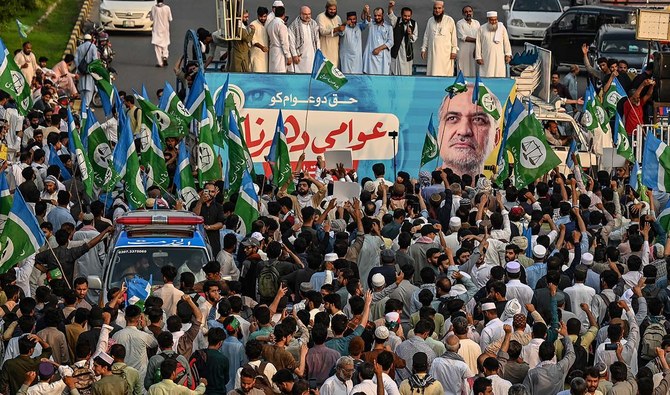
Activists and supporters of the Jamaat-e-Islami (JI) party take part in a demonstration against the country's rising inflation in Islamabad on July 26, 2024. (AFP)
Short Url
Updated 28 July 2024
Follow

Protesters camped in Islamabad for third day demand slashing petroleum levy, prices of essentials 

  • Thousands of Jamaat-e-Islami supporters have camped in Rawalpindi for a sit-in against inflation, new taxes 
  • Government has formed three-member committee for negotiations which are scheduled to begin today 

ISLAMABAD: A Pakistani religious party protesting against the rising cost of living in the country has put forth 10 demands for the government, which include reducing the petroleum levy and slashing prices of essential products, as it gears up for negotiations scheduled to be held today, Sunday. 

Thousands of Jamaat-e-Islami (JI) supporters have camped in Rawalpindi’s historic Liaqat Bagh ground, demanding the government remove additional taxes imposed in the latest budget presented last month.

JI chief Hafiz Naeem-ur-Rehman has also called for a reduction in power tariffs recommended by the International Monetary Fund (IMF) amid soaring inflation, along with a review of Pakistan’s loss-making agreements with independent power producers (IPPs).

The government formed a three-member negotiating committee on Friday to engage with the JI leadership when the party said hundreds of its workers had been arrested by law enforcement agencies.

“Jamaat-e-Islami has decided to put forth 10 demands before the government,” the religious party said in a statement issued on Saturday night. 

The party called on the government to provide a 50 percent “relief” to those who consumed 500 units of electricity and abolish the petroleum levy, and withdraw the recent hike in prices of petroleum products. 

JI demanded the government reduce the prices of essential commodities by 20 percent and withdraw taxes on stationery items. 

The party also demanded the government slash its non-development expenditures by 35 percent and reduce its overall expenditures. It also called on authorities to abolish agreements related to capacity charges and payments in dollars to IPPs and demanded a review of all existing agreements with the power producers. 

“Unauthorized taxes on agriculture and industries should be reduced by 50 percent,” JI said. “Industry, trade and investment should be ensured so that the youth get employment. Tax on the salaries class should be abolished and the privileged class should be brought under the tax net.”

’DON’T DISRUPT PUBLIC LIFE’

Pakistan’s Information Minister Attaullah Tarar announced the formation of the government’s negotiating team on Friday, saying it included him and two senior members of the ruling Pakistan Muslim League-Nawaz (PML-N) party.

“We are ready for negotiations, but don’t disrupt public life,” he said during a news conference. “The government’s three-member committee will talk to you. Amir Muqam, Tariq Fazal Chaudhry and I will negotiate with you. Whenever you express willingness, we are ready for the negotiations.”

The JI decided to form a four-member committee to negotiate with the government after Tarar and his delegation went to meet the party leaders and held a conversation in an amicable environment on Friday.

The JI said the information minister had assured its leadership of releasing the detained party workers.

Prior to that, the Rawalpindi district administration closed Murree Road, a main thoroughfare in the city, with shipping containers and deployed heavy contingents of security personnel around the sit-in site to avoid any untoward incident.

The JI chief had also addressed his supporters at Liaqat Bagh, expressing his resolve to make the government accept the party’s demands.

“If the government believes our sit-in will remain confined to Murree Road, this is its wishful thinking,” Naeem-ur-Rehman said. “If they do not reduce electricity bills, address the IPP issue and revoke tax slabs imposed on the salaried classes, then this sit-in will not remain limited here. It will spread to the entire country.”


Pakistan to launch AI screening in January to target fake visas, agent networks

Updated 05 December 2025
Follow

Pakistan to launch AI screening in January to target fake visas, agent networks

  • New system to flag forged-document travelers before boarding and pre-verify eligibility
  • Move comes amid increasing concern over fake visas, fraudulent agents, forged papers

ISLAMABAD: Pakistan will roll out an AI-based immigration screening system in Islamabad from January to detect forged documents and prevent illegal overseas travel, the government said on Thursday. 

The move comes amid increasing concern over fake visas, fraudulent agents and forged papers, with officials warning that such activity has contributed to deportations, human smuggling and reputational damage abroad. Pakistan has also faced scrutiny over irregular migration flows and labor-market vulnerability, particularly in the Gulf region, prompting calls for more reliable pre-departure checks and digital verification.

The reforms include plans to make the protector-stamp system — the clearance required for Pakistani citizens seeking overseas employment — “foolproof”, tighten labor-visa documentation, and cancel the passports of deportees to prevent them from securing visas again. The government has sought final recommendations within seven days, signalling a rapid enforcement timeline.

“To stop illegal immigration, an AI-based app pilot project is being launched in Islamabad from January,” Interior Minister Mohsin Naqvi said following a high-level meeting chaired by him and Minister for Overseas Pakistanis Chaudhry Salik Hussain.

Naqvi said the new screening technology is intended to determine travelers’ eligibility in advance, reducing airport off-loads and closing loopholes exploited by traffickers and unregistered agents.

The interior minister added that Pakistan remains in contact with foreign governments to improve the global perception and ranking of the green passport, while a uniform international driving license will be issued through the National Police Bureau.

The meeting also approved zero-tolerance measures against fraudulent visa brokers, while the Overseas Pakistanis Ministry pledged full cooperation to streamline the emigration workflow. Minister Hussain said transparency in the protector process has become a “basic requirement,” particularly for labor-migration cases.

Pakistan’s current immigration system has long struggled with document fraud, with repeated cases of passengers grounded at airports due to forged papers or agent-facilitated travel. The launch of an AI screening layer, if implemented effectively, could shift the burden from manual counters to pre-flight verification, allowing authorities to identify risk profiles before departure rather than after arrival abroad.

The reforms also come at a moment when labor mobility is tightening globally. Gulf states have begun demanding greater documentation assurance for imported labor, while European and Asian destinations have increased scrutiny following trafficking arrests and irregular-entry routes from South Asia. For Pakistan, preventing fraudulent departures is increasingly linked to protecting genuine workers, reducing deportation cycles and stabilizing the country’s overseas employment footprint.