

Strike on Israeli Golan Heights kills 11 and threatens to spark a wider war

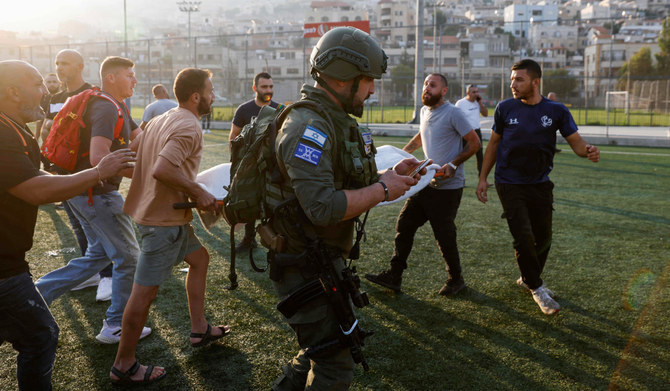
Israeli security forces and medics transport casualties from a site where a reported strike from Lebanon fell in Majdal Shams village in the Israeli-annexed Golan area on July 27, 2024. (AFP)
Short Url
Updated 28 July 2024
Follow

Strike on Israeli Golan Heights kills 11 and threatens to spark a wider war

  • Hezbollah denies Israel’s claim it is involved in strike that killed at least 11
  • All-out war with group with far superior firepower to Hamas could prove difficult for Israel 

TEL AVIV, Israel: A rocket strike Saturday at a soccer field killed at least 11 children and teens, Israeli authorities said, in the deadliest strike on an Israeli target along the country’s northern border since the fighting between Israel and the Lebanese militant group Hezbollah began. It raised fears of a broader regional war.
Israel blamed Hezbollah for the strike in the Israeli-controlled Golan Heights, but Hezbollah rushed to deny any role. Israeli Prime Minister Benjamin Netanyahu warned that Hezbollah “will pay a heavy price for this attack, one that it has not paid so far.”
The Israeli military’s chief spokesman, Rear Adm. Daniel Hagari, called it the deadliest attack on Israeli civilians since the Hamas attack on Oct. 7 that sparked the war in Gaza. He said 20 others were wounded.
“There is no doubt that Hezbollah has crossed all the red lines here, and the response will reflect that,” Israeli Foreign Minister Israel Katz told Israeli Channel 12. “We are nearing the moment in which we face an all-out war.”
Hezbollah chief spokesman Mohammed Afif told The Associated Press that the group “categorically denies carrying out an attack on Majdal Shams.” It is unusual for Hezbollah to deny an attack.
The strike at the soccer field, just before sunset, followed earlier cross-border violence on Saturday, when Hezbollah said three of its fighters were killed, without specifying where. Israel’s military said its air force targeted a Hezbollah arms depot in the border village of Kfar Kila, adding that militants were inside at the time.

Hezbollah said its fighters carried out 10 different attacks using rockets and explosive drones against Israeli military posts, the last of which targeted the army command of the Haramoun Brigade in Maaleh Golani with Katyusha rockets. In a separate statement, Hezbollah said it hit the same army post with a short-range Falaq rocket. It said the attacks were in response to Israeli airstrikes on villages in southern Lebanon.
The office of Netanyahu, who was on a visit to the United States, said he would cut short his trip by several hours, without specifying when he would return. It said he will convene the security Cabinet after arriving.
Far-right members of Netanyahu’s government called for a harsh response against Hezbollah. But an all-out war with a militant group with far superior firepower to Hamas would be trying for Israel’s military after nearly 10 months of fighting in Gaza.
Footage aired on Israeli Channel 12 showed a large blast in one of the valleys in the Druze town of Majdal Shams, in the Golan Heights, which Israel captured from Syria in the 1967 Mideast war and annexed in 1981. Some Druze have Israeli citizenship. Many still have sympathies for Syria and rejected Israeli annexation, but their ties with Israeli society have grown over the years.
Video showed paramedics rushing stretchers off the soccer field toward waiting ambulances.
Ha’il Mahmoud, a resident, told Channel 12 that children were playing soccer when the rocket hit the field. He said a siren was heard seconds before the rocket hit, but there was no time to take shelter.
Jihan Sfadi, the principal of an elementary school, told Channel 12 that five students were among the dead: “The situation here is very difficult. Parents are crying, people are screaming outside. No one can digest what has happened.”
Israel’s military said its analysis showed that the rocket was launched from an area north of the village of Chebaa in southern Lebanon.
The White House National Security Council in a statement said the US “will continue to support efforts to end these terrible attacks along the Blue Line, which must be a top priority. Our support for Israel’s security is iron-clad and unwavering against all Iranian-backed terrorist groups, including Lebanese Hezbollah.”
Lebanon’s government, in a statement that didn’t mention Majdal Sham, urged an “immediate cessation of hostilities on all fronts” and condemned all attacks on civilians.
Israel and Hezbollah have been trading fire since Oct. 8, a day after Hamas militants stormed into southern Israel. In recent weeks, the exchange of fire along the Lebanon-Israel border has intensified, with Israeli airstrikes and rocket and drone attacks by Hezbollah striking deeper and farther away from the border.
Majdal Shams had not been among border communities ordered to evacuate as tensions rose, Israel’s military said, without saying why. The town doesn’t sit directly on the border with Lebanon.
Officials from countries including the United States and France have visited Lebanon to try to ease the tensions but failed to make progress. Hezbollah has refused to cease firing as long as Israel’s offensive in Gaza continues. Israel and Hezbollah fought an inconclusive war in 2006.
Saturday’s violence comes as Israel and Hamas are weighing a ceasefire proposal that would wind down the nearly 10-month war in Gaza and free the roughly 110 hostages who remain captive there. Hamas’ attack on Oct. 7 killed some 1,200 people and took 250 others hostage. Israel’s offensive has killed more than 39,000 people, according to local health authorities.
Since early October, Israeli airstrikes in Lebanon have killed more than 450 people, mostly Hezbollah members, but also around 90 civilians and non-combatants. On the Israeli side, 44 have been killed, at least 21 of them soldiers.


How Israel’s ‘buffer zone’ plan could redraw the map of southern Lebanon

Updated 5 sec ago
Follow

How Israel’s ‘buffer zone’ plan could redraw the map of southern Lebanon

  • Mass evacuations empty southern towns as Israel advances plans for a deep security belt inside Lebanese territory
  • Beirut warns of a dangerous escalation as displacement rises and diplomacy struggles to halt the expanding campaign

BEIRUT: Lebanon faces what officials described as “one of the most dangerous moments in recent memory” after Hezbollah launched attacks on Israeli forces from areas both south and north of the Litani River, triggering a renewed Israeli air and ground campaign.

Announcing its ground incursion into southern Lebanon, Israel said it aims to establish what it called a permanent “security zone” along the border.

The exact depth of the proposed zone remains unclear, but its humanitarian cost is already emerging. More than 80 towns and villages have been emptied following successive evacuation orders, forcing tens of thousands of residents to flee north of the Litani River.

Orders to vacate have also reached Beirut’s southern suburbs, where residents have been told to leave their homes and not expect to return until Israel decides the time is right.

The evacuation net has spread wide, reaching villages deep in the south and others pressing against the western Bekaa.

Israeli reports estimate the number of Lebanese who will be forced from their homes at around 350,000 — on top of the roughly 85,000 frontline villagers who never made it back from earlier rounds of displacement.

Recent days have shown that Hezbollah remains active south of the Litani River, most visibly when its fighters engaged an Israeli tank in the border town of Kafr Kila.

The group has also maintained a steady stream of drone and rocket attacks toward Israel’s Upper Galilee from positions north of the river.

The Lebanese Army has redeployed along the border zone it has held since the Nov. 27, 2024, Israel-Hezbollah ceasefire, declaring in January that it had successfully cleared more than 90 percent of Hezbollah weapons from the area.

A military source confirmed that Israeli troops had crossed into Lebanon on Tuesday, moving through the towns of Kafr Kila and Khiam, shortly after Israel’s Defense Minister Israel Katz issued orders to seize additional strategic positions and tighten the grip on southern Lebanon.

The Israeli military called it a “forward defensive measure.”

Statements from Israeli officials and developments on the ground suggest a broader strategy to establish a civilian-free buffer zone along the 120 kilometer border, extending 10 kilometers deep into Lebanese territory.

That translates to roughly 1,200 square kilometers — close to 10 percent of Lebanon’s territory.

The blueprint was already being drafted during the 66-day war of 2024. Israeli forces razed homes in frontline border villages and sprayed chemical agents across farmland, stripping away vegetation that Hezbollah fighters had used for cover.

Five hilltop positions — Hamames, Uwayda, Aaziyyeh, Jabal Blat, and Labbouneh — remain under Israeli control inside Lebanese territory. The Lebanese Army reports additional positions have been established in recent months.

Brig. Gen. Mounir Shehadeh, the former Lebanese government coordinator with the United Nations Interim Force in Lebanon (UNIFIL), said that during the 2024 war, Israel sought to occupy all of southern Lebanon south of the Litani River.

However, UNIFIL forces deployed in the area refused to evacuate their positions.

“Israeli forces subsequently targeted those sites, injuring peacekeepers and shelling the entrance to the UNIFIL headquarters,” Shehadeh told Arab News.

He said the ceasefire agreement and the role of US mediation imposed “a fait accompli” in the border region. “Israel continued to violate the agreement through assassinations and the bulldozing of villages during this period,” he said.

Shehadeh noted that the term “buffer zone” is a concept Israel has used since its inception.

“In the media, it is framed as protecting settlements, but in reality Israel uses it to reshape facts on the ground, hoping that over time the buffer zone will become part of Israel. The Golan Heights is a clear example of this,” he added.

Shehadeh said the scale of the evacuation map suggests the buffer plan goes way beyond a localized response to rocket fire. Instead, it points to an attempt to impose a comprehensive security zone that would depopulate the border area and transform it into an open military zone.

“The Litani River is crucial to Israeli doctrine,” he said. “Based on that, the boundaries of the proposed buffer zone can be roughly estimated as follows.

“To the south, the entire Blue Line from Naqoura to the outskirts of Shebaa Farms; to the north, a line running roughly parallel to the Litani River in some sections and extending between three and eight kilometers into Lebanese territory, depending on terrain and population density.

“To the west, the Mediterranean coast at Naqoura; and to the east, the outskirts of the Arqoub region and the highlands overlooking the Upper Galilee.”

The buffer zone could span ​​approximately 250 to 400 square kilometers, depending on the depth of the actual incursion.

Shehadeh added that if Israeli forces reach the outskirts of the Litani River, it would effectively revive a security belt similar to the one that existed before 2000, but on a larger scale extending toward the outskirts of the western Bekaa Valley.

If Israel continues advancing, it could push even further north to the Awali River, as it did during the 1982 war that culminated in the occupation of Beirut, he said.

For its part, UNIFIL expressed “grave concern” regarding Israeli calls for the evacuation of civilians to the north of the Litani.

It also reported several Israeli military movements and activities in its area of ​​operations, including in the vicinity of Khiam, Beit Lif, Yaroun, Houla, Kfar Kila, El Khirbe, and Kfar Shouba, amid ongoing Israeli airstrikes and other aerial activities.

UNIFIL considered these actions “not only a violation of Resolution 1701, but also a violation of Lebanon’s sovereignty and territorial integrity.”

It also noted the new salvo of rockets and shells fired from Lebanese territory towards Israel, in violation of Resolution 1701.

The Lebanese Armed Forces command confirmed the incursion of Israeli forces into Lebanese territory in what it called a “flagrant violation of international resolutions and Lebanese sovereignty, following the launching of rockets and drones from Lebanese territory.”

It added that it continues to implement the decisions of the political authorities “in a manner that takes into account the supreme national interest,” and that it is coordinating with UNIFIL and the committee supervising the cessation of hostilities agreement “to halt Israeli attacks.”

The statement added that military units are redeploying at several border points within their assigned sectors despite limited capabilities, while implementing exceptional measures to maintain security and prevent armed activity in various areas.

According to Shehadeh, UNIFIL has already begun reducing troop numbers and withdrawing equipment ahead of the expected end of its mission in southern Lebanon in late 2027.

“In contrast, Israel no longer recognizes the Blue Line or Resolution 1701,” he told Arab News. “This will present Lebanon with a new security and geographical reality, altering the lines of deployment and engagement and complicating any subsequent political settlement.”

UNIFIL said its forces are still present on the ground and continue to carry out their tasks in southern Lebanon and along the Blue Line.

It also noted that it has adapted its activities in support of Resolution 1701, including, where possible, facilitating humanitarian assistance and protecting civilians, adding that the mission’s civilian footprint would be adapted accordingly.

Politically, the outlook in Lebanon’s external diplomacy appears no less bleak than the situation on the ground. Officials have been in contact with the US and France, urging them to pressure Israel to halt its attacks, but so far those efforts appear to have yielded little result.

The UN Security Council is set to hold a briefing next Tuesday on the implementation of Resolution 1701.

A senior Lebanese political source told Arab News: “The facts on the ground are changing every minute. What we are trying to do is stop the ongoing military operations so we can assess how to return to the negotiating table and implement international resolutions.”

The official source added that while the Lebanese government had openly raised the prospect of negotiations with Israel, Lebanon no longer appears to be a priority in international calculations, leaving the situation largely determined by the balance of power on the ground.

Meanwhile, the number of displaced people has reached almost 100,000, a figure expected to rise sharply following the mass exodus that began Thursday from Beirut’s southern suburbs, home to more than one million residents from across Lebanon’s various sectarian communities.

The Lebanese Ministry of Health reported on Thursday that at least 102 people have been killed and 638 injured since Israeli airstrikes on Lebanon began on Monday.

Lebanese Social Affairs Minister Haneen Sayed said that 83,847 displaced people, equivalent to 18,033 families, had registered in shelters due to the Israeli evacuation warnings, noting that the number of shelter centers had reached 399 across Lebanon.

Information Minister Paul Morcos said after the cabinet’s emergency session on Thursday that Prime Minister Nawaf Salam had criticized those responsible for dragging Lebanon into the latest escalation.

Quoting Salam, Morcos said: “Whoever committed a sin is the one who dragged Lebanon into repercussions we could have done without. Talk of treason is not courage; it is irresponsible and incites strife.”

The remarks came after Hezbollah Secretary-General Sheikh Naim Qassem criticized the government on Wednesday night as he defended the Iran-backed group’s decision to abandon earlier pledges to keep Lebanon neutral amid the regional conflict.

Morcos also announced that the government had decided to reinstate visa requirements for Iranian nationals entering Lebanon. It would also ban any activity by the Iranian Revolutionary Guard Corps, a main backer of Hezbollah, while seeking to deport its members from Lebanon.