

Pakistan Navy commissions advanced warship to enhance region’s maritime security

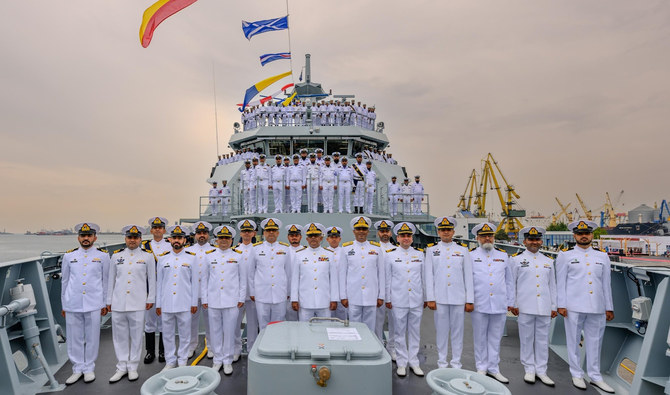
Pakistan Navy personnel pose for a picture onboard Pakistan's offshore patrol vessel, PNS Hunain, during a ceremony in Romania on July 25, 2024. (Pakistan Navy)
Short Url
Updated 26 July 2024
Follow

Pakistan Navy commissions advanced warship to enhance region’s maritime security

  • PNS Hunain was inducted at a ceremony in Romania that was attended by Pakistan’s naval chief
  • The Pakistani vessel is equipped with terminal defense and advanced electronic warfare systems

ISLAMABAD: The Pakistan Navy has commissioned its offshore patrol vessel, PNS Hunain, at a ceremony in Romania, the military’s media wing, Inter-Services Public Relations (ISPR), said on Friday, adding the move will help strengthen regional maritime security in the Indian Ocean.

Pakistan’s Chief of Naval Staff Admiral Naveed Ashraf attended the commissioning ceremony as chief guest which was also joined by Romanian Chief of Defense Staff General Gheorghita Vlad and other senior officials and dignitaries.

“The induction of the ship will further enhance Pakistan Navy’s maritime security capabilities, presence in distant international waters and operational readiness,” the ISPR quoted the naval chief as saying. “The induction of

PNS Hunain will further strengthen the regional maritime security patrol deployment in the Indian Ocean.”

PNS Hunain is a multi-role, ultra-fast warship equipped with terminal defense and advanced electronic warfare systems, anti-ship and anti-air warfare capabilities, the statement added.

The naval chief also appreciated the professionalism of Damen Shipyard and its management for providing modern technology to Pakistan.

Earlier this month, the Pakistan Navy assumed command of a multinational task force responsible for ensuring maritime security in the southeastern waters of the Middle East by operating in the Arabian Sea, Gulf of Oman and Gulf of Aden.

Combined Task Force 150 (CTF-150) is part of the Combined Maritime Forces (CMF), a 34-nation coalition aimed at promoting security and stability in some of the world’s most important shipping lanes, focusing on counter-terrorism, anti-smuggling and enhancing navigational security.


Pakistan says over 500 Afghan Taliban militants killed in airstrikes as fighting continues

Updated 4 sec ago
Follow

Pakistan says over 500 Afghan Taliban militants killed in airstrikes as fighting continues

  • Clashes began last week after Afghanistan targeted Pakistani military sites along the border
  • Pakistan says it struck 62 targets in Afghanistan, destroyed 237 check posts in the conflict

ISLAMABAD: Pakistan has killed 527 Afghan Taliban fighters, wounded more than 755 and struck 62 locations inside Afghanistan in air attacks, Information Minister Attaullah Tarar said on Friday, as fighting between the two neighbors enters the second week.

Clashes between the two countries began last week when Afghan forces launched a surprise attack on Pakistani military installations along their shared border. Afghanistan said the assault was in retaliation for Pakistan’s earlier airstrikes in February on what Islamabad described as militant camps inside Afghanistan.

Last Friday, Pakistan’s Defense Minister Khawaja Muhammad Asif said the situation had become “open war” between Pakistan and Afghanistan as strikes and fighting escalated.

“Summary of Afghan Taliban losses: 527 killed, 755 + injured, 237 checkposts destroyed, 38 posts captured, 205 tanks, armored vehicles and artillery guns destroyed,” Tarar wrote on the social media platform X.

“62 locations across Afghanistan effectively targeted by air.”

The development comes after the Tehreek-e-Taliban Pakistan (TTP), also known as the Pakistani Taliban, announced a fresh offensive against Pakistan earlier today.

Pakistan accuses Kabul of sheltering militant groups such as the TTP on its soil and facilitating attacks against Pakistan. Afghanistan denies the allegations and has urged Islamabad to address its security challenges without blaming Kabul.

Afghanistan has called for dialogue to resolve the conflict. Pakistan, however, has rejected talks with Kabul, saying its operation “Ghazab Lil Haq” — meaning Wrath for Truth — will continue until its objectives are achieved.

Since the conflict began, diplomatic efforts have intensified, with several countries and international bodies, including the European Union and the United Nations, urging restraint and calling for talks.

Turkish President Recep Tayyip Erdogan has told Pakistani Prime Minister Shehbaz Sharif that Ankara would help restore a ceasefire, as other countries that had offered to mediate have themselves been affected by the conflict in the Gulf.