

Gaza’s ancient Christian monastery gets ‘danger listing’ at UNESCO session in India

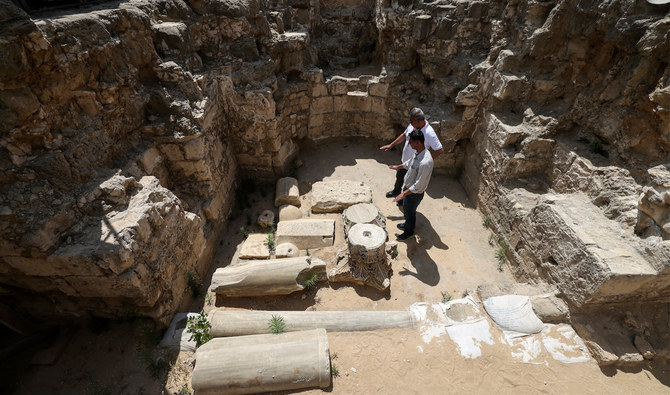
A picture shows a view of the archaeological site of Saint Hilarion in the center of the Gaza Strip, on June 8, 2022. (AFP)
Short Url
Updated 26 July 2024
Follow

Gaza’s ancient Christian monastery gets ‘danger listing’ at UNESCO session in India

  • Founded in 340 CE, Saint Hilarion’s monastery is one of the oldest in the Middle East
  • UNESCO inscription processed in wake of Israel’s destruction of Palestinian heritage sites

NEW DELHI: An ancient Christian monastery in Gaza was recognized as a World Heritage in Danger site during a UNESCO session in New Delhi on Friday.
Founded around 340 CE by Saint Hilarion, the monastery is part of Tell Umm Amer, an archaeological site located in the Nuseirat refugee camp of Gaza’s Deir Al-Balah governorate.
Submitted for inscription by the Permanent Delegation of Palestine to UNESCO in 2012, its nomination was processed on an emergency basis during the World Heritage Committee’s ongoing annual session.
Ambassador Mounir Anastas, Palestine’s permanent delegate to the UN’s cultural agency, welcomed the inscription as giving hope to the people of Gaza in the wake of the ongoing Israeli attacks, which since October have killed at least 40,000 people and destroyed most of the Palestinian enclave’s infrastructure.
“It constitutes a message of hope to our people in Gaza who are fleeing bombing, who have no shelter, no water, no food. Nevertheless, they are committed to protect their heritage because this heritage is part of our people’s memory and history,” Anastas told Arab News on the sidelines of the UNESCO session.

The move was submitted by Belgium and sponsored by 18 other members of the current World Heritage Committee, who resorted to the emergency procedure provided for in the World Heritage Convention, and agreed to inscribe the Saint Hilarion monastery complex both on the World Heritage list and on the list of the World Heritage in Danger.
By the terms of the convention, its 195 states parties — including Israel — are barred from directly or indirectly damaging the site and are committed to providing their cooperation for its protection.
“Once the site is enshrined on the World Heritage in Danger list, this means that all state parties to the convention are responsible for the protection and promotion of the site,” Mounir said.
“And this is also another strong message from the international community to our people in Gaza, saying that the international community did not forget you.”
Saint Hilarion was a native of the Gaza region and is considered the father of Palestinian monasticism. His monastery used to be an important station on the crossroads between Egypt, Palestine, Syria and Mesopotamia, and is associated with the phenomenon of monastic desert centers during the Byzantine period. It also bears testimony to Christianity in Gaza.
One of the oldest monasteries in the Middle East, the complex consists of two churches, a burial site, a baptism hall, a public cemetery, an audience hall, and dining rooms.
At least 207 archaeological sites and buildings of cultural and historical significance, out of a total of 320, have been reduced to rubble or severely damaged by Israel’s deadly military onslaught and indiscriminate bombardment of the Gaza Strip for the last 10 months.
These include the Orthodox Church of Saint Porphyrios — the world’s third oldest church — the 12th-century Great Omari Mosque and the nearby Al-Qissariya medieval Old City market, Gaza’s ancient seaport dating to 800 BCE, a Philistine cemetery dating to the Late Bronze period 1550-1200 BCE.
The destruction of many of the archaeological sites was detailed in South Africa’s case against Israel for the crime of genocide at the International Court of Justice. The case argues that the mass-scale killing and destruction of cultural heritage in Gaza demonstrates the Israeli leadership’s intent to destroy the Palestinian people and their cultural identity.


From round fruits to lucky charms: How Filipinos invite prosperous New Year

Updated 4 sec ago
Follow

From round fruits to lucky charms: How Filipinos invite prosperous New Year

  • Lights are lit, doors and windows open to allow good spirits in
  • Sticky rice dishes are served to keep family sticking together

MANILA: With the dining table set with symbolic foods, a bit of noise and rituals to invite good luck, Filipinos are ready to welcome the New Year, carefully observing every tradition and superstition to bring prosperity.

Media noche or the midnight dinner on New Year’s Eve is central to the celebration. Besides traditional meats, there will be sticky rice dishes to keep the family sticking together, and pancit or long rice noodles to represent long life.

There should also be 13 round fruits prepared specifically for the occasion, with 12 representing each month of the year, and the 13th adding extra luck. Because they are round like coins, they are believed to invite abundance, wealth and prosperity.

“We cook bilo-bilo (sticky rice balls) with coconut milk and palitaw (sweet rice cakes). It’s something we simply grew up with,” said Cel Reyes from Mabini in Batangas province, south of Manila.

“It’s sticky, so it symbolizes togetherness, and it is also round. Anything that’s round is prepared also as a symbol of prosperity.”

In Malabon, a coastal city in the northern part of Metro Manila, Priam Nepomuceno’s 86-year-old mother-in-law sets unhulled rice on the table.

“Because of the gold color, it’s believed to bring luck and abundance,” he said. “Grapes are also hung on the door. They’re not meant to be eaten and are kept hanging for the whole year as a symbol of prosperity.”

Some people also jump when the clock strikes 12, believing it will help them grow taller.

In many households, all lights are lit before midnight, with doors and windows open to allow good spirits to enter, while noise from firecrackers and party horns keeps the bad ones at bay.

“By nature, Filipinos are superstitious. We believe in good luck, deities. We give in to faith and luck, and it’s tied to deep spirituality,” said Juanita Galang-Trinidad, an 80-year-old editor from Bulacan province north of Manila.

“We also put 12 coins in varying amounts in our pockets and wear polka dot clothing. Rice, cereal, and salt containers should be full.”

New Year’s celebrations, like Christmas, bring families together, but with extra traditions for good luck. Beyond the midnight feast and keeping round objects on the table and at hand, Filipinos try to pay off debts to avoid financial trouble in the coming year.

On New Year’s Eve, they also avoid serving chicken, as chickens are believed to scratch backward when they eat, symbolically scratching away good fortune.

“We hold on to our traditions despite these growing changes, modernity, in our environment,” Trinidad said.

“We still hold on to our traditions and customs because they identify us as a people, as Filipinos.”