

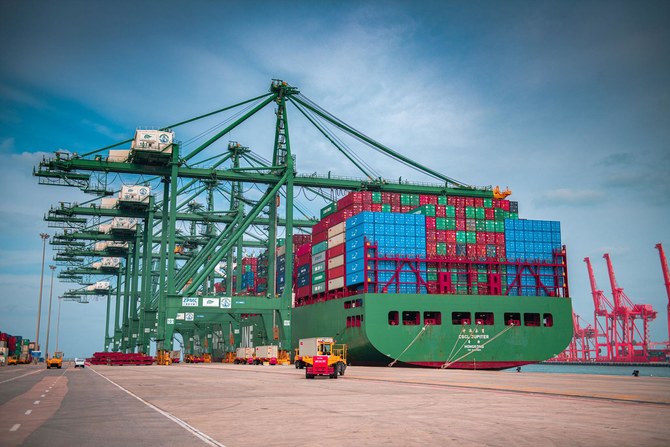
Saudi Arabia’s Dammam port records 37.4% surge in container handling

The port managed 1.53 million standard units in this period, up from 1.11 million units last year. Transshipment containers also surged by 87.87 percent to 37,806 units from 20,124 in 2023, according to data from the Saudi Ports Authority, also known as Mawani. File
Short Url
Updated 25 July 2024
Follow

Saudi Arabia’s Dammam port records 37.4% surge in container handling

  • Port managed 1.53 million standard units in this period, up from 1.11 million units last year
  • Outgoing containers rose by 39.07% to 624,710 units, while incoming ships increased by 34.68% to 872,445 units

RIYADH: Saudi Arabia’s King Abdulaziz Port in Dammam reported a notable 37.4 percent year-on-year increase in container handling during the first half of 2024, indicating strong growth in the maritime sector.

The port managed 1.53 million standard units in this period, up from 1.11 million units last year. Transshipment containers also surged by 87.87 percent to 37,806 units from 20,124 in 2023, according to data from the Saudi Ports Authority, also known as Mawani.

This progress aligns with Saudi Arabia’s broader efforts to enhance its logistics and transportation infrastructure, supporting the goals of Vision 2030 to diversify the economy and establish the Kingdom as a global logistics hub. Investments in maritime infrastructure, technology, and strategic partnerships are driving this transformation, solidifying the Kingdom’s role in international trade routes.

Outgoing containers rose by 39.07 percent to 624,710 units, while incoming ships increased by 34.68 percent to 872,445 units, demonstrating robust growth compared to last year’s figures of 449,219 and 647,790 units, respectively. The overall cargo volume at the port grew by 28.75 percent to 24.92 million tonnes from 19.36 million tonnes the previous year. General cargo handling also saw a significant rise, reaching 25.80 million tonnes, a 49.47 percent increase from 17.26 million tonnes in 2023.

Navigational traffic increased by 19.97 percent, with 1,430 ships docking compared to 1,192 vessels the previous year. Vehicle processing surged by 109.82 percent to 363,167 units, up from 173,086 units in 2023. However, passenger numbers declined sharply by 89.11 percent to 4,194 individuals from 38,518 the previous year.

During the year, King Abdulaziz Port initiated several strategic initiatives to enhance its infrastructure, including acquiring 21 coastal and bridge cranes to accommodate advanced, larger vessels efficiently. The port also introduced 80 electric trucks through a partnership between Saudi Global Ports Co. and Sany Global, establishing it as the largest port in the Middle East with such a fleet. The port also expanded its commercial traffic by launching six new shipping services in collaboration with major international lines.

A contract between Mawani and G4 Logistics Services Co. was also signed to establish grain silos and warehouses with an investment of up to SR200 million, covering an area of 100,000 sq. m. This initiative aims to bolster food security in Saudi Arabia.

In recognition of its achievements, King Abdulaziz Port was honored with the “Port of the Year” award at the ShipTek Awards in May, highlighting its pivotal role in the region's logistics and transportation landscape.



Saudi POS stays above $4bn as Ramadan spending lifts home goods

Updated 16 sec ago
Follow

Saudi POS stays above $4bn as Ramadan spending lifts home goods

RIYADH: Saudi point-of-sale transactions remained above $4 billion in the week ending Feb. 14, with spending on furniture and home supplies rising ahead of Ramadan, central bank data showed. 

Overall POS activity totaled SR15.34 billion ($4.09 billion), representing a 4.8 percent week-on-week decrease, while the number of transactions dipped 1.6 percent to 252 million, according to the Saudi Central Bank. 

Spending on furniture and home supplies rose 5.9 percent to SR697.35 million, marking the strongest weekly increase among major retail categories. 

Expenditure on electronics increased 2.9 percent, while spending on construction and building materials rose 1.1 percent.

Sectors that saw declines includes freight transport and courier services, which posted a drop of 5 percent to SR64.86 million.

Pharmacy and medical supplies spending fell 8.2 percent to SR223.81 million, but outlays on medical services rose 5.7 percent to SR539.68 million. 

Food and beverage expenditure decreased 4.3 percent, but the total spend of SR2.57 billion meant it retained the largest share of POS activity.

Restaurants and cafes followed with SR1.73 billion, despite a 4.7 percent decline. Apparel and clothing outlays represented the third-largest share of POS spending during the monitored week, up 0.5 percent to SR1.38 billion.

The Kingdom’s major urban centers mirrored the mixed national changes. Riyadh, which accounted for the largest share of total POS spending, saw a 3.4 percent drop to SR5.32 billion. The number of transactions in the capital reached 80.7 million, down 0.8 percent week on week. 

In Jeddah, transaction values decreased 4.4 percent to SR2.12 billion, while Dammam reported a 3.3 percent decrease to SR746.29 million. 

POS data, tracked weekly by SAMA, provides an indicator of consumer spending trends and the ongoing growth of digital payments in Saudi Arabia.  

The data also highlights the expanding reach of POS infrastructure, extending beyond major retail hubs to smaller cities and service sectors, supporting broader digital inclusion initiatives.  

The growth of digital payment technologies aligns with Saudi Arabia’s Vision 2030 objectives, promoting electronic transactions and contributing to the Kingdom’s broader digital economy.