First ships dock in Yemen harbor after Israel strike: Houthi media

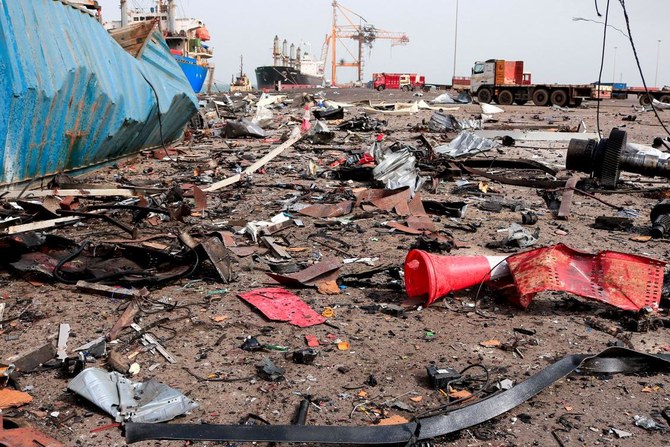
Debris litters a loading dock a day after Israeli strikes on the port of Yemen’s Houthi-held city of Hodeida on Jul. 21, 2024. (AFP)
Short Url
Updated 24 July 2024
Follow

First ships dock in Yemen harbor after Israel strike: Houthi media

  • “The port of Hodeida is working normally around the clock” to receive commercial ships, Ahmed Al-Murtada, the deputy director of the container terminal, said
  • Ship tracking website marinetraffic.com confirmed the arrival on Tuesday of Marsa Zenith

HODEIDA, Yemen: Two container ships have docked in Yemen’s Hodeida harbor, the first since a deadly Israeli strike hit fuel storage tanks at the militant-held port, according to Houthi media and ship trackers.
The strikes on Saturday, the first claimed by Israel on Yemen, triggered a massive blaze that burned for days at the dock amid slow firefighting efforts.
It destroyed some cranes and dozens of oil tanks, according to experts. Another tank exploded overnight between Tuesday and Wednesday, reigniting some flames at the harbor, a critical gateway for fuel imports and humanitarian aid into Houthi-held areas.
Despite the ongoing threat, “the port of Hodeida is working normally around the clock” to receive commercial ships, Ahmed Al-Murtada, the deputy director of the container terminal, told the Houthi-run Saba news agency on Tuesday.
The port’s director of maritime operations, Mohamed Al-Sais, told Saba that two ships had docked at the harbor on Tuesday.
He identified them as “Marsa Zenith,” a vessel that carried 514 containers of “various goods,” and “Brother 1,” which was loaded with 22,803 tons of iron, Saba said.
Ship tracking website marinetraffic.com confirmed the arrival on Tuesday of Marsa Zenith, identifying it as a Panama-flagged vessel that departed from the port of Djibouti.
It additionally reported the arrival of the Tanzania-flagged Brother 1, which also sailed from Djibouti, according to the website.
The quays of Hodeida were spared major damage in the Israeli strike that militants say killed nine people and targeted a fuel storage depot owned by the Yemen Petroleum Company as well as a power plant north of the port.
Maritime security firm Ambrey said there were no reports of major damage to vessels in or near the harbor following the strike.
The port, however, is still at risk of another “catastrophe,” said Mwatana for Human Rights, a Yemeni right group which dispatched an assessment team to the dock.
“Based on (the findings of) our field team, the risk of more fuel tanks exploding still remains,” it told AFP in an emailed statement.
“Whenever the firefighting teams tried to extinguish the fires, the explosions and flames reignited,” Mwatana said.
“There are major concerns that the teams may not be able to... prevent another explosion.”


First responders enter devastated Aleppo neighborhood after days of deadly fighting

Updated 12 January 2026
Follow

First responders enter devastated Aleppo neighborhood after days of deadly fighting

  • The US-backed SDF, which have played a key role in combating the Daesh group in large swaths of eastern Syria, are the largest force yet to be absorbed into Syria’s national army

ALEPPO, Syria: First responders on Sunday entered a contested neighborhood in Syria’ s northern city of Aleppo after days of deadly clashes between government forces and Kurdish-led forces. Syrian state media said the military was deployed in large numbers.
The clashes broke out Tuesday in the predominantly Kurdish neighborhoods of Sheikh Maqsoud, Achrafieh and Bani Zaid after the government and the Syrian Democratic Forces, the main Kurdish-led force in the country, failed to make progress on how to merge the SDF into the national army. Security forces captured Achrafieh and Bani Zaid.
The fighting between the two sides was the most intense since the fall of then-President Bashar Assad to insurgents in December 2024. At least 23 people were killed in five days of clashes and more than 140,000 were displaced amid shelling and drone strikes.
The US-backed SDF, which have played a key role in combating the Daesh group in large swaths of eastern Syria, are the largest force yet to be absorbed into Syria’s national army. Some of the factions that make up the army, however, were previously Turkish-backed insurgent groups that have a long history of clashing with Kurdish forces.
The Kurdish fighters have now evacuated from the Sheikh Maqsoud neighborhood to northeastern Syria, which is under the control of the SDF. However, they said in a statement they will continue to fight now that the wounded and civilians have been evacuated, in what they called a “partial ceasefire.”
The neighborhood appeared calm Sunday. The United Nations said it was trying to dispatch more convoys to the neighborhoods with food, fuel, blankets and other urgent supplies.
Government security forces brought journalists to tour the devastated area, showing them the damaged Khalid Al-Fajer Hospital and a military position belonging to the SDF’s security forces that government forces had targeted.
The SDF statement accused the government of targeting the hospital “dozens of times” before patients were evacuated. Damascus accused the Kurdish-led group of using the hospital and other civilian facilities as military positions.
On one street, Syrian Red Crescent first responders spoke to a resident surrounded by charred cars and badly damaged residential buildings.
Some residents told The Associated Press that SDF forces did not allow their cars through checkpoints to leave.
“We lived a night of horror. I still cannot believe that I am right here standing on my own two feet,” said Ahmad Shaikho. “So far the situation has been calm. There hasn’t been any gunfire.”
Syrian Civil Defense first responders have been disarming improvised mines that they say were left by the Kurdish forces as booby traps.
Residents who fled are not being allowed back into the neighborhood until all the mines are cleared. Some were reminded of the displacement during Syria’s long civil war.
“I want to go back to my home, I beg you,” said Hoda Alnasiri.