

Over 100,000 schools in Pakistan remain closed due to heat

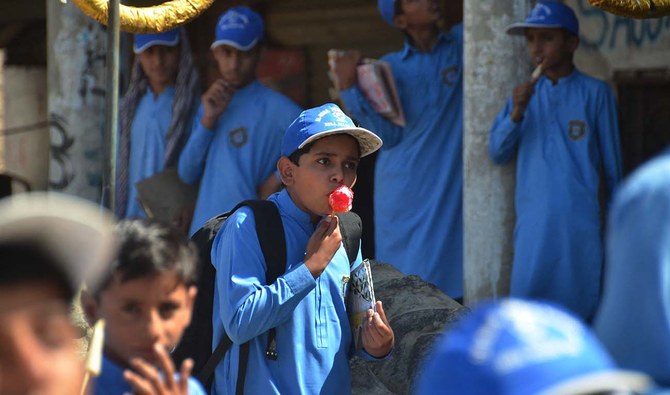
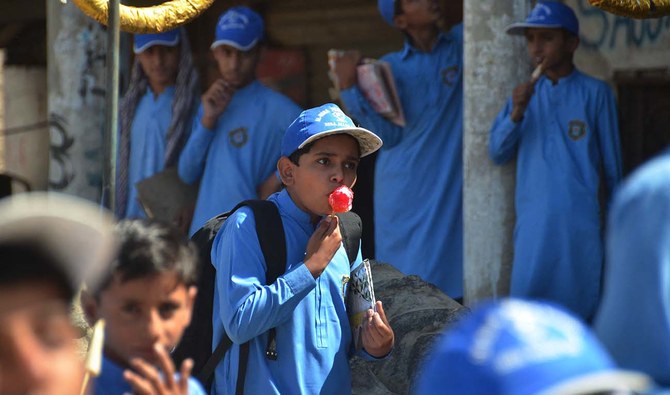
A school boy eats an ice gola (a street dessert made of crushing ice and syrups) outside his school during a hot summer day in Jaffarabad, in Pakistan's Balochistan province on May 29, 2024, amid the ongoing heatwave. (AFP/File)
Short Url
Updated 24 July 2024
Follow

Over 100,000 schools in Pakistan remain closed due to heat

  • Pakistan is increasingly vulnerable to extreme weather conditions resulting from climate change, including hotter heat waves
  • Pakistan’s southern Sindh province decides to close schools for additional two weeks to ensure children’s well-being

KARACHI: School summer holidays will be extended by two weeks in southern Pakistan because of high temperatures, affecting more than 100,000 schools, an education official said Tuesday.

Pakistan is increasingly vulnerable to extreme weather conditions resulting from climate change, including heatwaves that are hotter and more frequent and monsoons that are heavier and longer.

“We decided to close schools for an additional 14 days for the children’s well-being,” Atif Vighio, a spokesperson at the education department in Sindh province, told AFP.

Planned power cuts, also known as load-shedding, happen frequently in Pakistan due to an ongoing power supply crisis.

The load-shedding varies from city to city, but in rural areas of Sindh they can last for more than 12 hours a day, leaving schools without fans.

“As a teacher, I am worried about how I will complete the curriculum, but as a mother, I am concerned about kids going to school in this heat,” a public school teacher told AFP, asking for her name not to be used.

“It is the load-shedding we are worried about, not just the heat.”

The government has said more than 26 million children are out of school due to poverty.

Pakistan struggled through a series of heatwaves in May and June, with temperatures peaking at more than 50 degrees Celsius (122 degrees Fahrenheit) in parts of rural Sindh.

Authorities in Punjab province, the country’s most populous, started summer vacations in May one week early to protect children from the searing heat.

The UN children’s agency UNICEF said more than three-quarters of children in South Asia — or 460 million — are exposed to temperatures above 35C (95F) for at least 83 days per year.

Despite contributing less than one percent to global greenhouse gas emissions, Pakistan has experienced severe weather-related disasters in recent years due to changing weather patterns.


Pakistan bank enables Shariah-compliant digital payment facility for passengers at Islamabad airport

Updated 23 February 2026
Follow

Pakistan bank enables Shariah-compliant digital payment facility for passengers at Islamabad airport

  • Pakistan is a cash-dominated market where a significant portion of transactions in the informal sector are made without any taxes, officials say
  • The move comes amid Pakistan’s efforts to introduce a cashless model at airports under which only digital service providers can provide services

KARACHI: Aik, Pakistan’s first Islamic digital bank, has enabled fully digital payments at Islamabad International Airport to offer travelers and passengers secure, Shariah compliant digital transaction facility.

The development comes amid Pakistan’s efforts to introduce a cashless model at airports across the country, under which only digital service providers can provide services to customers.

Aik, a subsidiary of Bank Islami, said it has onboarded merchants across the Islamabad airport and integrated QR code deployments at key touchpoints to allow passengers and visitors to make secure, seamless, and Shariah-compliant digital transactions at all counters, retail outlets, and service points.

It said the implementation complies with the regulations and framework set by the State Bank of Pakistan (SBP) and is a working model for a large-scale adoption of cashless systems in public infrastructure.

“This deployment reflects our commitment to building practical digital infrastructure that improves everyday transactions,” Aik Chief Officer Ashfaque Ahmed said in a statement.

“By enabling a fully cashless environment at a major national gateway, we are supporting efficiency, transparency, and financial inclusion at scale. This is not only a project; it is a foundation for Pakistan’s cashless future.”

Pakistan is a cash-dominated market where a significant portion of transactions, particularly in the informal sector, are conducted in cash. Officials say many of these transactions are aimed at avoiding taxes.

In recent years, the SBP has taken steps to ensure a transition toward a more cashless economy so that transactions are more traceable, reducing chances of tax evasion and corruption.

By digitizing Islamabad airport, aik said it continues to invest in secure and accessible financial solutions that “expand digital participation and support national economic modernization.”