

Ambani wedding brings spotlight to Mumbai’s oldest restaurant for South Indian food

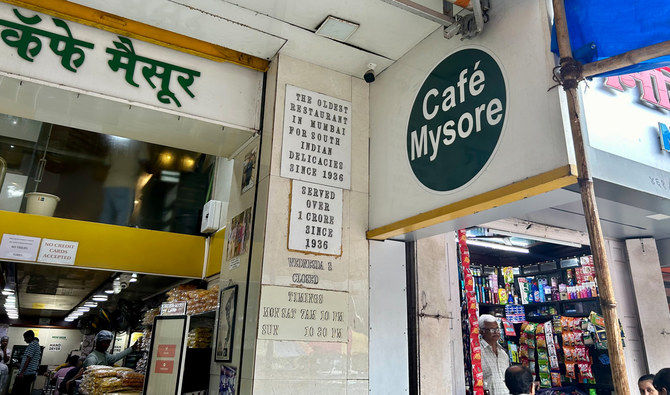
The entrance to Cafe Mysore in Mumbai, India, on July 20, 2024. (AN Photo)
Short Url
Updated 24 July 2024
Follow

Ambani wedding brings spotlight to Mumbai’s oldest restaurant for South Indian food

  • Cafe Mysore was established in Mumbai’s Matunga area in 1936
  • Viral clip shows India’s wealthiest family paying respect to its owner

MUMBAI: In the line of A-lister guests that Radhika Merchant and Anant Ambani greeted at their glitzy wedding, it was one elderly lady who had them bow and shout in reverence: “Thank you so much for coming! Every Sunday we eat your food.”
A short clip showing the scene soon went viral on social media, where the multimillion-dollar nuptials that took place over a week ago are still making the rounds.
The lady whom the son of Asia’s richest man and his bride received with so much warmth is Shateri Nayak, the owner of Cafe Mysore, the oldest restaurant in Mumbai for South Indian food.
Located near the King’s Circle railway station in Matunga area, it was founded in 1936 by Nayak’s father-in-law, Nagesh Rama Nayak, who moved to Mumbai from the southern state of Karnataka, and brought with him the flavors and quality that soon turned his business into a legendary spot.
But it was the recognition from the son and daughter-in-law of billionaire Mukesh Ambani that shot the place to Internet fame.
“I heard a lot about this, so I decided to visit,” Yashi Raj, a researcher at the Indian Institute of Technology in Mumbai, whose curiosity was piqued by India’s most expensive wedding.
She ordered Cafe Mysore’s special dosas — thin, savory crepes stuffed with paneer cheese, capsicum and vegetables — and dahi vada, or light round fritters with curd and spices on top.

“Both were superb and very tasty,” she told Arab News. “After visiting this cafe, I realized why it is so famous. It stays true to its taste and the food is very authentic.”
The restaurant’s nondescript interior is like of any other Indian eatery, but the flavors, diners say, are something else.
“I crave South Indian food quite a time and this is one of my very go-to places in Matunga, because they have an amazing rasam vada,” said Shrishti Tiwari, a student and Mumbai native.
She was referring to a popular appetizer made with lentil fritters in a soup that has tamarind juice as a base and is considered one of the healthiest South Indian comfort foods.
“I love their rasam, very frequently I come over for rasam vada,” Tiwari said. “I love this place because of the distinct flavors that come out in the masalas and the sambar ... and the people here treat you very nicely.”
Mythili Mistri, a business professional and the restaurant’s regular, comes almost every day for afternoon coffee and bonda, a crispy and savory potato snack.
Cafe Mysore’s coffee is typical filtered South Indian coffee — light and flavorful at the same time.
“I have been coming here for years actually ... I always come here for coffee and if I come in the afternoon they have this vegetable bonda which is excellent,” Mistri said.
She was not surprised that the restaurant appealed to all Indians, including the Ambanis.
“They are serving good food. We don’t get such good South Indian food in many locations,” she told Arab News.
“Just because you are rich it doesn’t mean that you don’t want to enjoy good food ... I think everybody likes to enjoy good food.”


At Jazan festival, Suad Al-Asiri paints memory, land and leadership

Updated 13 January 2026
Follow

At Jazan festival, Suad Al-Asiri paints memory, land and leadership

  • Local artist channels personal hardship into works that reflect Jazan’s identity, heritage
  • Jazan: A Nation and a Prince, places region at the heart of a composition featuring Prince Mohammed bin Abdulaziz and Prince Nasser bin Mohammed bin Abdullah bin Jalawi

RIYADH: At the Ahad Al-Masarihah pavilion at Jazan Festival 2026, Suad Al-Asiri’s paintings blend memory, place and personal history, offering visual narratives shaped by beauty and hardship. 

A novelist and visual artist, Al-Asiri has long used art as a storytelling tool. After a near-fatal car accident in March 2024, her work took on a new urgency. Bedridden for 11 months, cut off from the public world for more than a year, she describes that period as one of the most painful in her life — yet also transformative. 

“First of all, praise be to God for granting me life, as the accident was extremely severe,” she said. “By God’s grace, I was given a new life. All my thinking after the accident was about becoming an inspiration to others — about enduring pain and obstacles, and still leaving an impact.” 

Her return to public life came in 2025, when she participated in National Day celebrations with the ministry of interior. By the time she arrived at Jazan Festival, she was ready to channel that experience into her art. 

The centerpiece of her display, “Jazan: A Nation and a Prince,” places the region at the heart of a composition featuring Prince Mohammed bin Abdulaziz and Prince Nasser bin Mohammed bin Abdullah bin Jalawi, governor and deputy governor of Jazan respectively. 

Visitors linger over the details: the painting incorporates coffee beans, sesame and khudair — materials drawn from local products.

“I wanted people to recognize these products immediately,” she said. “They are part of Jazan’s daily life, and using them makes the work more tangible, more connected to everyday experience.” 

The painting sparks conversation. Visitors discuss leadership, identity, and the intimate relationship between people and their environment. 

Beyond the central piece, Al-Asiri presents individual portraits of the two princes, expanding the dialogue into a broader exploration of heritage and memory.  

Her journey into art is tied to her life as a storyteller. Early experiments with charcoal and pencil evolved into abstract art, drawn by its expressive freedom. 

From there, she explored realism, surrealism, and eventually modern art, particularly pop art, which has earned her wide recognition in artistic circles. Her novels and media work complement her visual practice, earning her the title “the comprehensive artist” from the governor.

Yet what stands out most in this exhibition is how Al-Asiri’s personal resilience flows through each piece. Her experience of surviving a devastating accident, enduring months of immobility, and returning to the public eye informs every brushstroke. 

Visitors sense not just her artistic skill, but her determination to turn life’s hardships into inspiration for others. 

Walking through the pavilion, one can see it in the way she blends heritage symbols, southern landscapes, and scenes of daily life. 

Each painting becomes both a document and a dialogue — a celebration of Jazan’s culture, a reflection on identity, and a testament to the power of human perseverance. 

At Jazan Festival 2026, Suad Al-Asiri’s art is a quiet, persistent inspiration for anyone who pauses long enough to listen.