

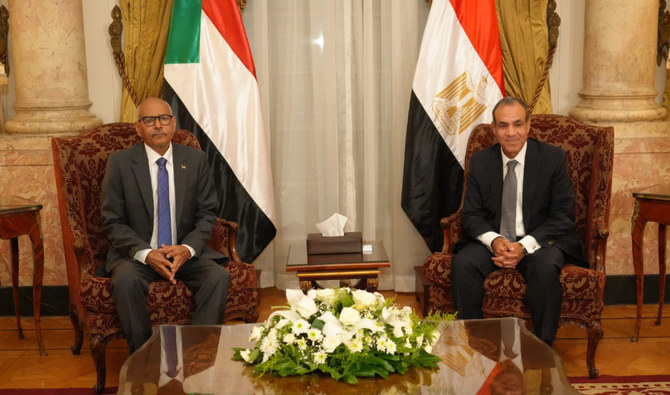

Egypt’s foreign minister, Badr Abdelatty, pledged his country’s continued support for the stability and security of Sudan, during a meeting on Tuesday with his counterpart from the country, Hussein Awad.
Abdelatty said Egypt would spare no effort to help its “Sudanese brothers overcome the political, security and humanitarian challenges resulting from the ongoing war” in the nation.
He highlighted the outcomes of a conference in Cairo on July 6 and 7 attended by Sudanese political factions and civil groups, the most important of which were, he said, recognition of the need to preserve state institutions, to provide relief and humanitarian support to Sudan and neighboring countries, and to ensure ownership of the political process remains with the Sudanese people.
He also reviewed the progress of development projects undertaken by Egypt in Sudan, and pledged his country’s continuing commitment to such initiatives along with its determination to respond to the nation’s humanitarian needs.
Abdelatty stressed the important need for donor countries and organizations to accelerate the fulfillment of pledges made during conferences in Geneva and Paris, in June 2023 and April 2024 respectively, of support for Sudan and neighboring countries hosting Sudanese refugees, support for the UN’s humanitarian response plan in the country, and to help bridge existing financing gaps.
He also discussed with Awad regional initiatives that have been proposed to help address the crisis in Sudan, and the important and pivotal role neighboring countries are playing, especially Egypt, which Abdelatty said was making strenuous efforts to help Sudan at this important time.
Other topics for discussion included wider bilateral ties and ways in which coordination between the countries might be enhanced, along with regional issues of mutual interest, including the situation in the Horn of Africa, the war in Gaza, security in the Red Sea, the situations in Libya, the Sahel and the Sahara region, and the Renaissance Dam built by Ethiopia on the Blue Nile upstream of Sudan and Egypt.
Awad thanked the Egyptian government for the facilities and services it has provided to the Sudanese people since the start of the crisis in his country.


