Ukraine’s foreign minister arrives in China to discuss ‘fair peace’

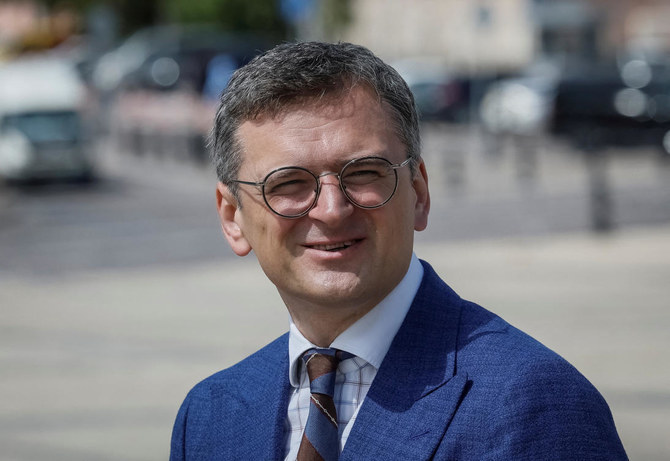
Ukraine's foreign minister Dmytro Kuleba arrived in China on Tuesday for talks with Foreign Minister Wang Yi on ways to achieve a "fair peace" in the war with Russia and also to discuss bilateral relations. (Reuters/File)
Short Url
Updated 23 July 2024
Follow

Ukraine’s foreign minister arrives in China to discuss ‘fair peace’

  • Kuleba said he would hold “extensive, detailed, substantive negotiations” with his Chinese counterpart
  • “We must avoid competition between peace plans. It is very important that Kyiv and Beijing conduct a direct dialogue,” he wrote in a statement on Instagram

KYIV: Ukraine’s foreign minister arrived in China on Tuesday for talks with Foreign Minister Wang Yi on ways to achieve a “fair peace” in the war with Russia and also to discuss bilateral relations, he said.
Dmytro Kuleba’s visit is the first by a high-ranking Ukrainian official since Russia’s full-scale February 2022 invasion, which China, the world’s second largest economy, has not publicly condemned.
Kuleba said he would hold “extensive, detailed, substantive negotiations” with his Chinese counterpart, but did not say when the talks would happen. He said earlier his trip would continue until Thursday.
“We must avoid competition between peace plans. It is very important that Kyiv and Beijing conduct a direct dialogue,” he wrote in a statement on Instagram, announcing his arrival in China.
Various peace initiatives have emerged in recent months ahead of a US election in November that could see the return to the White House of former president Donald Trump who has threatened to cut vital aid flows to Ukraine. The United States under President Joe Biden has been Ukraine’s biggest backer.
Kyiv is pushing to hold a second international summit later this year to advance its vision for peace after an initial gathering in Switzerland in June drew dozens of delegations from around the world but not from Russia or China.
Ukraine has said it would like its second summit to be hosted by a “Global South” country and that Russia could attend. Kyiv has also said it would like to see China play a more active role in ending the war.
China and Brazil published a joint six-point peace proposal in May, saying they supported the holding of an international peace conference that both sides in the war would recognize.
Kuleba said his trip to China, the first by a Ukrainian foreign minister since 2012, aimed to develop contacts between Chinese and Ukrainian leaders.
China declared a “no limits” partnership with Russia in 2022 days before the invasion and has helped Russia keep its economy afloat. China says its ties with Russia are built on the basis of non-alliance and do not target any third party.


Terror at Friday prayers: Witnesses describe blast rocking Islamabad mosque

Updated 40 min 15 sec ago
Follow

Terror at Friday prayers: Witnesses describe blast rocking Islamabad mosque

  • The Daesh group has claimed responsibility for the attack, according to the SITE Intelligence Group, which monitors jihadist communications

ISLAMABAD: A worshipper at the Shiite mosque in Islamabad where dozens of people were killed in a suicide blast on Friday described an “extremely powerful” explosion ripping through the building just after prayers started.
Muhammad Kazim, 52, told AFP he arrived at the Imam Bargah Qasr-e-Khadijatul Kubra mosque shortly after 1:00 p.m. (0800 GMT) on Friday and took up a place around seven or eight rows from the Imam.
“During the first bow of the Namaz (prayer ritual), we heard gunfire,” he told AFP outside the Pakistan Institute of Medical Sciences (PIMS) hospital, where many of the wounded were brought for treatment.
“And while we were still in the bowing position, an explosion occurred,” he said.
Kazim, who is from Gilgit-Baltistan in northern Pakistan and lives in Islamabad, escaped unharmed, but accompanied his wounded friend to the PIMS hospital for treatment.
“It was unclear whether it was a suicide bombing, but the explosion was extremely powerful and caused numerous casualties,” Kazim said.
“Debris fell from the roof, and windows were shattered,” he added. “When I got outside, many bodies were scattered... Many people lost their lives.”

People mourn the death of their relatives following a suicide bombing at a Shiite mosque, outside a hospital in Islamabad on February 6, 2026. (AFP)

The Daesh group has claimed responsibility for the attack, according to the SITE Intelligence Group, which monitors jihadist communications.
Another worshipper, Imran Mahmood, described a gunfight between the suicide bomber, a possible accomplice and volunteer security personnel at the mosque.
“The suicide attacker was trying to move forward, but one of our injured volunteers fired at him from behind, hitting him in the thigh,” Mahmood, in his fifties, told AFP.
“He fell but got up again. Another man accompanying him opened fire on our volunteers,” he said, adding the attacker “then jumped onto the gate and detonated the explosives.”
As of Saturday morning, the death toll stood at 31, with at least 169 wounded.
The attack was the deadliest in the Pakistani capital since September 2008, when 60 people were killed in a suicide truck bomb blast that destroyed part of the five-star Marriott hotel.

Shiite Muslims demand adequate security from the government during an impromptu protest outside a hospital following a suicide bombing at a Shiite mosque in Islamabad on February 6, 2026. (AFP)

Lax security

Describing the aftermath of the attack, Kazim said unhurt worshippers went to the aid of those wounded.
“People tried to help on their own, carrying two or three bodies in the trunks of their vehicles, while ambulances arrived about 20 to 25 minutes later,” he told AFP.
“No one was allowed near the mosque afterwards.”
Kazim, who has performed Friday prayers at the mosque “for the past three to four weeks,” said security had been lax.
“I have never seen proper security in place,” he told AFP.
“Volunteers manage security on their own, but they lack the necessary equipment to do it effectively,” he said.
“Shiite mosques are always under threat, and the government should take this seriously and provide adequate security,” he added.