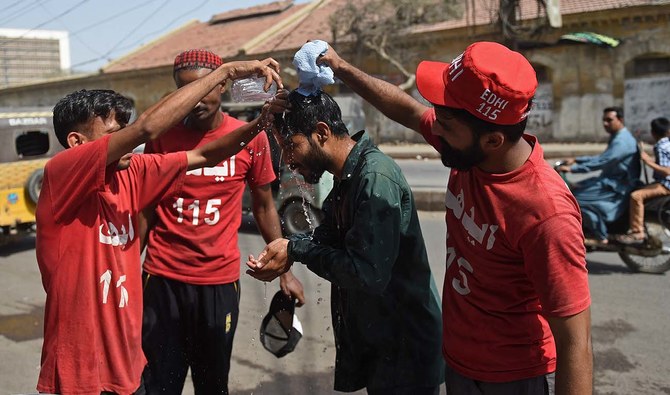
KARACHI: Pakistan’s southern Sindh province, which has been in the grip of hot weather for months, has extended summer vacations in educational institutions till August 14, the provincial education department said on Tuesday, as a Pakistani charity reported nine suspected heat-related deaths.
Pakistan has witnessed several heat waves since May, with temperatures rising above 52°C (125.6°F) in the Sindh province, according to the Pakistan Meteorological Department (PMD).
The province has received less rains so far this year, compared to other parts of Pakistan, while residents complain of humid weather making the weather even hotter for them.
On Tuesday, Edhi Foundation, Pakistan’s largest charity, said it had found nine bodies in Hyderabad, the second-largest city in Sindh, suspected to have died from extreme heat, with temperatures recorded at 41°C a day earlier.
“The summer vacation are hereby extended in all public and private institutions under the administrative control of the School Education and Literacy Department till 14.8.2024 in the wake of the heatwave and expected monsoon rains,” the Sindh education department said in a notification.
Sumer vacations in Sindh schools were due to end on July 31, according to an earlier notification issued by authorities.
Deaths in Hyderabad
Earlier in the day, Mairaj Ahmed, a top Edhi Foundation official in Hyderabad, said their volunteers found nine dead bodies in the city on Monday, which was “the largest number in recent years.”
“We typically discover one or two bodies a day, but since the beginning of the heat wave, the number has often risen to three, four or even five per day,” he told Arab News.
Ali Nawaz Channa, a spokesperson of the Sindh health department, told Arab News no such deaths were recorded in Hyderabad on Monday, though the Edhi Foundation shared the details of all individuals, including their phone numbers.
“Yesterday, we found nine bodies. Today, we have found two more,” Ahmed said, adding most of the deceased were drug addicts and beggars who often stay on the streets.
“While we are not qualified to confirm that heatstroke was the cause of death, we are certain that these deaths are linked to hot weather.”
Earlier this month, Muhammad Amin, an Edhi Foundation official in Karachi, told Arab News that hundreds of people were brought to the charity organization’s morgues who had possibly died of hot weather.
“We have received 1,309 dead bodies since June 19,” Amin said, though he was unable to confirm if all the bodies belonged to people who had lost their lives due to heat wave complications.
The Sindh health department has reported only 45 people died of heatstroke, though 3,338 people experienced it across the province in the ongoing summer season.
The health department has not shared data on heatstroke cases for July.
Rain and flash flood forecast
On Sunday, the Provincial Disaster Management Authorities (PDMA) in Sindh warned of flash floods in the province amid a forecast of heavy rains, the state-run Radio Pakistan broadcaster reported.
Rains and thunderstorms are likely to hit Sindh’s Tharparkar, Umarkot, Badin, Mirpurkhas, Sanghar, Hyderabad, Tando Mohammad Khan, Tando Allah Yar, Matiari, Kambar, Shadad kot, Kashmore, Shikarpur, Jacobabad, Ghotki, Sukkur, Thatta and Sajawal districts this week.
A PDMA spokesperson urged the masses to follow the government’s instructions and take necessary precautionary measures to avoid any incident.
Pakistan is recognized as one of the most vulnerable countries to climate change effects in the world. Unusually heavy rains in June 2022 triggered flash floods in many parts of the country, killing over 1,700 people, inflicting losses of around $30 billion, and affecting at least 30 million people.


![]()

Pakistan’s Sindh extends summer vacations as charity suspects nine heat-related deaths in Hyderabad
Short Url
https://arab.news/mjuhy
Pakistan’s Sindh extends summer vacations as charity suspects nine heat-related deaths in Hyderabad
- Pakistan has witnessed several heat waves since May, with temperatures rising above 52°C in the Sindh province
- Provincial Disaster Management Authorities has also warned of flash floods in Sindh amid forecast of heavy rains
Latest updates


Recommended


© 2026 SAUDI RESEARCH & PUBLISHING COMPANY, All Rights Reserved And subject to Terms of Use Agreement.