

Scramble to send aid after Ethiopia landslide kills over 200

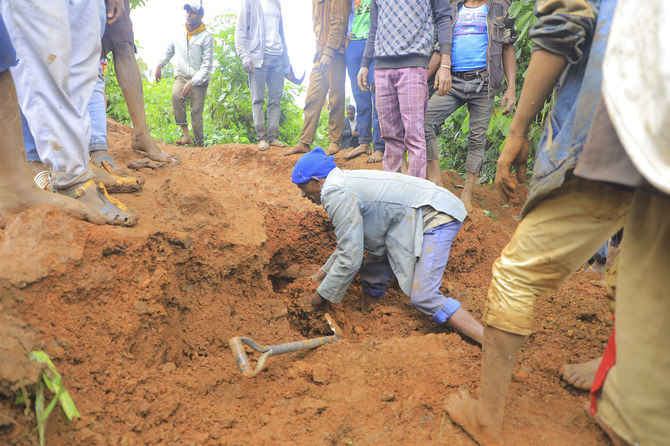
In this handout photo released by Gofa Zone Government Communication Affairs Department, a man searches for survivors hundreds of people gather at the site of a mudslide in the Kencho Shacha Gozdi district, Gofa Zone, southern Ethiopia, Monday, July 22, 2024. (Gofa Zone Government Communication Affairs Department via AP)
Short Url
Updated 24 July 2024
Follow

Scramble to send aid after Ethiopia landslide kills over 200

  • Crowds gathered at the site of the tragedy in an isolated and mountainous area of South Ethiopia regional state as some people clawed through mounds of red dirt
  • Among the victims were the locality’s administrator as well as teachers, health professionals and agricultural professionals

ADDIS ABABA: Humanitarian agencies were scrambling Tuesday to send desperately needed aid to a remote area of southern Ethiopia where a landslide has killed more than 200 people in the deadliest such disaster recorded in the Horn of Africa nation.

Crowds gathered at the site of the tragedy in an isolated and mountainous area of South Ethiopia regional state as residents used shovels or their bare hands to dig through mounds of red dirt in the hunt for victims and survivors, according to images posted by the local authority.

So far, 148 men and 81 women are confirmed to have died after the disaster struck on Monday in the Kencho-Shacha locality in the Gofa Zone, the local Communications Affairs Department said.

Images published on social media by the Gofa authority showed residents carrying bodies on makeshift stretchers, some wrapped in plastic sheeting.

Five people had been pulled alive from the mud and were receiving treatment at medical facilities, the government-owned Ethiopian Broadcasting Corporation reported earlier.

It quoted local administrator Dagemawi Ayele as saying that most of the victims were buried after they went to help local residents hit by a first landslide following heavy rains.

Dagemawi said that among the victims were the locality’s administrator as well as teachers, health professionals and agricultural professionals.

The UN’s humanitarian response agency OCHA said more than 14,000 people had been affected in the hard-to-access area, which is roughly 450 kilometers (270 miles) from the capital Addis Ababa, about a 10-hour drive.

It said support for those affected was mostly being shouldered by the local community but some initial relief items had been sent by federal and regional authorities and local partners, including four trucks of supplies dispatched by the Ethiopian Red Cross for 500 households.

“Agencies are ready to deliver critical supplies, including food, medical items, and water, sanitation and hygiene support,” OCHA said, adding that agencies would be assessing the scale of the impact of the tragedy, including displacement and damage to livelihoods.

Ethiopia, the second most populous country in Africa with around 120 million people, is highly vulnerable to climate disasters including flooding and drought.

“I am deeply saddened by this terrible loss,” Ethiopian Prime Minister Abiy Ahmed said on X.

“Following the accident, the Federal Disaster Prevention Task Force has been deployed to the area and is working to reduce the impact of the disaster.”

World Health Organization chief Tedros Adhanom Ghebreyesus, who is Ethiopian, sent a message of condolence on X and said a WHO team was being deployed to support immediate health needs.

African Union Commission chief Moussa Faki Mahamat also posted a statement on X, saying “our hearts and prayers” were with the families of the victims.

Firaol Bekele, early warning director at the Ethiopian Disaster Risk Management Commission (EDRMC), told AFP that residents had mobilized to try to save lives after four households were initially affected by a mudslide.

“But they too perished when the landslide engulfed them,” he said, adding that the commission had sent an emergency team to the area, along with food and other aid for the stricken community.

He said there needed to be a “solid assessment and scientific investigation” into the cause of the landslide.

“An integrated, study-based solution is needed to address the risk permanently. This may include relocating the population.”

OCHA said Tuesday that a similar, but lower-scale landslide had occurred in May in the same area, where more than 50 people had died.

Seasonal rains in South Ethiopia state between April and early May had caused flooding, mass displacement and damage to livelihoods and infrastructure, it had said in May.

“This isn’t the first time this type of disaster has happened,” said an Ethiopian refugee living in Kenya who is from a district located near the site.

“Last year in a similar disaster more than 20 people were killed and before that almost every rainy season people die because of landslides and heavy rains in that area.”

In another incident in 2017, at least 113 people died when a mountain of garbage collapsed in a dump in the outskirts of Addis Ababa.

The deadliest landslide in Africa was in Sierra Leone’s capital in Freetown in August 2017, when 1,141 people perished.

Mudslides in the Mount Elgon region of eastern Uganda killed more than 350 people in February 2010.


Nigerian villagers are rattled by US airstrikes that made their homes shake and the sky glow red

Updated 4 sec ago
Follow

Nigerian villagers are rattled by US airstrikes that made their homes shake and the sky glow red

JABO: Sanusi Madabo, a 40-year-old farmer in the Nigerian village of Jabo, was preparing for bed on Thursday night when he heard a loud noise that sounded like a plane crashing. He rushed outside his mud house with his wife to see the sky glowing a bright red.
The light burned bright for hours, Madabo said: “It was almost like daytime.”
He did not learn until later that he had witnessed a USattack on an alleged camp of the militant Daesh group.
US President Donald Trump announced late Thursday that the United States had launched a “powerful and deadly strike” against Daesh militants in Nigeria. The Nigerian government has since confirmed that it cooperated with the US government in its strike.
A panicked village
Nigerian government spokesperson Mohammed Idris said Friday that the strikes were launched from the Gulf of Guinea in the Atlantic Ocean shortly after midnight and involved “16 GPS-guided precision” missiles and also MQ-9 Reaper drones.
Idris said the strikes targeted areas used as “staging grounds by foreign” Daesh fighters who had sneaked into Nigeria from the Sahel, the southern fringe of Africa’s vast Sahara Desert. The government did not release any casualty figures among the militants.
Residents of Jabo, a village in the northwestern Nigerian state of Sokoto, spoke to The Associated Press on Friday about panic and confusion among the villagers following the strikes, which they said hit not far from Jabo’s outskirts. There were no casualties among the villagers.
They said that Jabo has never been attacked as part of the violence the US says is widespread — though such attacks regularly occur in neighboring villages.
Abubakar Sani, who lives on the edge of the village, recalled the “intense heat” as the strikes hit.
“Our rooms began to shake, and then fire broke out,” he told the AP.
“The Nigerian government should take appropriate measures to protect us as citizens,” he added. “We have never experienced anything like this before.”
It’s a ‘new phase of an old conflict’
The strikes are the outcome of a months long tense diplomatic clash between the West African nation and the US
The Trump administration has said Nigeria is experiencing a genocide of Christians, a claim the Nigerian government has rejected.
However, Nigeria’s Ministry of Foreign Affairs now said the strikes resulted from intelligence sharing and strategic coordination between the two governments.
Yusuf Tuggar, Nigeria’s foreign minister, called the airstrikes a “new phase of an old conflict” and said he expected more strikes to follow.
“For us, it is something that has been ongoing,” Tuggar added, referring to attacks that have targeted Christians and Muslims in Nigeria for years.
Bulama Bukarti, a security analyst on sub-Saharan Africa, said the residents’ fear is compounded by a lack of information.
Nigerian security forces have since cordoned off the area of the strikes and access was not allowed.
Bukarti said transparency would go a long way to calm the local residents. “The more opaque the governments are, the more panic there will be on the ground, and that is what will escalate tensions.”
Foreign fighters operate in Nigeria
Analysts say the strikes might have been intended for the Lakurawa group, a relatively new entrant to Nigeria’s complex security crisis.
The group’s first attack was recorded around 2018 in the northwestern region before the Nigerian government officially announced its presence last year. The composition of the group has been documented by security researchers as primarily consisting of foreigners from the Sahel.
However, experts say ties between the Lakurawa group and Daesh are unproven. The Islamic State West African Province — a Daesh affiliate in Nigeria — has its strongholds in the northeastern part of the country, where it is currently involved in a power struggle with its parent organization, Boko Haram.
“What might have happened is that, working with the American government, Nigeria identified Lakurawa as a threat and identified camps that belong to the group,” Bukarti said.
Still, some local people feel vulnerable.
Aliyu Garba, a Jabo village leader, told the AP that debris left after the strikes was scattered, and that residents had rushed to the scene. Some picked up pieces of the debris, hoping for valuable metal to trade, and Garba said he fears they could get hurt.
The strikes rattled 17-year-old Balira Sa’idu, who has been preparing for her upcoming marriage.
“I am supposed to be thinking about my wedding, but right now I am panicking,” she said. “The strike has changed everything. My family is afraid, and I don’t even know if it is safe to continue with the wedding plan in Jabo.”