

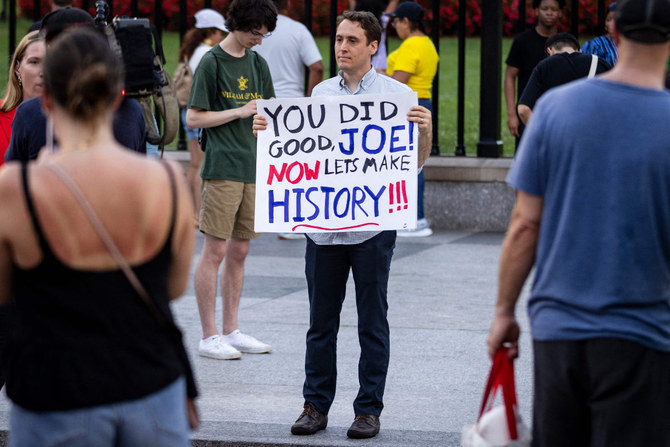



HARPER WOODS, Michigan: After weeks of uncertainty about who would be at the top of the Democratic Party’s ticket in November, many voters expressed relief over the news that President Joe Biden would drop his reelection bid and began to think about who might replace him in a dramatically altered election landscape.
Jerod Keene, a 40-year-old athletic trainer from swing-state Arizona, had planned to vote for Biden in November but was thankful for the president’s decision, calling it “inevitable.” Keene said he’s excited about the next candidate, hoping it will be Vice President Kamala Harris, whom Biden endorsed on Sunday.
“Kamala Harris is the easiest pick based on the fact that she’s vice president and it would be tough for the party to try to go a different direction on that,” said Keene, who lives in Tucson. “And I think she seems ready.”
The Democratic Party has been deeply divided since Biden’s poor debate performance on June 27, which left many questioning his ability to defeat Republican Donald Trump in November and secure another term. Party leaders had increasingly called for Biden to step aside, but his reluctance to bow out left voters nationwide uncertain about who would face Trump in November.
Recent AP-NORC polling revealed that nearly two-thirds of Democrats felt Biden should withdraw from the presidential race, while a majority believe Harris would perform well in the top slot.
Keene’s relief that the saga surrounding Biden’s decision was over was echoed by voters nationwide in interviews with The Associated Press. In key swing states such as Wisconsin, Arizona, Michigan, Pennsylvania, Georgia, and Nevada, many expressed optimism about the party’s next nominee — whether it be Harris or someone else.
In Pittsburgh, Fred Johnston said he has been terrified of another Trump presidency and had long worried that Biden couldn’t beat Trump again. After seeing Biden’s wobbly debate performance, he was eager for Biden to drop out and hand off his candidacy to Harris.
“Kamala is someone we can vote for, and that’s what we need,” Johnston said.
He also thinks she can win Pennsylvania: “I have no logical basis for this, but it’s good to have hope. I haven’t had hope for a while.”
In Las Vegas, Lucy Ouano, 68, said she was proud of both Biden’s decision to drop out of the race and his move to quickly endorse Harris.
“He’s ending on a great note,” Ouano said. “Trump should be worried. He’s now running against someone strong.”
Ouano, who emigrated in 1960 to the US from Thailand as a young child with her parents, said she couldn’t have imagined this outcome just a few weeks ago when she attended a Harris rally in Las Vegas meant to quiet concerns about Biden’s reelection campaign.
At the time, she told the AP that while she planned on voting for Biden, she wanted Harris at the top of the ticket.
“She’s going to get the Asians drummed up, and she’s going to get the women drummed up,” Oaano said Sunday after learning about Biden’s decision.
Similarly, Arthur L. Downard Jr., a 72-year-old resident of Portland, Oregon, viewed Biden’s presidency favorably but said he was “very pleased” that Biden stepped aside. The Democratic voter, who cast his ballot for Biden in 2020, said his opinion of Biden changed after what he called a “disastrous” debate.
“He’s been a great president and he’s gotten a lot done for our country. But he’s too old, he’s not articulate,” he said. “He’s not a good messenger for the Democratic Party.”
Some voters, like Nebraska resident Lacey LeGrand, had planned to reluctantly vote for Biden simply because he wasn’t Trump.
“I’m definitely not supporting Trump,” LeGrand said. “So I think by default I was going to end up supporting Biden. I wasn’t very happy about it.”
LeGrand, a registered Democrat in Nebraska’s swing district, a potentially decisive electoral vote that Biden and Obama both won previously, believes Harris “has a shot” at defeating Trump, though she added, “I wouldn’t say it’s a great shot.”
But not all voters were happy about Sunday’s news. Georgia voter Dorothy Redhead, 76, was “disappointed” that Biden dropped out of the race but said she is “just having to accept” Biden’s decision as one between the president and God.
Jarvia Haynes, a real estate agent in New Orleans, said she has “mixed feelings” about Biden’s decision to leave the race.
“I don’t think President Biden should have dropped out,” she said. “On the other hand, maybe it’s for the best.”
Haynes, 72, of Harvey, Louisiana, a suburb of New Orleans, quickly focused on who should lead the Democratic ticket, saying she is “very positive about Vice President Kamala Harris being able to handle the job.”
She added that she hopes Harris would choose Michigan Gov. Gretchen Whitmer to be her running mate.
“I think two women would change the whole dynamic of the race,” said Haynes, who joins Harris as a member of Alpha Kappa Alpha Sorority, Inc., the first intercollegiate historically African American sorority. The group boasts more than 360,000 members in graduate and undergraduate chapters in 12 countries and could be a formidable political force of its own.
Barbara Orr, a psychotherapist in the Lancaster, Pennsylvania area, said she thought Biden was capable of running for president, beating Trump and serving as president. She viewed his decision to end his candidacy, however, as a sign that he is not guided by ego and recognized that, because of his debate performance, voters assume that he can’t do the job.
Orr, 65, said she isn’t “super impressed” with Harris, “but she might rise to the occasion. That’s happened before in history.”
She also acknowledged that Harris hasn’t had the chance to prove her mettle as a candidate against Trump.
Orr, a self-described progressive who favored Vermont Sen. Bernie Sanders or Massachusetts Sen. Elizabeth Warren for president in 2020, said she would probably prefer Whitmer to replace Biden on the Democratic ticket.
“I love what she stands for,” Orr said.
Joe DeFrain was out kayaking when a text informed him that Biden had dropped out. While the Grosse Pointe Woods, Michigan, resident said he wasn’t stunned to learn of the development, one thing did surprise him.
“I was waiting to see if all the boaters out there were going to be screaming with joy, because a lot of them are Trump fans. And I didn’t hear anything,” DeFrain said after sitting down for dinner at They Say, a restaurant in the Detroit suburb of Harper Woods.
Biden visited They Say earlier this year, a moment that manager George Ledbetter said was “the best ever.”
Ledbetters’ first reaction to the news came down to a single word: “Why?”
“He’s a good president. I like Biden,” Ledbetter said. But, he added, “You gotta do what you gotta do.”
Ledbetter said he’ll support Harris despite his disappointment.
“I’ll take that, too. I think she can do it. First woman president. That’d be nice. African American president. It’d be nice again,” said Ledbetter, who is Black.
As for DeFrain, he said he’ll be watching to see what happens before and during the Democratic National Convention.
“It’s going to be something we have never seen in our lifetime,” said DeFrain, who has voted for Democrats in recent elections. “It should be entertaining.”


