

Pakistan’s Hajj Medical Mission wraps up operations, says treated over 169,000 pilgrims 

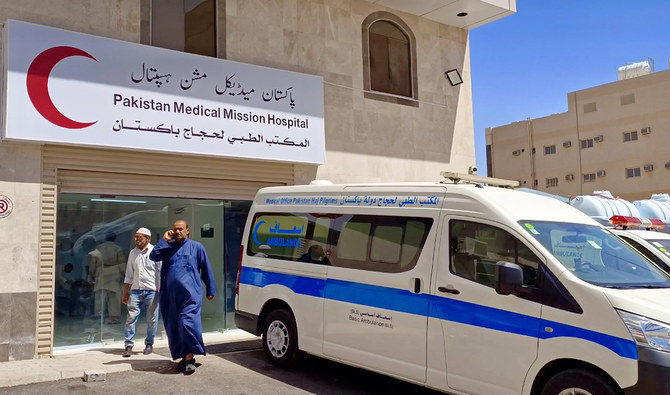
People walk past Pakistan Medical Mission Hospital in Madinah on May 16, 2024, as Pakistani Hajj Mission sets up medical facilities for Pakistani pilgrims in Saudi Arabia ahead of annual Islamic pilgrimage. (Photo courtesy: Pakistan Hajj Medical Mission/File)
Short Url
Updated 21 July 2024
Follow

Pakistan’s Hajj Medical Mission wraps up operations, says treated over 169,000 pilgrims 

  • Pakistan Hajj Medical Mission also treated pilgrims from other countries who sought assistance, says director 
  • Over 400-member mission provided pilgrims with health care facilities in Makkah and Madinah since May 9

ISLAMABAD: The Pakistan Hajj Medical Mission wrapped up its operations in Saudi Arabia this week after treating over 169,000 pilgrims in the kingdom, the mission’s director confirmed on Sunday. 

Over 160,000 Pakistanis attended this year’s annual Hajj pilgrimage, which ran from June 14-19. Pakistan established two hospitals and 11 dispensaries in the holy cities of Makkah and Madinah on May 9. 

“The Pakistan Hajj Medical Mission completed its operations in Saudi Arabia on July 20, and since the start of services on May 9 this year, almost 169,000 pilgrims received free health treatment,” Brig. Jamil Ahmed Lakhair, the mission’s director, told Arab News over the phone from Makkah.

Lakhair said that out of the total number of patients, at least 60 percent were male while 40 percent were women. He said the mission also provided services to pilgrims from other countries who sought medical assistance.

Lakhair said a dedicated team of over 400 members from the medical mission tirelessly performed their duties to assist Pakistani pilgrims in Saudi Arabia during the annual Islamic pilgrimage.

“More than 19000 lab tests were done on almost 4000 patients and around 5000 patients availed dental treatment facilities, including minor procedures,” he revealed. Lakhair said over 3,000 patients availed radiological facilities, including ultrasound, at the hospital.

The Pakistani official credited the Saudi government for ensuring excellent medical facilities, praising their robust patient evacuation system and well-equipped hospitals, adding that Pakistan’s medical mission helped pilgrims access these facilities.

“Two hundred and fifty patients treated in tertiary care facilities of the kingdom’s hospitals as indoor cases,” Lakhair said. 

He shared that over 12,000 pilgrims were treated as emergency cases while 188 bed-ridden patients were taken to Arafat for Hajj rituals in ambulances and buses.

He said respiratory tract infections and musculoskeletal problems were the most common among pilgrims, accounting for 18 percent of the total cases, followed by gastrointestinal problems at 12 percent, diabetes mellitus at 11 percent, unspecified fever at 9 percent, and cardiovascular diseases, including hypertension and ischemic heart diseases, at 5 percent


Islamic military coalition, Pakistan to deepen cooperation to combat ‘terrorism’ — Pakistani military

Updated 02 February 2026
Follow

Islamic military coalition, Pakistan to deepen cooperation to combat ‘terrorism’ — Pakistani military

  • Islamic Military Counter Terrorism Coalition is a 43-member alliance that includes Pakistan, Saudi Arabia, Egypt, Jordan, UAE and other nations
  • The Pakistani military statement comes after a meeting between IMCTC secretary-general and the chief of Pakistani defense forces in Rawalpindi

ISLAMABAD: Pakistan and the Islamic Military Counter Terrorism Coalition (IMCTC) have reaffirmed their commitment to deepening cooperation, including intelligence sharing and capacity building, to jointly combat “terrorism” and “extremism,” the Pakistani military said on Monday.

The IMCTC is a 43-member military alliance that was formed on Saudi Arabia’s initiative in Dec. 2015 to consolidate Muslim countries’ efforts in countering “terrorism.”

A 17-member IMCTC delegation is visiting Pakistan from Feb. 2-6 to conduct a training at National University of Sciences and Technology on “Re-integration and Rehabilitation of Extremist Elements,” according to the Pakistani military.

On Monday, IMCTC Secretary-General Maj. Gen. Mohammed bin Saeed Al-Moghedi held a meeting with Chief of Pakistani Defense Forces Field Marshal Asim Munir to discuss cooperation among IMCTC member states.

“During the meeting, matters of mutual interest were discussed, with particular emphasis on regional security dynamics and enhanced cooperation in counter-terrorism efforts,” the Inter-Services Public Relations (ISPR), the Pakistani military’s media wing, said in a statement.

“Both sides reaffirmed their shared commitment to combating terrorism and extremism through collaborative strategies, intelligence sharing, and capacity building among member states.”

The IMCTC features Pakistan, Saudi Arabia, Türkiye, Afghanistan, Egypt, Jordan, Qatar, Palestine, UAE, Bangladesh and other nations. In 2017, Pakistan’s former army chief Gen. (retd) Raheel Sharif was appointed as the IMCTC commander-in-chief.

During discussions with Major General Al-Moghedi, Field Marshal Munir appreciated the role of IMCTC in fostering stability and promoting coordinated counterterrorism initiatives across the Islamic world, according to the ISPR.

The IMCTC secretary-general acknowledged Pakistan’s significant contributions and sacrifices in the fight against militancy and lauded the professionalism of Pakistan’s armed forces.

“The meeting underscored the resolve of both sides to further strengthen institutional collaboration for peace, stability, and security in the region,” the ISPR added.

Pakistan enjoys cordial ties with most Muslim countries around the world, particularly Gulf Cooperation Council countries. In Sept. 2025, Pakistan signed a landmark defense pact with Saudi Arabia according to which an act of aggression against one country will be treated as an act of aggression against both.