
PARIS: A year ago, the head of the Paris Olympics boldly declared that France’s capital would be ” the safest place in the world ” when the Games open this Friday.
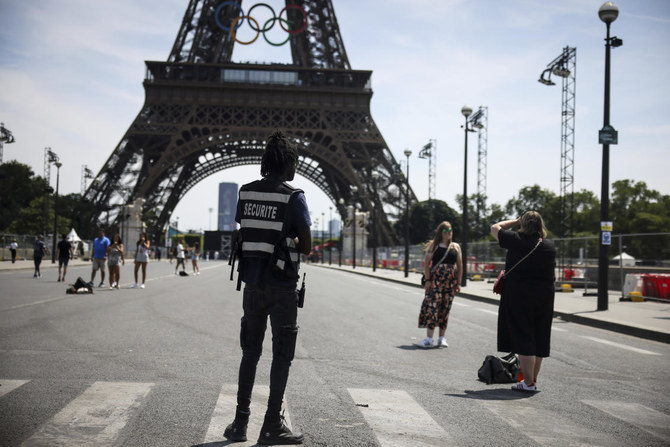
Tony Estanguet’s confident forecast looks less far-fetched now with squadrons of police patrolling Paris’ streets, fighter jets and soldiers primed to scramble, and imposing metal-fence security barriers erected like an iron curtain on both sides of the River Seine that will star in the opening show.
France’s vast police and military operation is in large part because the July 26-Aug. 11 Games face unprecedented security challenges. The city has repeatedly suffered deadly extremist attacks and international tensions are high because of the wars in Ukraine and Gaza.
Rather than build an Olympic park with venues grouped together outside of the city center, like Rio de Janeiro in 2016 or London in 2012, Paris has chosen to host many of the events in the heart of the bustling capital of 2 million inhabitants, with others dotted around suburbs that house millions more. Putting temporary sports arenas in public spaces and the unprecedented choice to stage a river-borne opening ceremony stretching for kilometers (miles) along the Seine, makes safeguarding them more complex.
Olympic organizers also have cyberattack concerns, while rights campaigners and Games critics are worried about Paris’ use of AI-equipped surveillance technology and the broad scope and scale of Olympic security.
Paris, in short, has a lot riding on keeping 10,500 athletes and millions of visitors safe. Here’s how it aims to do it.
The security operation, by the numbers
A Games-time force of up to 45,000 police and gendarmes is also backed up by a 10,000-strong contingent of soldiers that has set up the largest military camp in Paris since World War II, from which soldiers should be able to reach any of the city’s Olympic venues within 30 minutes.
Armed military patrols aboard vehicles and on foot have become common in crowded places in France since gunmen and suicide bombers acting in the names of Al-Qaeda and the Daesh group repeatedly struck Paris in 2015. They don’t have police powers of arrest but can tackle attackers and restrain them until police arrive. For visitors from countries where armed street patrols aren’t the norm, the sight of soldiers with assault rifles might be jarring, just as it was initially for people in France.
“At the beginning, it was very strange for them to see us and they were always avoiding our presence, making a detour,” said Gen. Éric Chasboeuf, deputy commander of the counter-terror military force, called Sentinelle.
“Now, it’s in the landscape,” he said.
Rafale fighter jets, airspace-monitoring AWACS surveillance flights, Reaper surveillance drones, helicopters that can carry sharpshooters, and equipment to disable drones will police Paris skies, which will be closed during the opening ceremony by a no-fly zone extending for 150 kilometers (93 miles) around the capital. Cameras twinned with artificial intelligence software — authorized by a law that expands the state’s surveillance powers for the Games — will flag potential security risks, such as abandoned packages or crowd surges,
France is also getting help from more than 40 countries that, together, have sent at least 1,900 police reinforcements.
Trump assassination attempt highlights Olympic risks
Attacks by lone individuals are major concern, a risk driven home most recently to French officials by the assassination attempt against Donald Trump.
Some involved in the Olympic security operation were stunned that the gunman armed with an AR-style rifle got within range of the former US president.
“No one can guarantee that there won’t be mistakes. There, however, it was quite glaring,” said Gen. Philippe Pourqué, who oversaw the construction of a temporary camp in southeast Paris housing 4,500 soldiers from the Sentinelle force.
In France, in the last 13 months alone, men acting alone have carried out knife attacks that targeted tourists in Paris, and children in a park in an Alpine town, among others. A man who stabbed a teacher to death at his former high school in northern France in October had been under surveillance by French security services.
With long and bitter experience of deadly extremist attacks, France has armed itself with a dense network of police units, intelligence services and investigators who specialize in fighting terrorism, and suspects in terrorism cases can be held longer for questioning.
Hundreds of thousands of background checks have scrutinized Olympic ticket-holders, workers and others involved in the Games and applicants for passes to enter Paris’ most tightly controlled security zone, along the Seine’s banks. The checks blocked more than 3,900 people from attending, Interior Minister Gerald Darmanin said. He said some were flagged for suspected Islamic radicalization, left- or right-wing political extremism, significant criminal records and other security concerns.
“We’re particularly attentive to Russian and Belorussian citizens,” Darmanin added, although he stopped short of linking exclusions to Russia’s war in Ukraine and Belarus’ role as an ally of Moscow.
Darmanin said 155 people considered to be “very dangerous” potential terror threats are also being kept away from the opening ceremony and the Games, with police searching their homes for weapons and computers in some cases.
He said intelligence services haven’t identified any proven terror plots against the Games “but we are being extremely attentive.”
Critics fear intrusive Olympic security will stay after the Games
Campaigners for digital rights worry that Olympic surveillance cameras and AI systems could erode privacy and other freedoms, and zero in on people without fixed homes who spend a lot of time in public spaces.
Saccage 2024, a group that has campaigned for months against the Paris Games, took aim at the scope of the Olympic security, describing it as a “repressive arsenal” in a statement to The Associated Press.
“And this is not a French exception, far from it, but a systematic occurrence in host countries,” it said. “Is it reasonable to offer one month of ‘festivities’ to the most well-off tourists at the cost of a long-term securitization legacy for all residents of the city and the country?“