

One month on, family awaits recovery of sons abducted by Baloch separatists in southwestern Pakistan

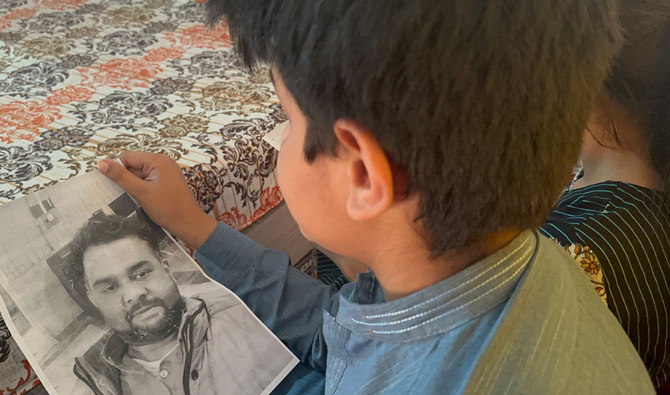
Rihan Raza, 13, holds the picture of his father Muhammad Raza, abducted by a separatist group last month from a tourist spot in Pakistan’s southwestern Balochistan province, during an interview with Arab News in Quetta on July 19, 2024. (AN Photo)
Short Url
Updated 20 July 2024
Follow

One month on, family awaits recovery of sons abducted by Baloch separatists in southwestern Pakistan

  • Baloch Liberation Army kidnapped seven ethnic Punjabi tourists from a picnic spot in Balochistan on June 19
  • BLA offered to release the abductees in exchange for its fighters, but the government refused the proposal

QUETTA: Shan Raza, 58, was devastated last month upon learning that a separatist group had abducted his three sons, Rehan, Farhan and Hassan, along with two other relatives, in Pakistan’s southwestern Balochistan province.
Since then, Raza has been trying hard to bring a smile on the faces of his grandchildren, whom he finds wearing a dismal look since their fathers were taken away from Shaban, a tourist spot some 35 kilometers away from the provincial capital of Quetta.
Pakistan’s most impoverished Balochistan province shares its border with Iran and Afghanistan and has been the scene of a low-level insurgency for the last two decades. The separatists demand independence from Pakistan and seek control over provincial resources like gold and copper.
These groups have often targeted Pakistani forces and people from the Punjab province, the heartland of Pakistani military and political elite, in the restive southwestern region over what they say are enforced disappearances and extra-judicial killings of Baloch men. Pakistan denies it.
Raza’s sons, his nephew and a relative had gone to Shaban for picnic on June 19. They were among seven people abducted from the spot by the outlawed Balochistan Liberation Army (BLA).
“My entire house is empty now, my family keeps asking me about the release of my abducted sons, but now we are in very gloomy conditions for the last thirty days,” Raza told Arab News this week.
“The tears in the eyes of my wife and daughters-in-law are dried, they want nothing from me but the safe return of my sons.”
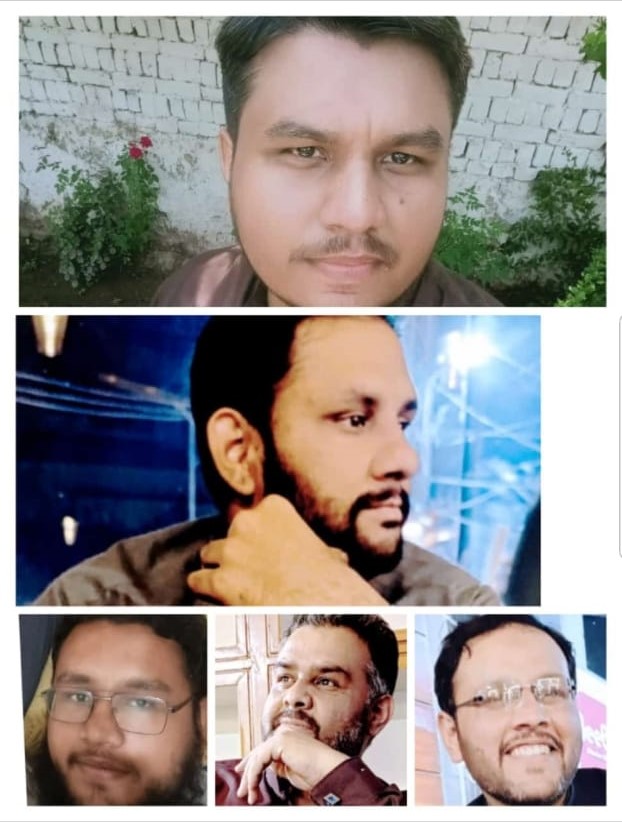


This combination of handout photos shows abducted family members, including three sons, of Shan Raza. All five members were abducted by Baloch separatist group from a picnic spot in Balochistan on June 19, 2024. (AN Photo/Supplied)

Recalling the day when his sons left home for Shaban, the 58-year-old said they had initially planned to go to Peer Ghaib, another picnic spot in Balochistan’s mountainous Bolan district, but he didn’t allow them due to security concerns.
“Then they told me that they were going to Shaban, but I didn’t know this place was not safe either,” Raza added.
Shortly after their abduction, the BLA offered the government to negotiate their release in exchange for BLA fighters incarcerated in Pakistani jails.
The group this month announced it would “implement punishments of the arrested suspects” after the government refused to negotiate their release, but there has since been no news of the hostages. The separatists accuse ethnic Punjabi settlers in Balochistan of spying for state agencies, though they have rarely offered any evidence to support their claim.
But Raza was hopeful that the government might be making efforts to secure the release of his sons and others. “I want nothing from them [Pakistani officials], but a safe recovery of my sons,” he said.
Shahid Rind, a spokesman for the Balochistan government, said the government and Pakistani security forces were making joint efforts to recover the abductees.
“The chief minister met with the despondent families and apprised them of government efforts,” Rind told Arab News. “[But] the demand to release detained terrorists for a swap of Shaban abductees is unacceptable for the government of Balochistan.”
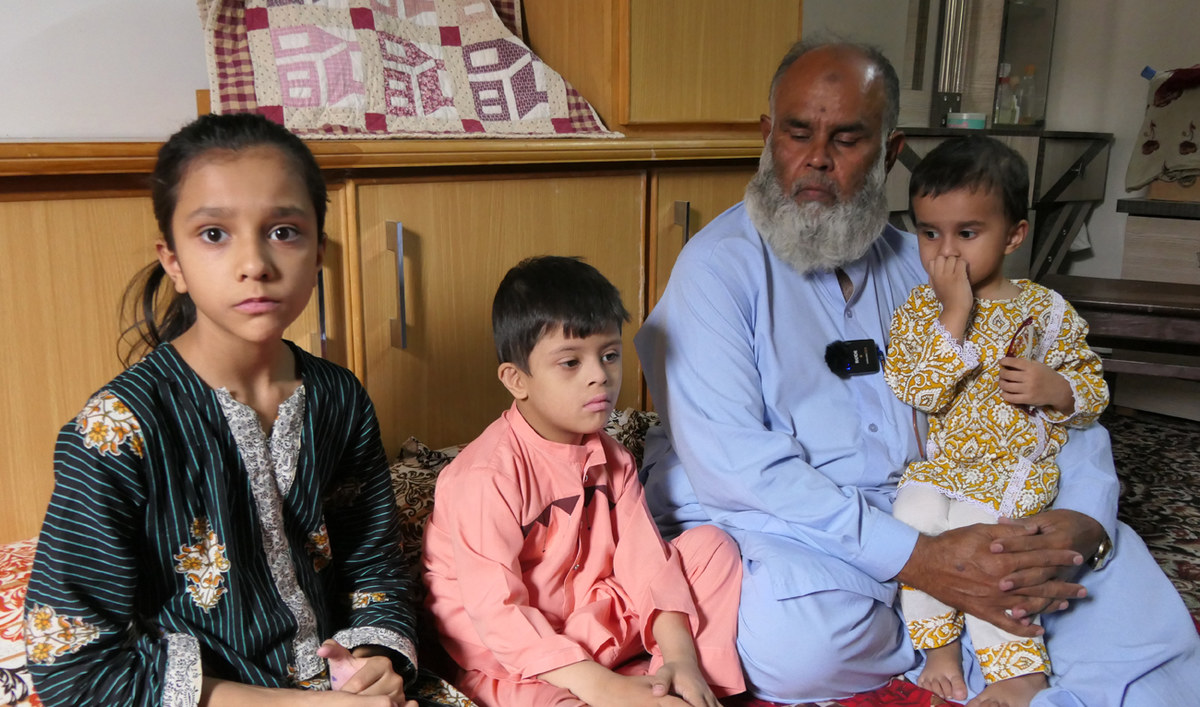


Shan Raza, 58, gestures with his grandchildren during an interview with Arab News in Quetta on July 19, 2024. Raza's five family members, including three sons, were abducted by a Baloch separatist group on June 19 from a tourist spot in Pakistan’s southwestern Balochistan province. (AN Photo)

Rihan, the son of Raza’s abducted nephew Muhammad Raza, said his family was praying day and night for the release of his father. “My mother, sister and grandmother are very much depressed since my father was kidnapped,” the 13-year-old said.
Raza said the wait for his sons and other abductees has been “excruciating.”
“We run toward the door on every single knock and get alerted on every single call on our cell phones with hopes that my sons will return home,” the dejected father said, with teary eyes.


US sees 18 percent rise in Pakistani students despite UGRAD pause, opens new USEFP headquarters

Updated 9 sec ago
Follow

US sees 18 percent rise in Pakistani students despite UGRAD pause, opens new USEFP headquarters

  • USEFP inaugurates purpose-built campus in Islamabad as Fulbright program marks 75 years in Pakistan
  • Undergraduate UGRAD program remains suspended but graduate scholarships and visas continue, US officials say

ISLAMABAD: The United States inaugurated a new purpose-built headquarters for the United States Educational Foundation in Pakistan (USEFP) this week, as American officials reported an 18 percent rise in Pakistani students studying in the US, despite the suspension of a major undergraduate exchange scheme earlier this year.

The launch comes as the Fulbright program completes 75 years in Pakistan, the world’s largest US-funded scholarship portfolio for master’s and PhD study. Officials said growing student mobility and stable visa issuance reflect continued academic engagement between the two countries, even after the UGRAD exchange program was paused in April.

USEFP Executive Director Peter Moran told Arab News that Pakistani students are still securing visas without unusual difficulty and enrollment levels remain strong.

“We are not finding that Pakistani students are facing undue difficulties getting their visas when they want to go and study on their own. The number of Pakistani students who are studying in the United States, actually based on data from the year before last, because you know there’s always a lag, it’s up 18 percent,” Moran said, citing 2023 figures.

He said nearly 10,000 Pakistanis are currently enrolled in US institutions, including self-funded students. While UGRAD, which previously sent 100–130 undergraduates per year, remains paused under US budget adjustments, Moran said there is hope it will return.

“So, the UGRAD program for now is on pause ... the UGRAD program sent undergraduate, actually high school students. That program ended in April. We don’t know when that will come back, but we sure hope that it will.”

USEFP clarified that no reductions have been applied to graduate programs.

“There is no cut on Fulbright… and we don’t anticipate there being any,” Moran added.

Around 65 Pakistani scholars left for the US through Fulbright this year, another 10–12 departed under the Humphrey Fellowship, and USEFP expects next year’s Fulbright cohort to rise to 75–80.

The inauguration of the new headquarters brought together US officials, scholarship alumni and education leaders.

US Embassy Minister Counselor for Public Diplomacy Andy Halus said the new facility reflects the depth of the bilateral academic partnership.

“We have over 9,000 students in Pakistan that have had experience in the United States on the Fulbright programs that started 70 years ago. Our commitment to sending more and more students to the United States on the Fulbright program is strong and it’s going to continue.”

Among attendees was Fulbright alumnus Aftab Haider, the CEO of Pakistan Single Window, the government-backed digital trade clearance platform. He credited the scholarship with shaping his career:

“I am a very proud Fulbrighter from 2008. I think it is one of the most transformational programs that can be offered to young Pakistanis to have the opportunity to be educated abroad, come back to Pakistan and contribute in public service delivery as well as in enhancement of the private sector.”