ISLAMABAD: The US State Department on Thursday emphasized the importance of journalist safety worldwide while commenting on the killing of a Pakistani reporter in the northwestern Khyber Pakhtunkhwa province by unidentified gunmen last week.
Malik Hassan Zaib, who was fatally shot by unknown people on a motorbike in KP’s Nowshera city, was the eighth journalist to be killed in Pakistan in the ongoing year.
His assassination was condemned by press freedom organizations that maintained it highlighted the increasing dangers faced by journalists in the South Asian state.
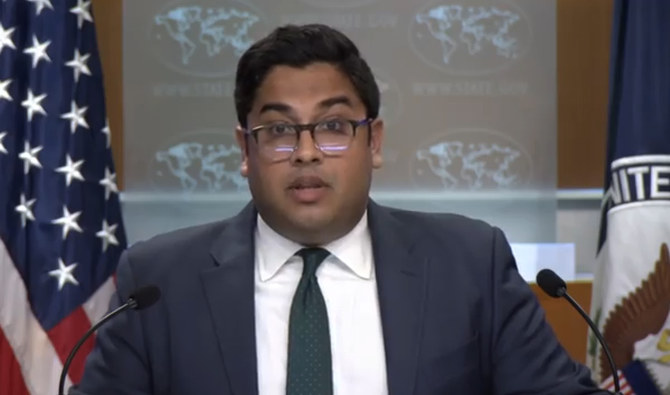
Asked about the development during the State Department media briefing, the principal deputy spokesperson, Vedant Patel, said it was vital for journalists to be able to carry out their responsibilities anywhere in the world.
“Journalists need to be protected and they need to be allowed to do their jobs, whether that be the United States, whether that be Pakistan, whether that be in the Gaza Strip,” he said. “That is something that we feel strongly, and it’s something that is deeply personal to the Secretary [Antony Blinken].”
“It’s obviously personal to us and this team having – spending most of our days engaging with you all,” he continued. “But simply put, journalists need to be protected and need to be able to do their jobs.”
The Pakistani correspondent’s death also prompted New York-based Committee to Protect Journalists to urge the Pakistani authorities to deal with the “horrifying wave of violence” against the media.
It also asked the government to bring the perpetrators of the crime to justice.
“The continued impunity for those who attack journalists is creating an atmosphere of fear and intimidation in Pakistan, which prevents the practice of free and independent journalism,” it added.


US calls for media safety following journalist’s killing in Pakistan’s northwest
https://arab.news/ypuhv
US calls for media safety following journalist’s killing in Pakistan’s northwest

- Malik Hassan Zaib was fatally shot by unknown gunmen on motorbike in KP’s Nowshera city
- State Department says journalists should be allowed to carry out their duties worldwide

How do Pakistan and Taliban Afghan militaries stack up as tensions flare?
- Pakistan fields 660,000 active troops, 465 combat aircraft and 170 nuclear warheads, dwarfing Taliban forces
- Afghan Taliban command about 172,000 personnel with limited air capability and no nuclear arsenal
Cross-border fighting between Pakistan and Afghanistan intensified overnight, with both sides claiming heavy losses and the Pakistani defense minister saying his country was in an “open war” with its neighbor.
As tensions persist, here is a look at how Pakistan dwarfs Afghanistan’s military forces and arsenals, according to data from the London-based International Institute for Strategic Studies.
OVERVIEW
Pakistan’s armed forces benefit from good recruitment and retention, bolstered by equipment from its main defense partner China. Islamabad continues to invest in its military nuclear programs and is also modernizing its navy and air force.
The capability of the Afghan Taliban’s armed forces, meanwhile, is declining, with a fall in their ability to use foreign equipment that the Islamist group seized when it returned to power in the landlocked country in 2021.
A lack of international recognition for the Taliban administration has also hurt military modernization.
PERSONNEL
Pakistan has 660,000 active personnel in its defense forces, of whom 560,000 are in the army, 70,000 are in the air force, and 30,000 are in the navy.
The strength of the Afghan Taliban’s military is thinner, with only 172,000 active personnel. The group has, however, announced plans to expand its armed forces to 200,000 personnel.
FIGHTING VEHICLES AND ARTILLERY
Pakistan has more than 6,000 armored fighting vehicles, and over 4,600 pieces of artillery.
The Afghan forces also possess armored fighting vehicles, including Soviet-era main battle tanks, armored personnel carriers and autonomous underwater vehicles, but their exact number is unknown.
The precise number of artillery they possess, which is of at least three different types, is similarly not known.
AIR FORCE
Pakistan has a fleet of 465 combat aircraft and more than 260 helicopters that include multi-role, attack and transport choppers.
Afghanistan has no fighter jets and no real air force to speak of. It is known to possess at least six aircraft — some of them dating back again to the Soviet era — and 23 helicopters, although it is not possible to assess how many are in flying condition.
NUCLEAR ARSENAL
While Pakistan is a nuclear-armed country and has 170 warheads, Afghanistan does not have a nuclear arsenal.


